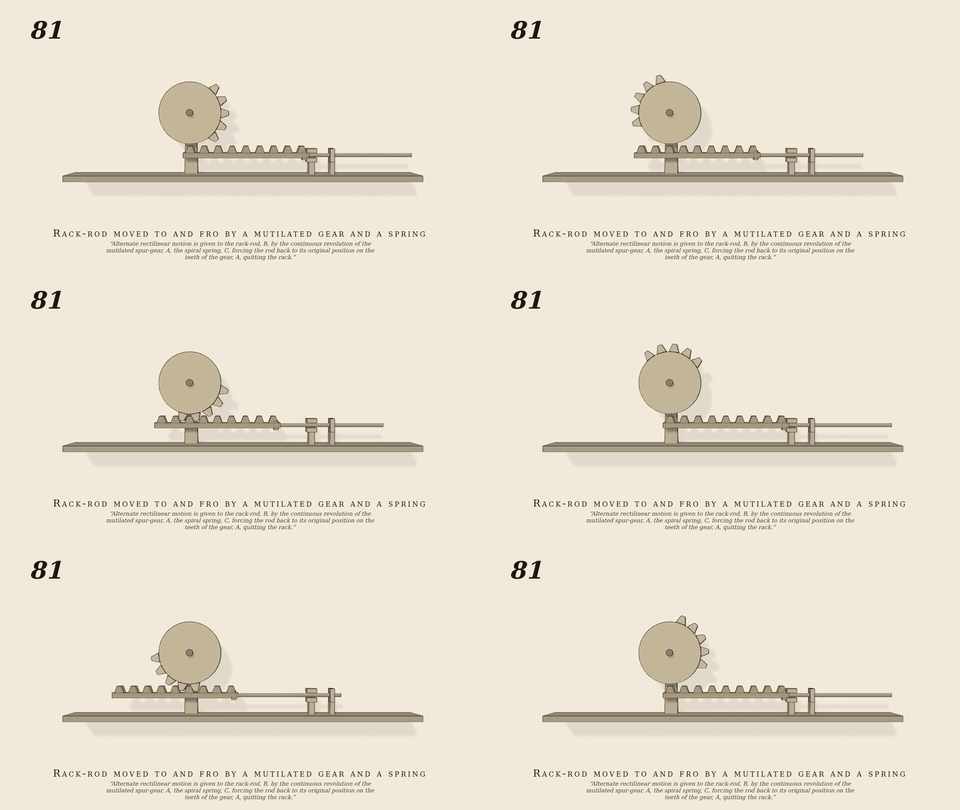
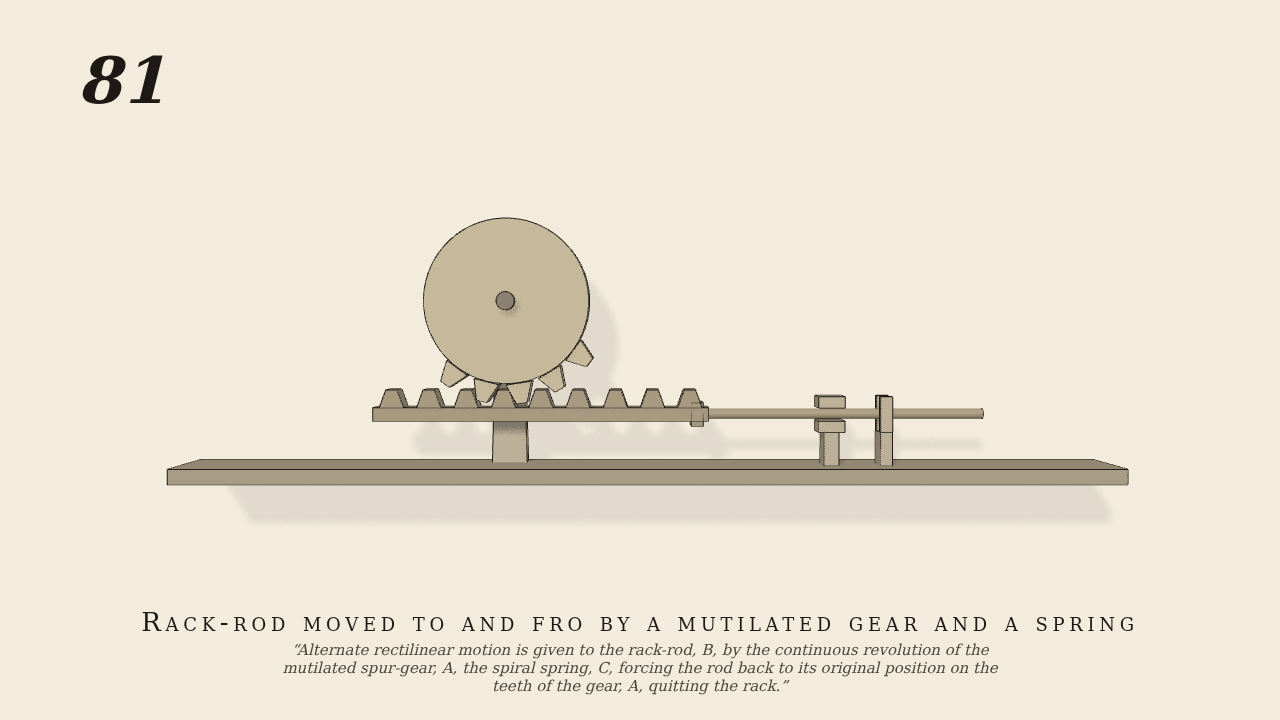
Alternate rectilinear motion is given to the rack-rod, B, by the…
Alternate rectilinear motion is given to the rack-rod, B, by the continuous revolution of the mutilated spur-gear, A, the spiral spring, C, forcing the rod back to its original position on the teeth of the gear, A, quitting the rack.
Only the input is driven; every other part of this model moves by physics (MuJoCo), and its ratios are measured. Run it live, change its parameters, or switch the friction off to see the output stop.
- Modelled as
- The mutilated spur-gear A (16 tooth spaces, module 0.8, straight-flanked teeth as No. 34) has teeth on 5 of them. The rest of its rim is cut down to the root circle. A turns continuously and is the only driven joint, at 30 rpm. While its teeth pass the rack on rod B they draw B 16.6 cm to the left. When the last tooth quits the rack, the spring C forces B back until its collar comes against the stop at the first guide, and holds it there. The spring is modelled as B's joint spring (30 N/m, 3 cm of preload at the stop, damped).
- Measured
- B follows A while the teeth are in, 2.45 to 2.85 s: slope -0.0640 m/rad vs -R = -0.064 (r2 0.9998). B is back at the stop (0.02 cm) before the teeth come round again. Stroke 16.6 cm, over 5 teeth plus run-in and run-out. Max penetration 0.20 mm.
- Notes
- The spring C is not drawn; it acts as a joint spring on B, which the rules allow. The rack teeth are a little thinner (0.42 p) and shorter (addendum 0.5 m) than the basic rack, so their tips clear the gear's straight-flanked spaces: with the full rack the first tooth jammed at 1.05 rad.
Film (MP4) · GIF · Still (PNG) · Spec (YAML) · Model (MJCF)