Reciprocating rectilinear motion of the rod, B, produces a nearly…
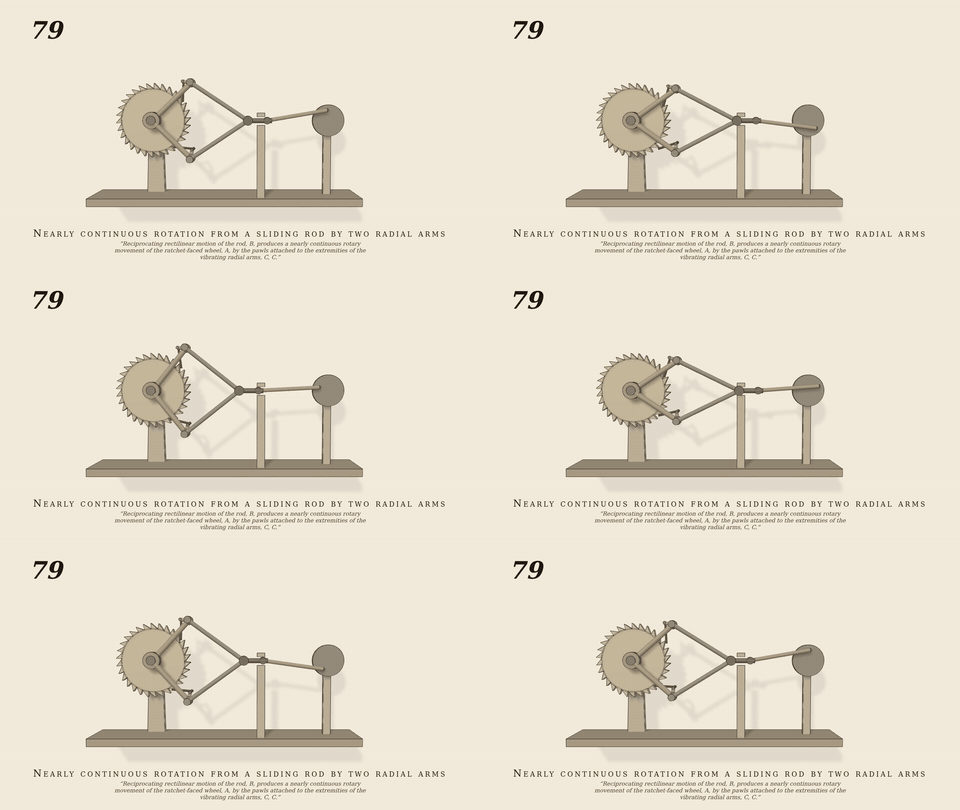
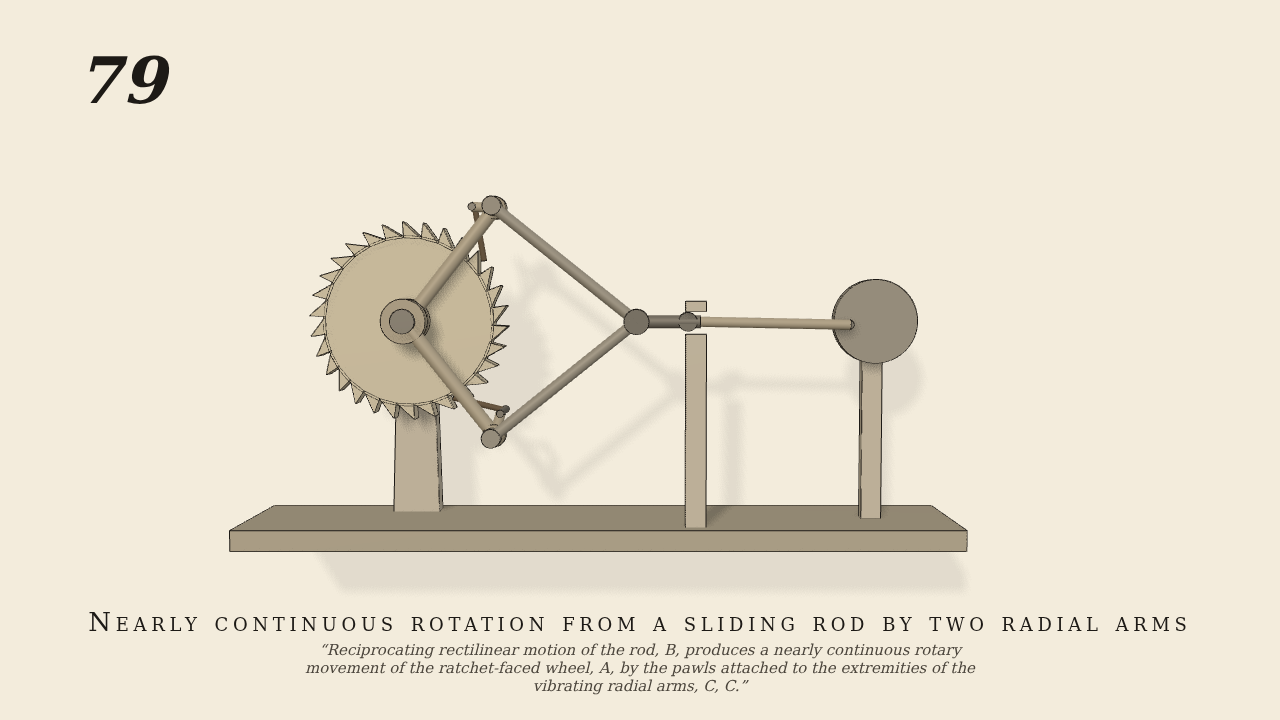
Reciprocating rectilinear motion of the rod, B, produces a nearly continuous rotary movement of the ratchet-faced wheel, A, by the pawls attached to the extremities of the vibrating radial arms, C, C.
Only the input is driven; every other part of this model moves by physics (MuJoCo), and its ratios are measured. Run it live, change its parameters, or switch the friction off to see the output stop.
- Modelled as
- Two radial arms C, C swing loose on the axis of the 30-tooth ratchet-wheel A, 42 deg above and below the horizontal. A link from each arm end is pinned to rod B. B slides 2.74 cm to and fro, worked by a crank and connecting-rod; the crank is the only driven joint, at 30 rpm. The arms swing oppositely, 1.6 pitch each. The sprung pawls at their ends push A clockwise on alternate strokes, the upper as B goes out, the lower as it comes back. A is held by bearing friction.
- Measured
- Ratio A/crank, 3 to 13 s: 0.06657 vs 2/30 (-0.15%). One tooth each stroke, two per crank turn. Max penetration 0.2 mm.
- Notes
- Rod B is worked by a crank and connecting-rod, which the plate does not show. The two pawl tips sit a whole number of teeth apart (arms at +/-42 deg, 7 pitches), so each pawl drops in 0.6 pitch behind a face and pushes exactly one tooth. At +/-40 deg (6.67 pitches) the upper pawl fell short of the drop-in and A made only 1 tooth a turn. Saw teeth on the rim stand in for the plate ratchet face.
Film (MP4) · GIF · Still (PNG) · Spec (YAML) · Model (MJCF)