Another contrivance for registering or counting revolutions
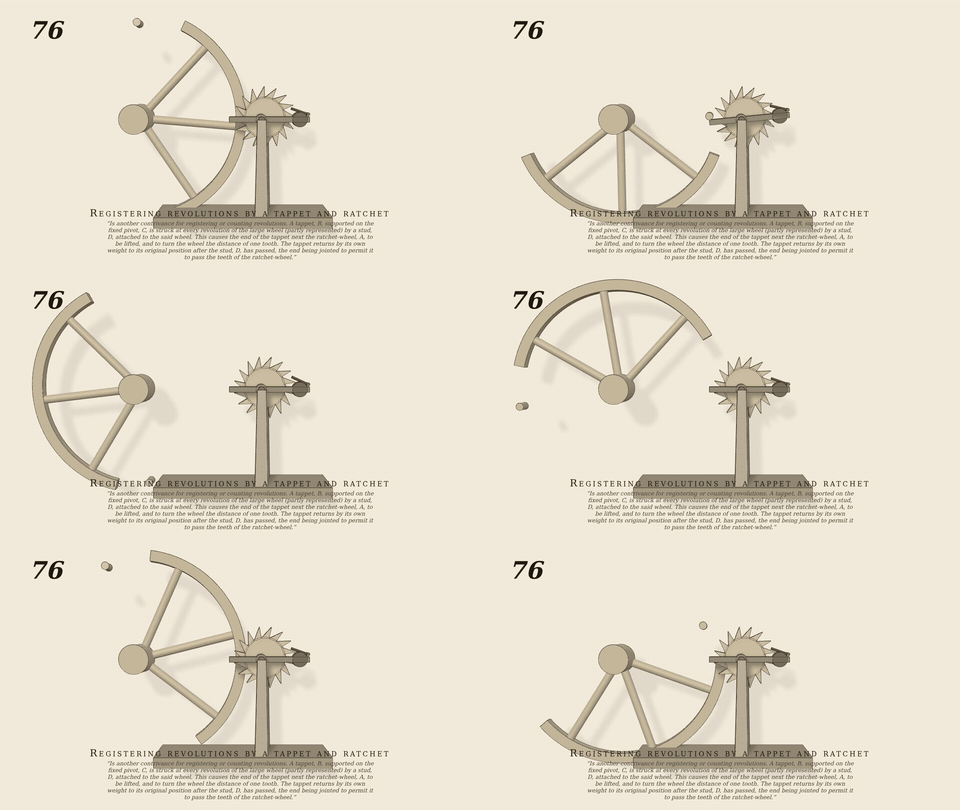
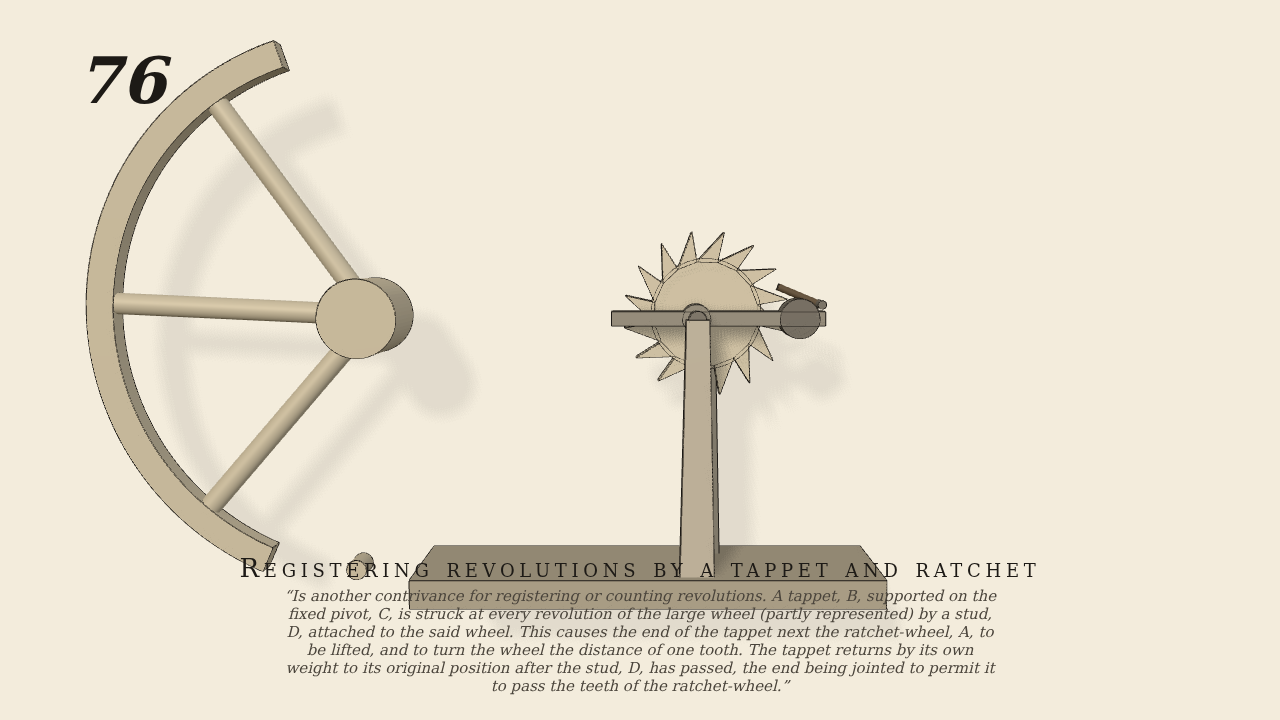
Is another contrivance for registering or counting revolutions. A tappet, B, supported on the fixed pivot, C, is struck at every revolution of the large wheel (partly represented) by a stud, D, attached to the said wheel. This causes the end of the tappet next the ratchet-wheel, A, to be lifted, and to turn the wheel the distance of one tooth. The tappet returns by its own weight to its original position after the stud, D, has passed, the end being jointed to permit it to pass the teeth of the ratchet-wheel.
Only the input is driven; every other part of this model moves by physics (MuJoCo), and its ratios are measured. Run it live, change its parameters, or switch the friction off to see the output stop.
- Modelled as
- The large wheel (the only driven joint, 12 rpm) carries stud D, which strikes the left arm of tappet B on its fixed pivot C once a revolution and lifts it. The heavy right end carries a jointed finger that pushes a face of the 16-tooth ratchet-wheel A, which is held by bearing friction. The tappet falls back by its own weight, and the finger folds out against its weight to pass the teeth, then drops in behind the next face. The finger stroke is about 1.3 pitches, so A self-indexes to exactly one tooth a revolution.
- Measured
- Ratio of A to the wheel, 4 to 19 s (3 revolutions): 0.06252 vs 1/16, +0.03%. A advances 1.1782 rad = 3 x 2pi/16. Max penetration under 1 mm.
- Notes
- The finger joint sits outside the tooth circle, and A is centred on the tappet side so that the finger arc and the tip circle touch internally. The arm end XL works from 8.9 to 9.1 (9.0 used). At 9.2 the finger stroke lands on a tooth tip and jams.
Film (MP4) · GIF · Still (PNG) · Spec (YAML) · Model (MJCF)