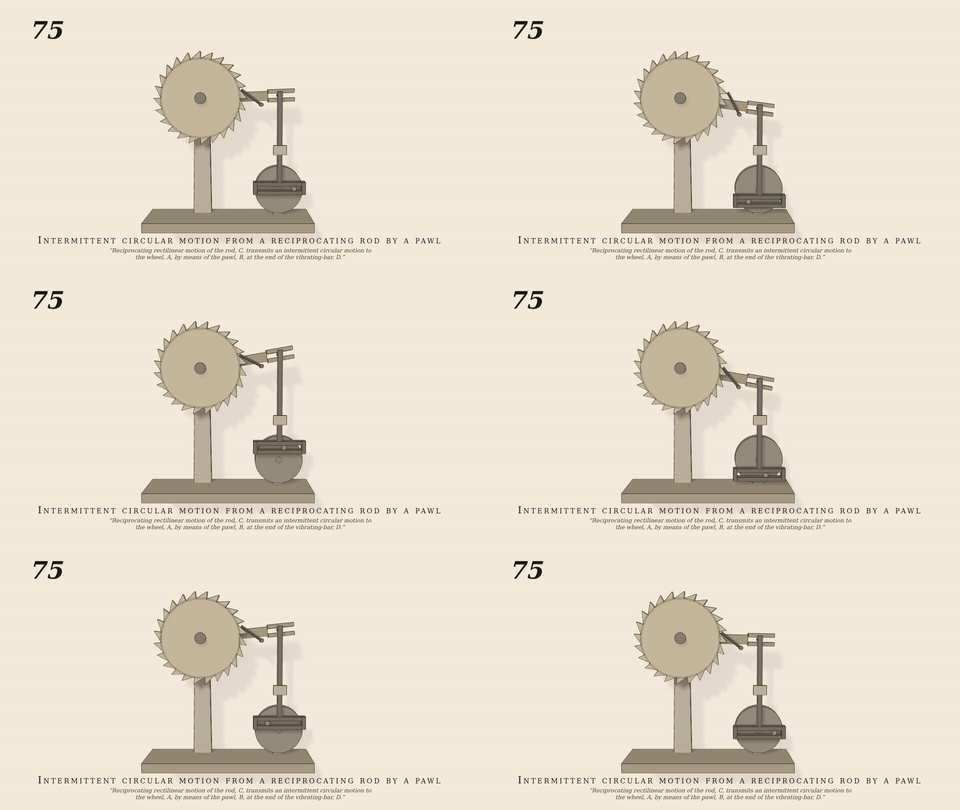
Reciprocating rectilinear motion of the rod, C, transmits an…
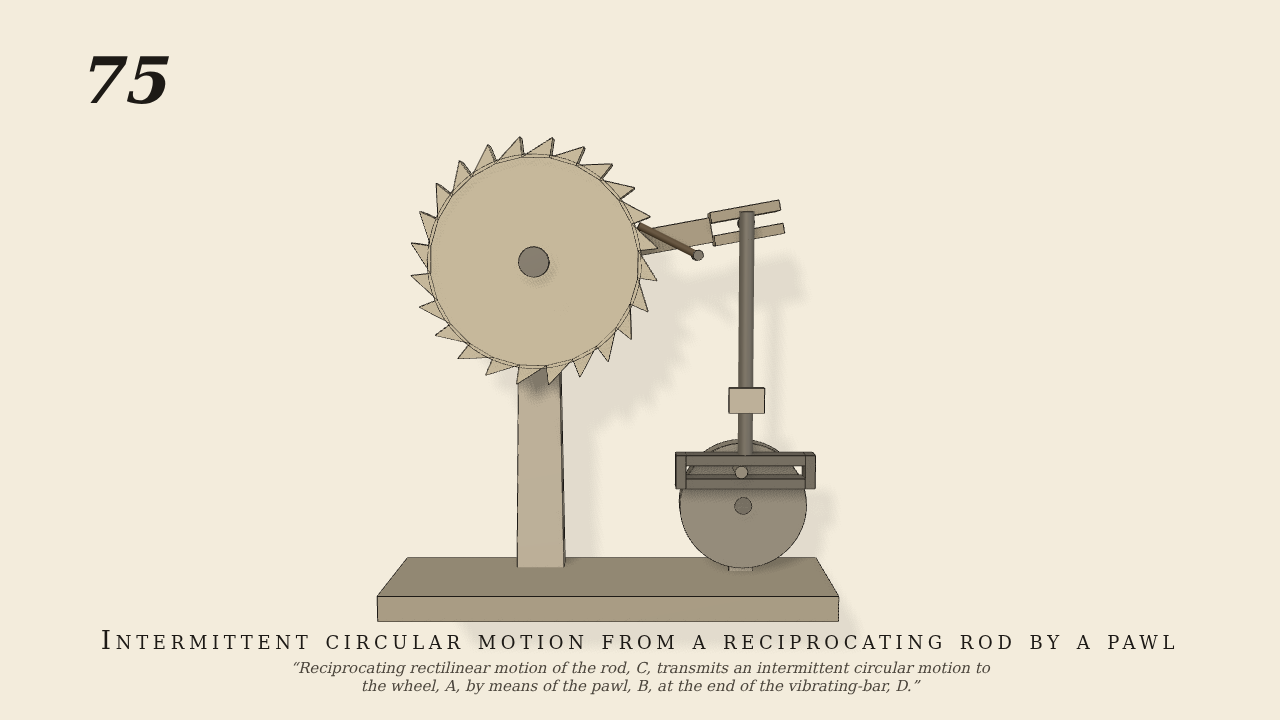
Reciprocating rectilinear motion of the rod, C, transmits an intermittent circular motion to the wheel, A, by means of the pawl, B, at the end of the vibrating-bar, D.
Only the input is driven; every other part of this model moves by physics (MuJoCo), and its ratios are measured. Run it live, change its parameters, or switch the friction off to see the output stop.
- Modelled as
- A (24-tooth ratchet) and the vibrating bar D turn on one fixed centre. The rod C slides up and down 1.6 cm either way, worked by a crank and slotted yoke below (the crank is the only driven joint, 30 rpm); a pin on C works in a slot at the end of D, so D swings about 22 deg (1.45 pitch). The pawl B on D (joint spring holding it on the teeth) pushes a tooth face on the up-stroke and rides back over one tooth on the down-stroke; A bearing friction (frictionloss 0.01) holds A while the pawl slides back. All motion by contact: crank pin in yoke, rod pin in slot, pawl on teeth.
- Measured
- A advances 0.13090 rad per beat of C (expect pi/24 = 0.13090: one tooth per double stroke, over 8 beats, exact to 5 places); the pawl rides back over a tooth every down-stroke (5 clicks in 10 s); max penetration 0.18 mm.
- Notes
- A rod driven directly by a swinging velocity servo drifted under the asymmetric load (D top stroke shifted 0.0008 rad a stroke), so the rod is worked by a crank and yoke instead. Since D swing lies between one and two pitches, every up-stroke ends with a face at the pawl: the step is exactly one tooth. Tested under the Nix flake env.
Film (MP4) · GIF · Still (PNG) · Spec (YAML) · Model (MJCF)