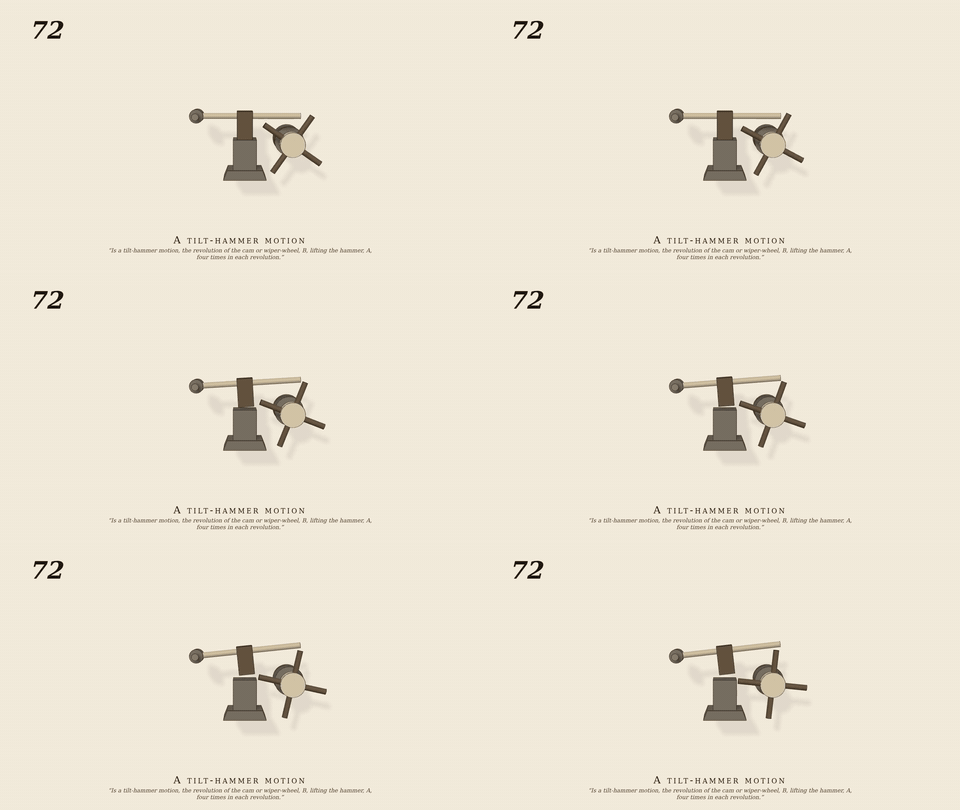
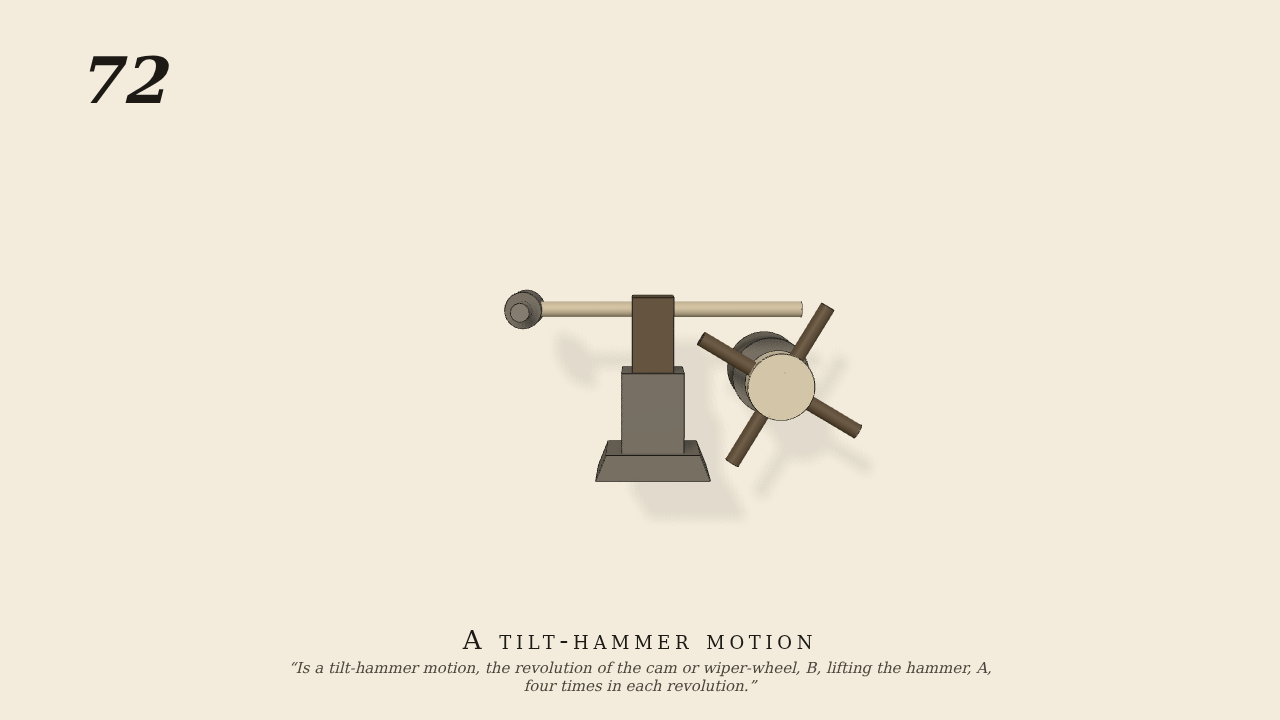
A tilt-hammer motion, the revolution of the cam or wiper-wheel, B,…
Is a tilt-hammer motion, the revolution of the cam or wiper-wheel, B, lifting the hammer, A, four times in each revolution.
Only the input is driven; every other part of this model moves by physics (MuJoCo), and its ratios are measured. Run it live, change its parameters, or switch the friction off to see the output stop.
- Modelled as
- Wiper wheel B (the only driven shaft, clockwise) carries four wipers. The helve of hammer A turns on a fixed centre at the left and rests by its head on a fixed anvil with its nose over B. Each wiper rises under the nose, lifts it and slips off its end; the hammer falls on the anvil under gravity. A is lifted only by wiper contact and brought down only by its weight.
- Measured
- B advances 0.78540 rad per beat of A (expect pi/4 = 0.78540: a quarter turn per blow, counted rise and fall, over 7 whole blows); A reaches 0.123 rad vs the quasi-static wiper reach 0.1226 rad; 8 blows in 9.2 s, back on the anvil each time; max penetration 0.03 mm.
- Notes
- With four wipers the arc in which a wiper touches the resting helve must be under 90 deg or the next wiper catches the helve before it reaches the anvil; raising the helve (axis 3.0 over a 3.6 tip circle) gives about 61 deg. The advance window runs from just before one rise to just after the eighth so the uneven rise and fall halves do not bias the count.
Film (MP4) · GIF · Still (PNG) · Spec (YAML) · Model (MJCF)