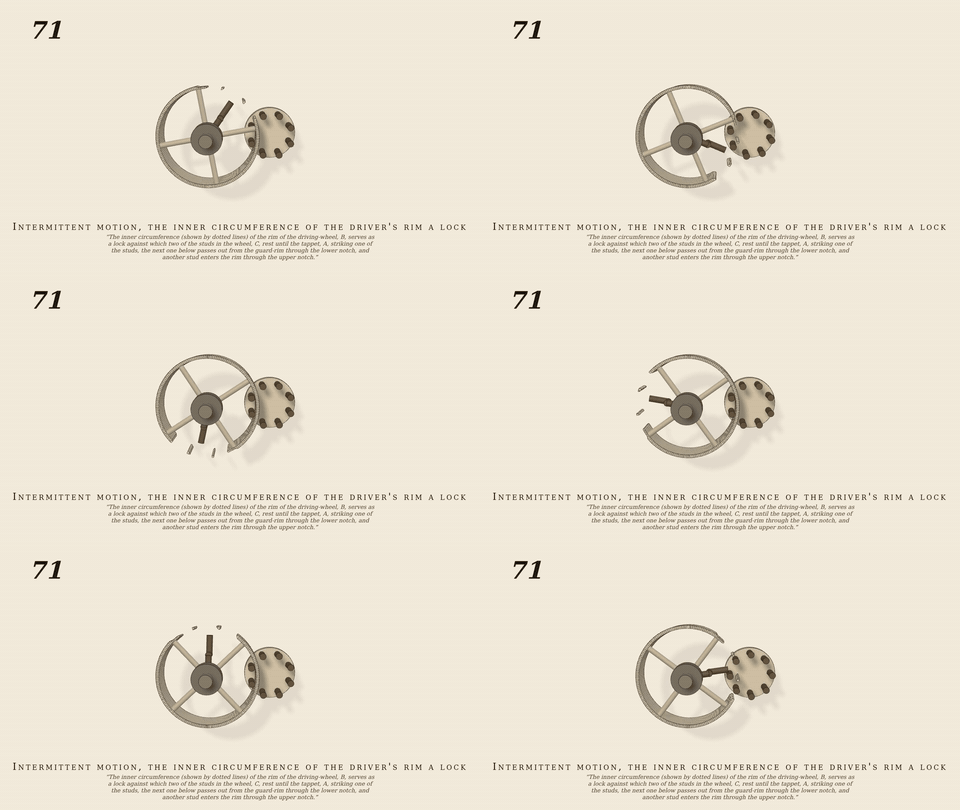
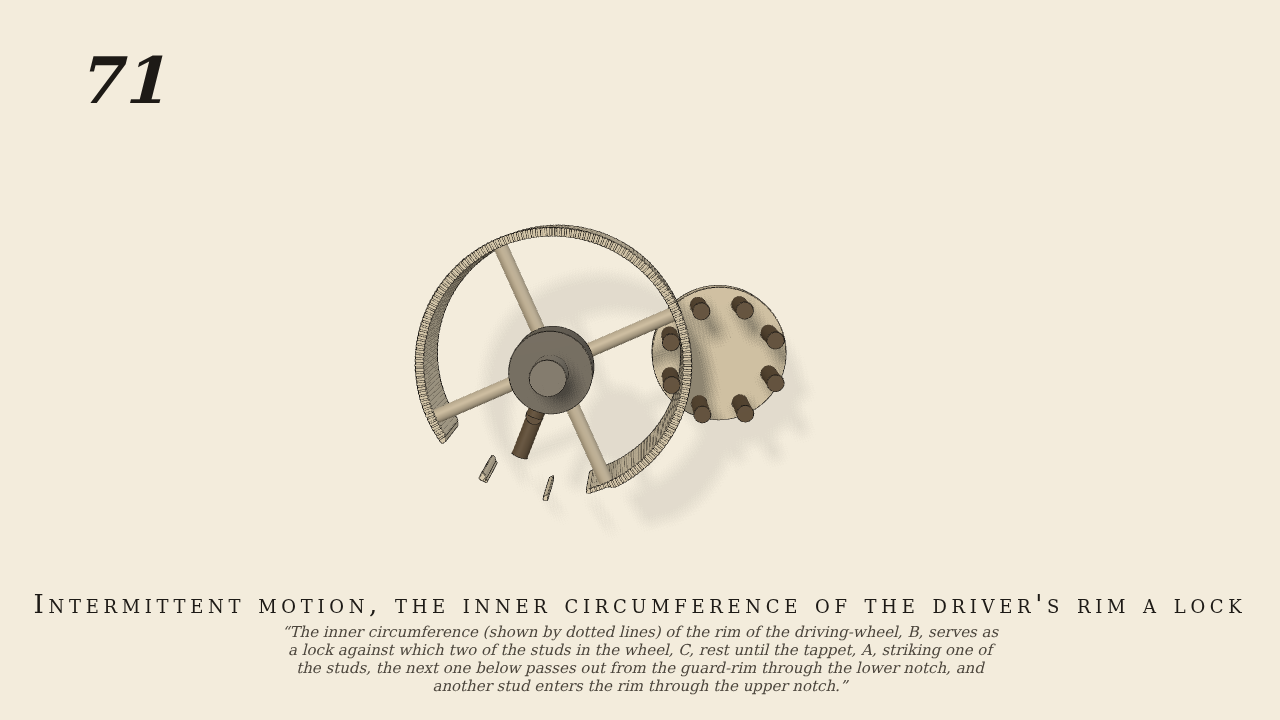
The inner circumference (shown by dotted lines) of the rim of the…
The inner circumference (shown by dotted lines) of the rim of the driving-wheel, B, serves as a lock against which two of the studs in the wheel, C, rest until the tappet, A, striking one of the studs, the next one below passes out from the guard-rim through the lower notch, and another stud enters the rim through the upper notch.
Only the input is driven; every other part of this model moves by physics (MuJoCo), and its ratios are measured. Run it live, change its parameters, or switch the friction off to see the output stop.
- Modelled as
- Driving wheel B (front, clockwise) carries a rim 0.3 thick and the tappet A; between strokes two of the 8 studs of C stand inside the rim and bear on its inner circumference (0.02 clear), so C cannot turn either way. A strikes the upper stud; the stud below passes out through the lower notch and the next enters through the upper. The notches are carved by sweeping the studs along the push; the tappet carries C 0.17 rad past the pitch and a 20 deg cam ramp at the trailing end of each notch pushes it back. Only j_b is driven; C moves only by stud contact with tappet and rim.
- Measured
- Ratio j_c/j_b 0.1250 vs 1/8 (+0.03%, three whole turns of B, mid-dwell to mid-dwell); C still in dwell (mean
- Notes
- 0.0000 < 0.005); max penetration 0.03 mm. Every dwell lands on a whole pitch (steps 0.7854).
Film (MP4) · GIF · Still (PNG) · Spec (YAML) · Model (MJCF)