For transmitting two speeds by gearing
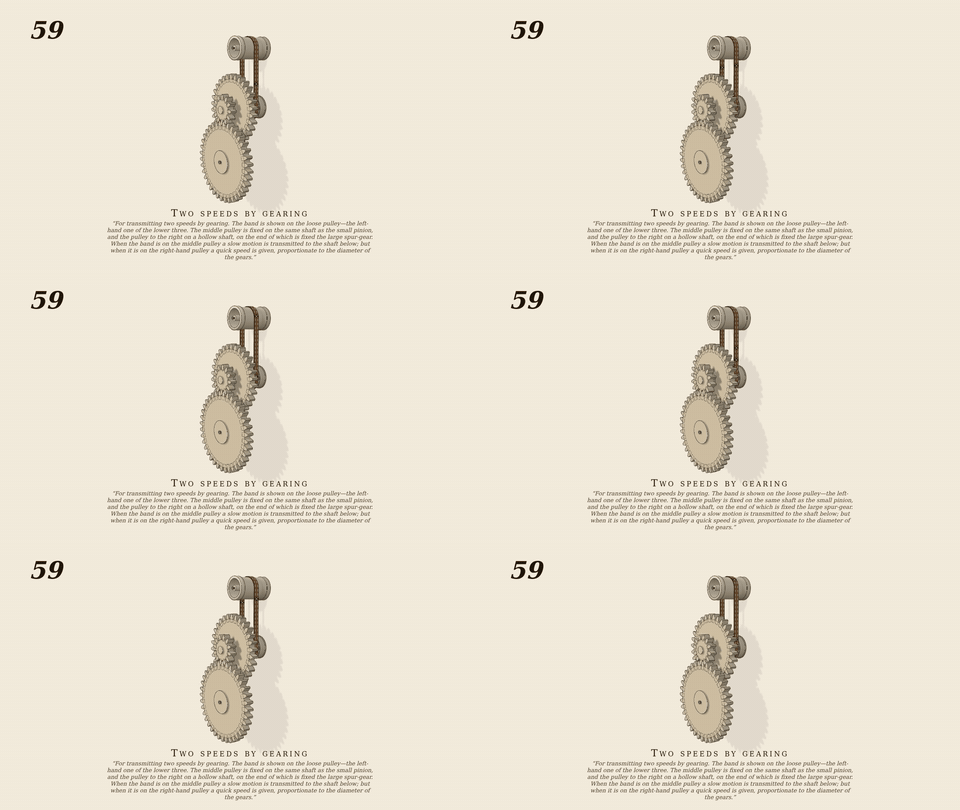
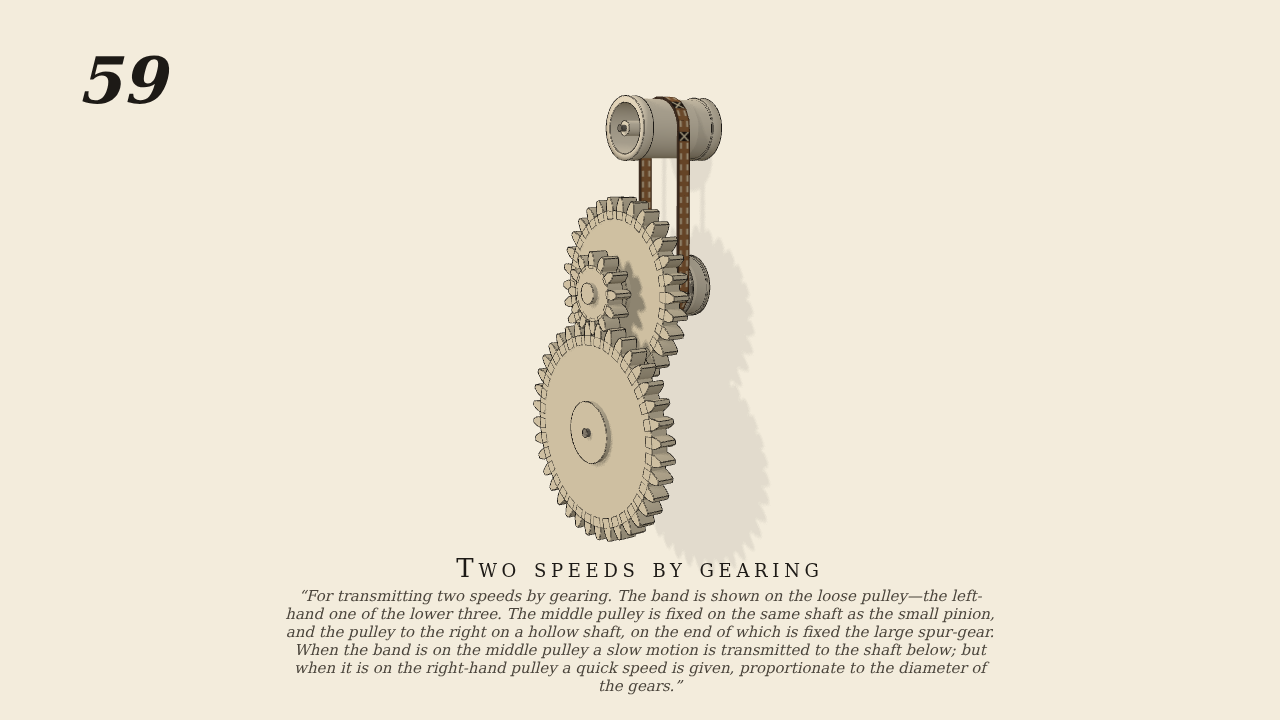
For transmitting two speeds by gearing. The band is shown on the loose pulley—the left-hand one of the lower three. The middle pulley is fixed on the same shaft as the small pinion, and the pulley to the right on a hollow shaft, on the end of which is fixed the large spur-gear. When the band is on the middle pulley a slow motion is transmitted to the shaft below; but when it is on the right-hand pulley a quick speed is given, proportionate to the diameter of the gears.
Only the input is driven; every other part of this model moves by physics (MuJoCo), and its ratios are measured. Run it live, change its parameters, or switch the friction off to see the output stop.
- Modelled as
- Brown's figure 59: a wide drum (the driven shaft) above three equal pulleys: loose; fast on the main shaft (small pinion, 12); on a hollow shaft (large gear, 30); always in mesh with 36 and 18 on the shaft below. The band's position is a passive variant
- Measured
- pass (band on the middle pulley): below/main −0.3333 (−12/36), below/drum −0.3311, the idle hollow shaft driven back exactly (−0.5991); max penetration 0.08 mm; also passes at 45 rpm. Variants (test_059): −0.3313 / −1.6000 (−1/3, −5/3), loose pulley 0.0000
- Notes
- As No. 58 (batch7/gen059.py). At the quick speed the idle main shaft runs at 5x the drum, so its bearings are light (0.001) and the load 0.02; with 0.005 / 0.05 the band crept 6%. Negative control: the shaft below lowered 3 out of mesh → it stands (0.000).
Film (MP4) · GIF · Still (PNG) · Spec (YAML) · Model (MJCF)