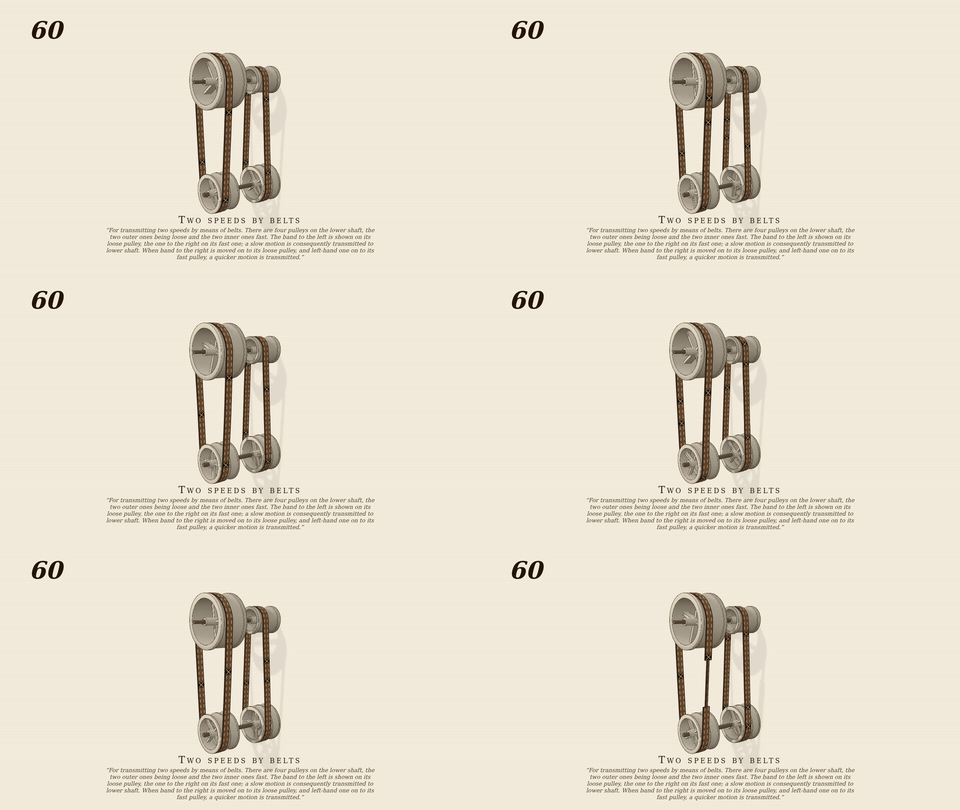
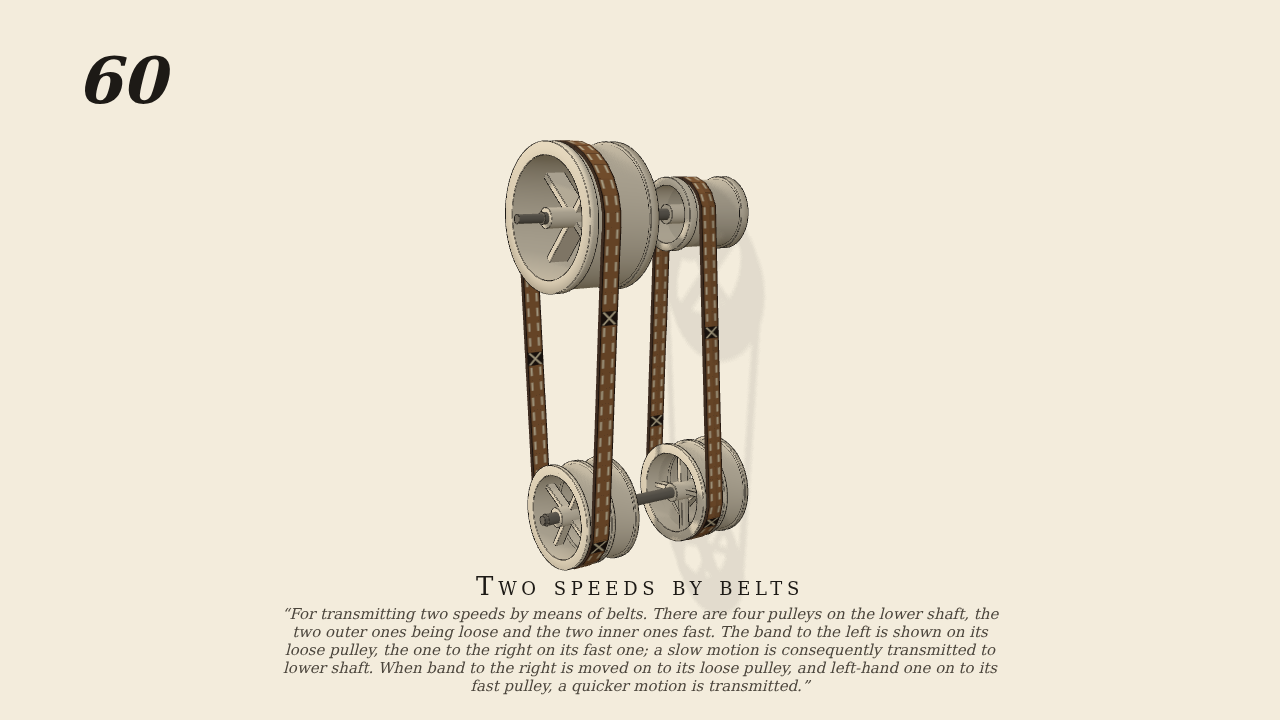
For transmitting two speeds by means of belts
For transmitting two speeds by means of belts. There are four pulleys on the lower shaft, the two outer ones being loose and the two inner ones fast. The band to the left is shown on its loose pulley, the one to the right on its fast one; a slow motion is consequently transmitted to lower shaft. When band to the right is moved on to its loose pulley, and left-hand one on to its fast pulley, a quicker motion is transmitted.
Only the input is driven; every other part of this model moves by physics (MuJoCo), and its ratios are measured. Run it live, change its parameters, or switch the friction off to see the output stop.
- Modelled as
- Brown's figure 60: a large drum (r 7) and a small one (r 3.5) on the upper shaft (the driven shaft), each with its own band; four equal pulleys (r 5) below, the outer two loose, the inner two fast. The bands' positions are passive variants
- Measured
- pass (as drawn: left band on its loose pulley, right on its fast one): lower 0.6947 (3.5/5 = 0.7), left loose pulley 1.3767 (1.4); also passes at 45 rpm. Variant (test_060): bands shifted → lower 1.3739 (1.4), right loose pulley 0.6882 (0.7)
- Notes
- Two flat steel bands of links (No. 7's), friction only. The drums' stations are set far apart: pulley rims collide as capsules, and the large drum's end caps would otherwise reach the small drum's band. batch7/gen060.py. Negative control: the right fast pulley unkeyed (its own bearing) → the lower shaft stands (0.000). A low band friction is no control: the rim's friction (0.3) governs the contact.
Film (MP4) · GIF · Still (PNG) · Spec (YAML) · Model (MJCF)