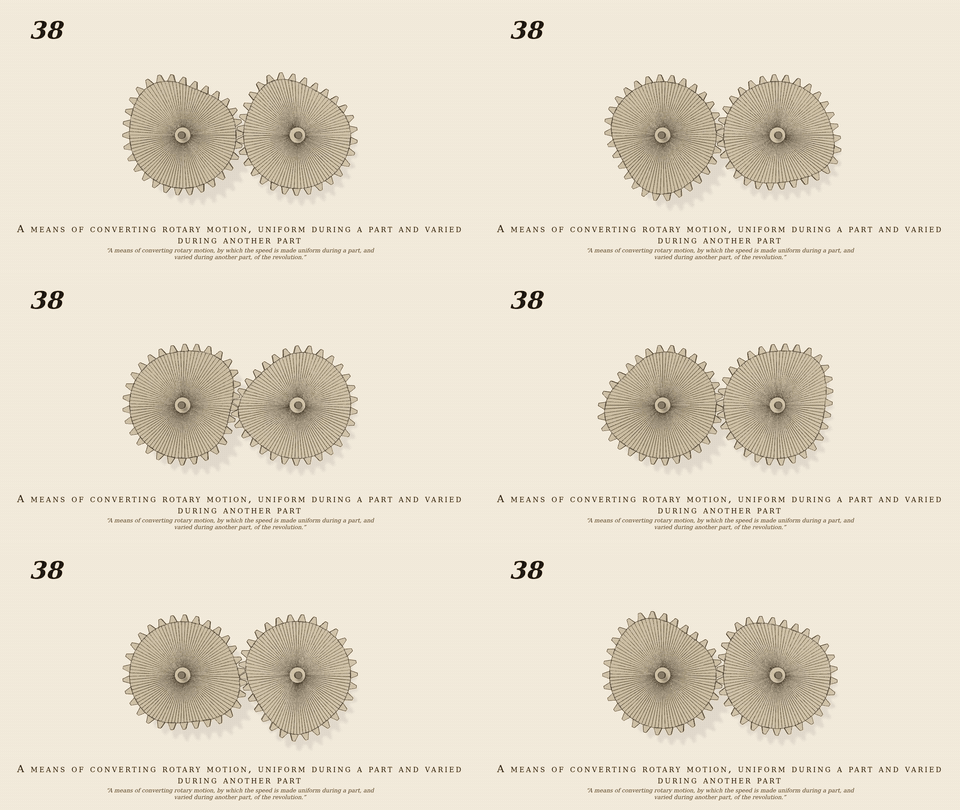
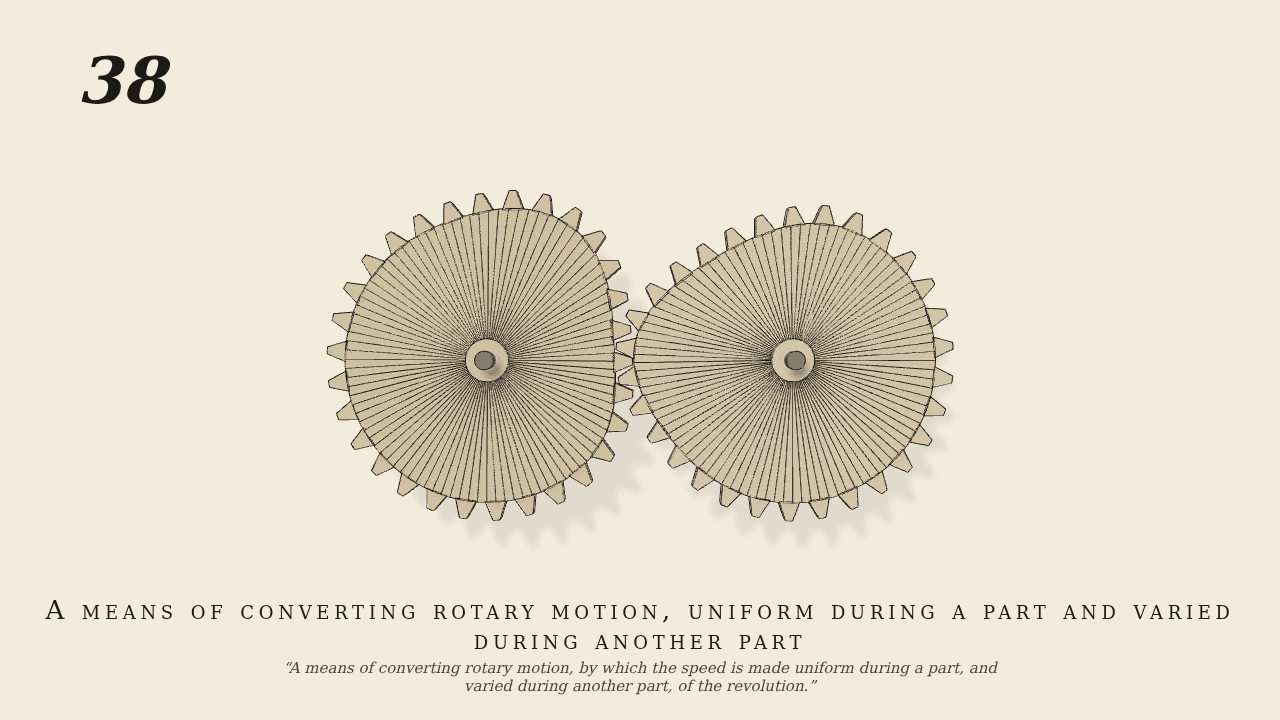
A means of converting rotary motion, by which the speed is made…
A means of converting rotary motion, by which the speed is made uniform during a part, and varied during another part, of the revolution.
Only the input is driven; every other part of this model moves by physics (MuJoCo), and its ratios are measured. Run it live, change its parameters, or switch the friction off to see the output stop.
- Modelled as
- two 30-tooth gears whose pitch curves are true circles (r 10) over half a turn and a smooth bulge (r 10 + 1.6·sin2u·sin²u) over the other half, the follower's curve solved so the pair closes (centres 20.04 apart); straight 20° teeth at equal arc pitch
- Measured
- −0.9997 over two turns (ideal −1); −1.004 in the uniform half (ideal −0.996); slice means swing −1.238..−0.812 in the varied half (ideal −1.227..−0.809)
- Notes
- Only the driver is motor-driven (20 rpm). Thicker teeth (0.44 pitch, addendum 0.30) jammed on entry to the varied half, two pairs pinching one tooth; 0.40 pitch / addendum 0.26 runs clean in 6 perturbed runs. Negative control: the follower's teeth out of contact → it only sways on its unbalanced bulge (−0.047, no turning).
Film (MP4) · GIF · Still (PNG) · Spec (YAML) · Model (MJCF)