Sun-and-planet motion
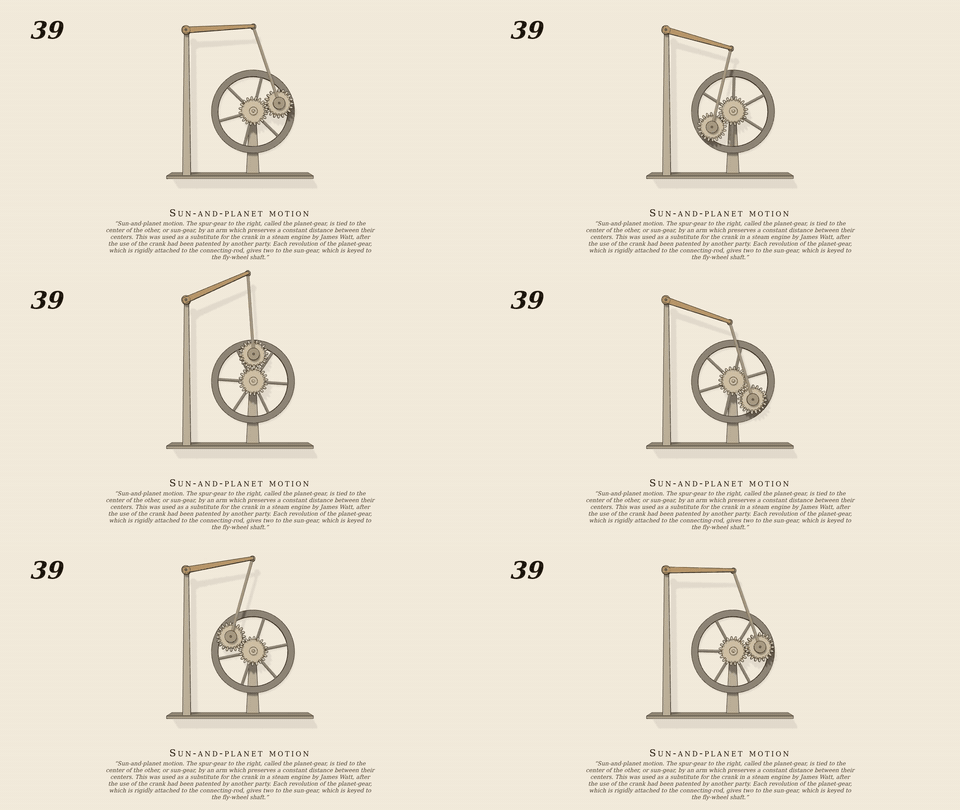
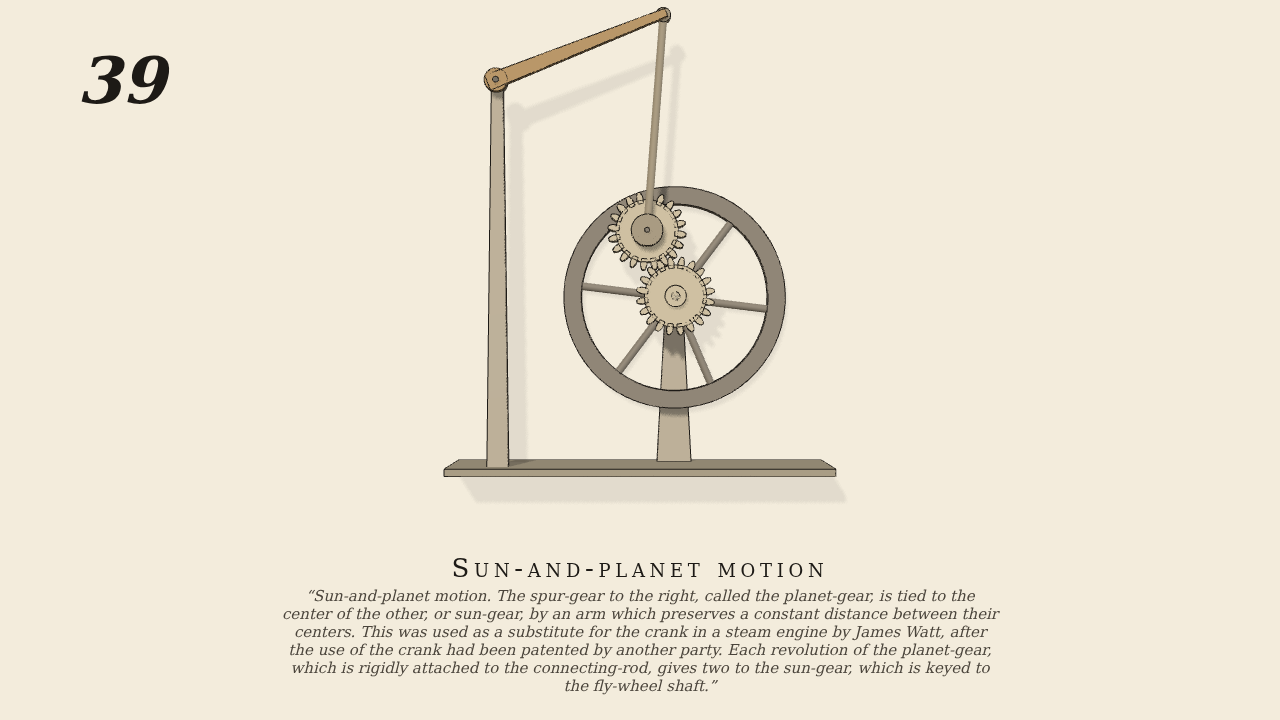
Sun-and-planet motion. The spur-gear to the right, called the planet-gear, is tied to the center of the other, or sun-gear, by an arm which preserves a constant distance between their centers. This was used as a substitute for the crank in a steam engine by James Watt, after the use of the crank had been patented by another party. Each revolution of the planet-gear, which is rigidly attached to the connecting-rod, gives two to the sun-gear, which is keyed to the fly-wheel shaft.
Only the input is driven; every other part of this model moves by physics (MuJoCo), and its ratios are measured. Run it live, change its parameters, or switch the friction off to see the output stop.
- Modelled as
- Watt's engine: a beam (25) rocked by the one actuator, a connecting rod (30) pinned to its end with the 20-tooth planet-gear fixed to the rod's foot; a free arm (10) from the fly-wheel shaft pinned to the planet's centre; the 20-tooth sun-gear keyed to the fly-wheel shaft
- Measured
- sun/arm = 2.0000 over four strokes (ideal 1 + 20/20 = 2); the fly-wheel never runs back (largest run-back 0.000 rad)
- Notes
- The beam's driver is a velocity servo of its swing (0.5 Hz), at amplitude 0.45 rad, a little over the 0.413 the linkage allows (solved by batch7/gen039.py): at exactly 0.413 any lag at the start is never made up and the crank turns back short of a dead point; a little over, the beam is stopped by the linkage at each end and the fly-wheel carries it through. Robust over 7 perturbed runs. Spurs may now be keyed to a part (OpenSpec add-spur-on-part). Negative control: the planet's teeth out of contact → the sun-gear stands (0.0000 rad in 10 s) while the beam rocks.
Film (MP4) · GIF · Still (PNG) · Spec (YAML) · Model (MJCF)