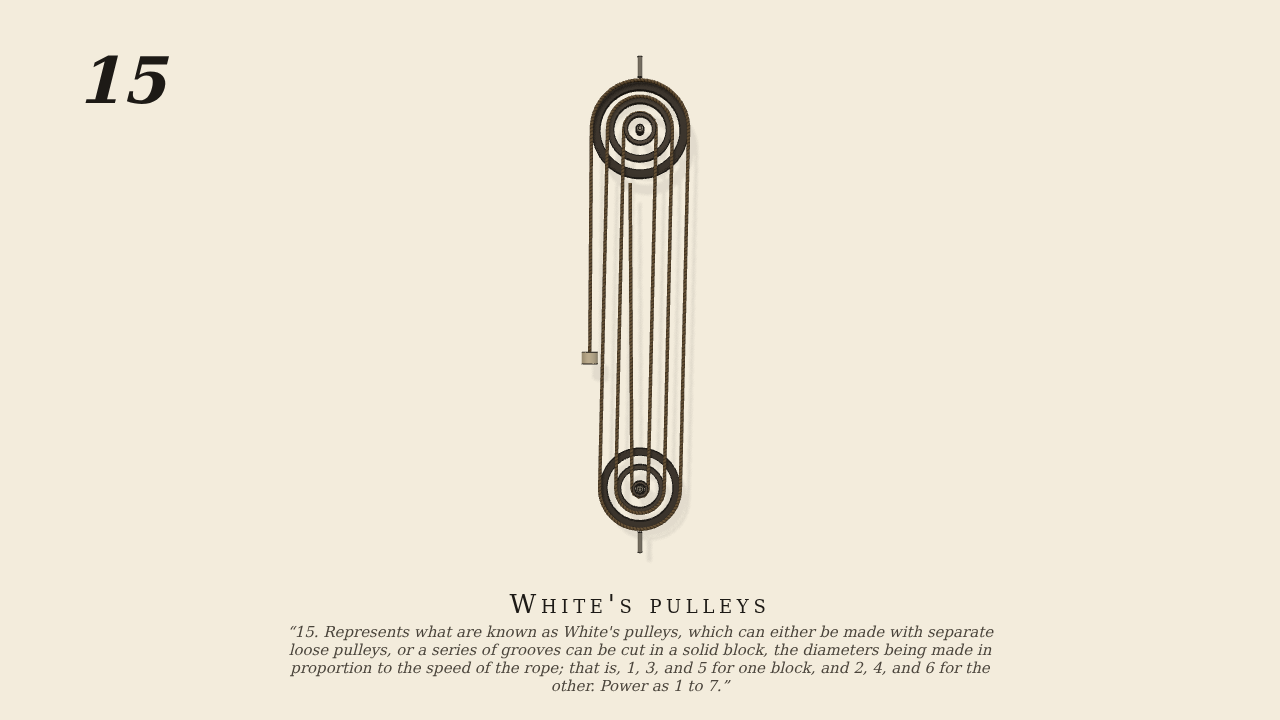
White’s pulleys, which can either be made with separate loose…
Represents what are known as White’s pulleys, which can either be made with separate loose pulleys, or a series of grooves can be cut in a solid block, the diameters being made in proportion to the speed of the rope; that is, 1, 3, and 5 for one block, and 2, 4, and 6 for the other. Power as 1 to 7.
Only the input is driven; every other part of this model moves by physics (MuJoCo), and its ratios are measured. Run it live, change its parameters, or switch the friction off to see the output stop.
- Modelled as
- rope (capstan friction model: one hemp rope from an eye under the upper block, round six loose sheaves whose pitch radii go 1, 3, 5 (lower block) and 2, 4, 6 (upper) × 1.4 cm, every groove wrapped the same way, to the hand)
- Measured
- block/hand 0.1667 (six falls: 1/6), all six sheaves −11.90 rad/m (1/(6A) = 11.905: grooves in proportion to the rope's speed, so all turn alike and none slips on its pin), pull 16.45 N against W/6 less the hand's weight 16.43 N; rope cut control 0.0%
- Notes
- Only the hand is driven (4 cm/s); 12 kg on the lower block. Brown allows separate loose pulleys, which are used here (each a step further back on the pin), drawn as concentric grooves as in the engraving. Departure: the engraving's six falls give 1 to 6, not Brown's "1 to 7" (the free end leaves the upper block, so it carries no load).
Film (MP4) · Still (PNG) · Spec (YAML) · Model (MJCF)