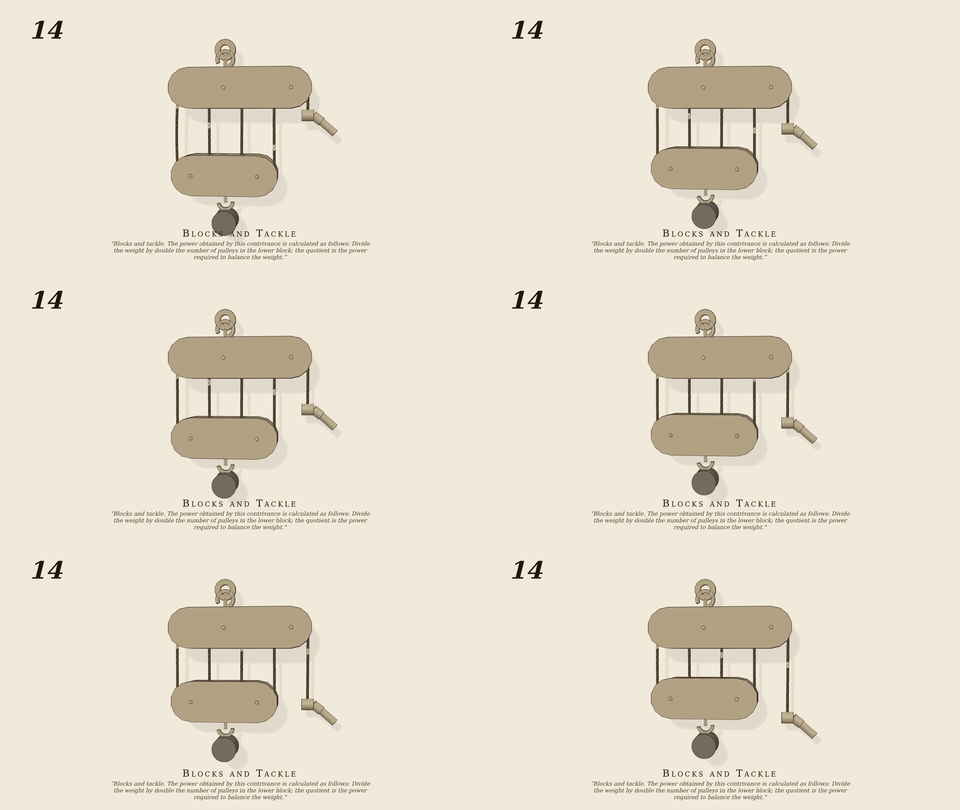
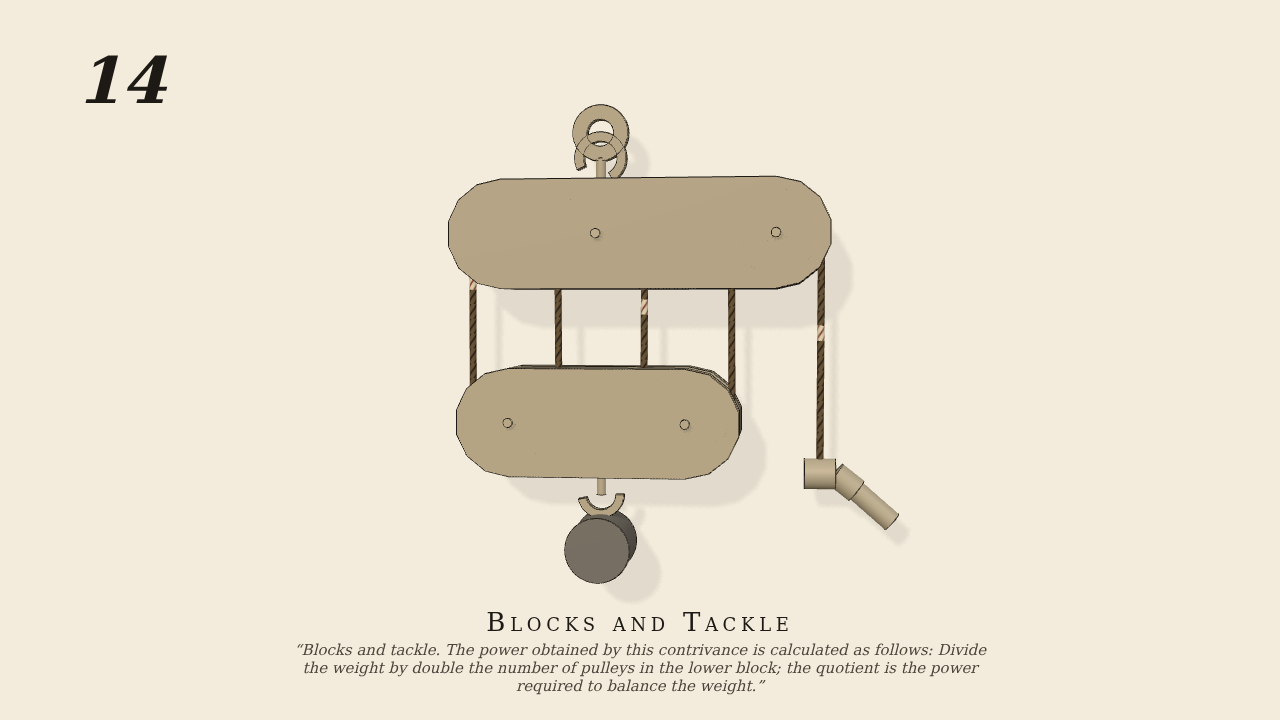
Blocks and tackle
Blocks and tackle. The power obtained by this contrivance is calculated as follows: Divide the weight by double the number of pulleys in the lower block; the quotient is the power required to balance the weight.
Only the input is driven; every other part of this model moves by physics (MuJoCo), and its ratios are measured. Run it live, change its parameters, or switch the friction off to see the output stop.
- Modelled as
- rope (friction on four sheaves; 100-link hemp chain from an eye in the upper block, under l1, over u1, under l2, over u2, to the hand)
- Measured
- block/hand 0.263 (Brown 1/(2×2) = 0.25), pull 51.3 N against W/4 less the hand's weight 50.8 N, sheaves u1 10.29, l1 −5.18 rad/m and l2/u2 −0.751 (fall speeds 0, 2u, 2u, 4u: 10.20, −5.10, −0.75), pen ≤ 0.05 mm
- Notes
- Only the hand is driven (a slide in a guide down the rope, 8 cm/s). Each sheave turns at the rate its two falls set: the standing fall is at rest, so l1 rolls up it. Link spring 150 kN/m (stiffer is unstable at dt 1e-4 with 1.6 cm links). Negative control: the rope's contact with the sheaves off → the block does not rise (0.000; it falls 8 cm to its stop).
Film (MP4) · GIF · Still (PNG) · Spec (YAML) · Model (MJCF)