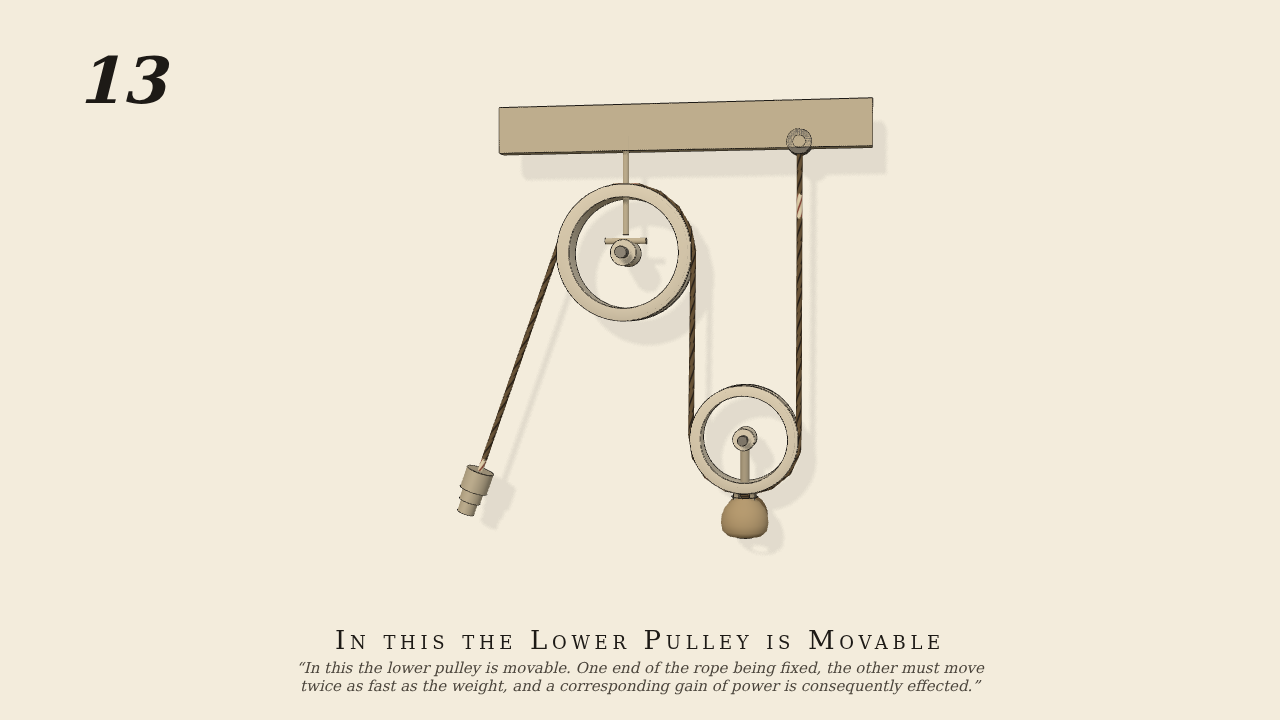
In this the lower pulley is movable
In this the lower pulley is movable. One end of the rope being fixed, the other must move twice as fast as the weight, and a corresponding gain of power is consequently effected.
Only the input is driven; every other part of this model moves by physics (MuJoCo), and its ratios are measured. Run it live, change its parameters, or switch the friction off to see the output stop.
- Modelled as
- rope (friction on both sheaves; 48-link hemp chain, its eyes pinned to the hand and to an eye in the beam, passed UNDER the movable block's sheave)
- Measured
- block/hand 0.490 (Brown's "twice as fast", 2.0%), fixed pulley −10.47 and block's sheave 6.62 rad/m (geometry 10.64 and 6.76), pull 100.2 N against the half-weight's 99.6 N, block rises 2.7…6.1 cm, pen ≤ 0.06 mm
- Notes
- Only the hand is driven (a slide joint in a guide along the rope, 6 cm/s). The block's sheave turns at the block's own rate (v_block/R = 6.76 rad/m), not the rope's: it rolls without slipping on the standing strand, which is at rest, while its centre climbs. Negative control: the rope's contact with the sheaves off → the block does not rise (0.000; it falls 2 cm to its stop); with μ≈0 it still rises (0.485), the sheave being dragged by the links, not by friction.
Film (MP4) · Still (PNG) · Spec (YAML) · Model (MJCF)