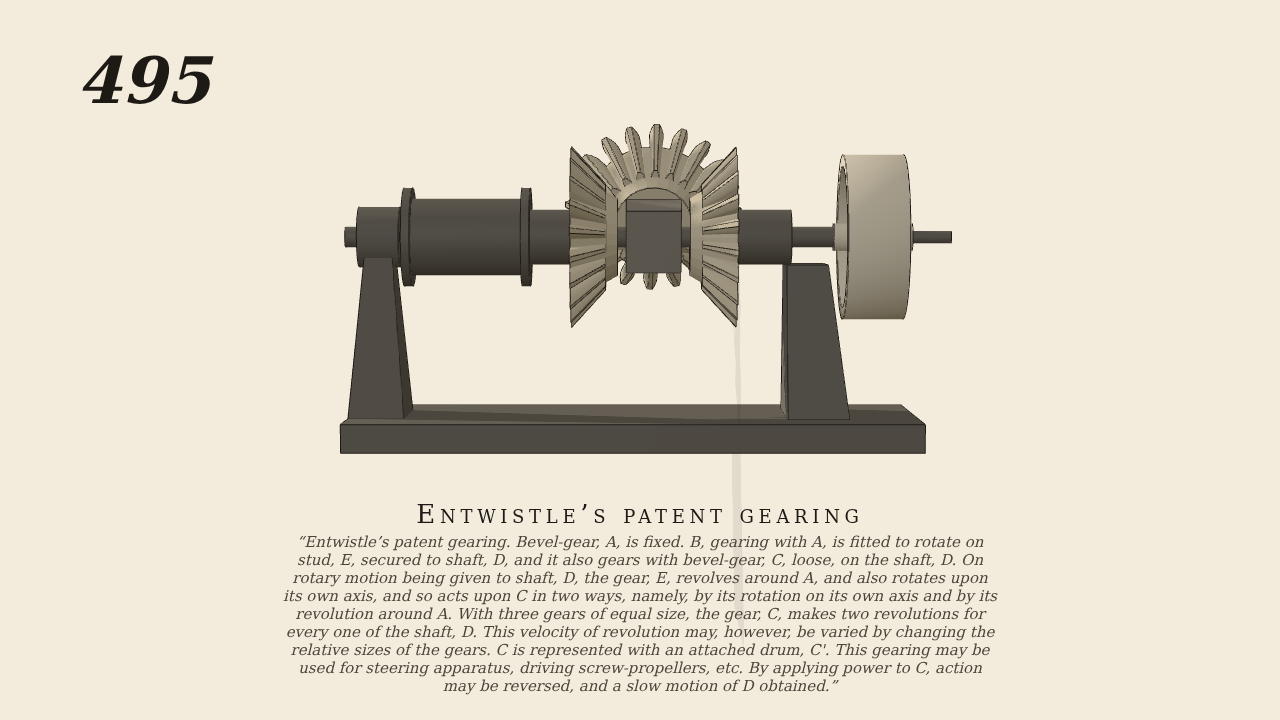
Entwistle’s patent gearing
Entwistle’s patent gearing. Bevel-gear, A, is fixed. B, gearing with A, is fitted to rotate on stud, E, secured to shaft, D, and it also gears with bevel-gear, C, loose, on the shaft, D. On rotary motion being given to shaft, D, the gear, E, revolves around A, and also rotates upon its own axis, and so acts upon C in two ways, namely, by its rotation on its own axis and by its revolution around A. With three gears of equal size, the gear, C, makes two revolutions for every one of the shaft, D. This velocity of revolution may, however, be varied by changing the relative sizes of the gears. C is represented with an attached drum, C'. This gearing may be used for steering apparatus, driving screw-propellers, etc. By applying power to C, action may be reversed, and a slow motion of D obtained.
Only the input is driven; every other part of this model moves by physics (MuJoCo), and its ratios are measured. Run it live, change its parameters, or switch the friction off to see the output stop.
- Modelled as
- Seen from the side, as Brown, with A on the right. Three equal straight bevel gears (20 teeth, 6 cm pitch radius, 45-degree cones, apexes at one point on the shaft D): A is bolted to the right-hand standard and does not turn; B turns freely on the stud E, which stands out from a boss fast on D; C is loose on D and carries the drum C'. D is turned by the pulley at its right-hand end - the only input, a steady 20 rpm - and the drum C' takes a light load. The bevels mesh by their real teeth.
- Measured
- As D turns, B is carried round A and rolls on it, turning once on its stud for each turn of D; it drives C both by that rotation and by its revolution, so C and its drum make 2.00 turns for every turn of D, the same way, as Brown says.
- Notes
- Brown draws the gears in section; here they are solid, with a short drum. The reversed use (power on C for a slow motion of D) is not built.
Film (MP4) · Still (PNG) · Spec (YAML) · Model (MJCF)