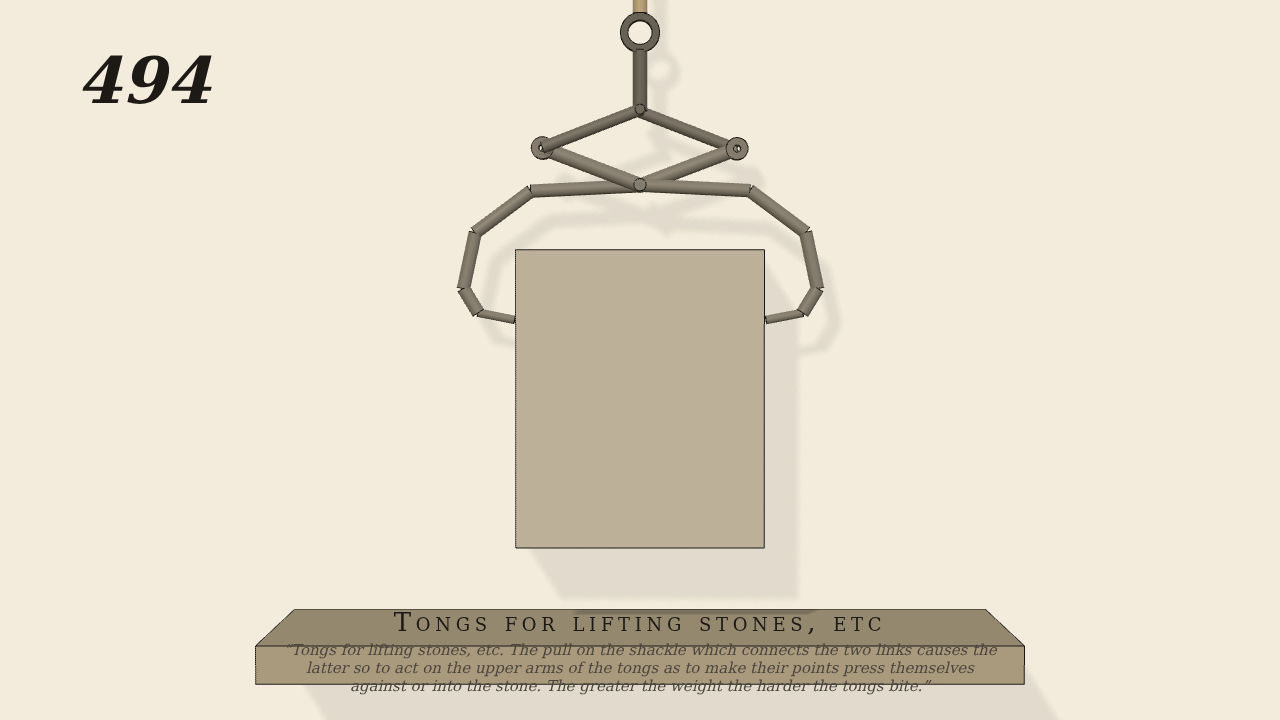
Tongs for lifting stones, etc
Tongs for lifting stones, etc. The pull on the shackle which connects the two links causes the latter so to act on the upper arms of the tongs as to make their points press themselves against or into the stone. The greater the weight the harder the tongs bite.
Only the input is driven; every other part of this model moves by physics (MuJoCo), and its ratios are measured. Run it live, change its parameters, or switch the friction off to see the output stop.
- Modelled as
- Seen from in front, as Brown, gravity on. Two curved tongs cross on a pin; each one's short upper arm is jointed by a link to the shackle at the top, so the two upper arms, the two links and the shackle make a lozenge. The tongs' points rest against the sides of a block of stone (about 14 kg) standing on the ground. The tongs' pin is free to rise and fall. The crane hoisting the shackle (drawn up at a steady 3 cm/s) is the only input; the links are real pinned bars.
- Measured
- The pull on the shackle, resisted by the stone's weight hanging from the tongs' pin, draws the lozenge out long and its side pins together, so the upper arms close the points on the stone; their grip by friction lifts it, 1.00 cm per cm of the shackle (r² 1.00). The force on the points is proportional to the pull, so the heavier the stone the harder they bite.
- Notes
- The tongs' pin rises and falls on the centre line (the gear hangs symmetric); the stone is a plain block.
Film (MP4) · Still (PNG) · Spec (YAML) · Model (MJCF)