“Lewis,” for lifting stone in building
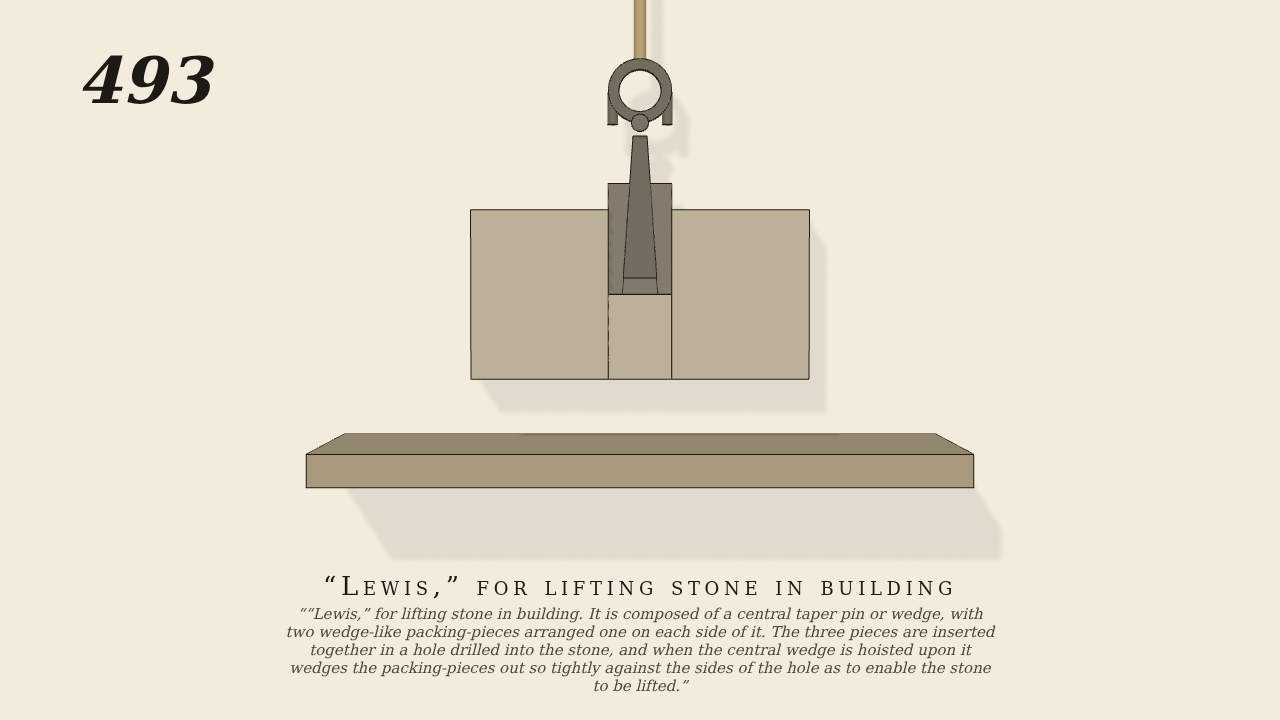
“Lewis,” for lifting stone in building. It is composed of a central taper pin or wedge, with two wedge-like packing-pieces arranged one on each side of it. The three pieces are inserted together in a hole drilled into the stone, and when the central wedge is hoisted upon it wedges the packing-pieces out so tightly against the sides of the hole as to enable the stone to be lifted.
Only the input is driven; every other part of this model moves by physics (MuJoCo), and its ratios are measured. Run it live, change its parameters, or switch the friction off to see the output stop.
- Modelled as
- Seen from in front with the stone cut through the hole, as Brown's section, gravity on. A 6 cm hole is cut 8 cm into a block of stone (about 15 kg) resting on the ground. In it stand the central taper pin, 3.2 cm thick at the foot and narrowing upward, and the two packing pieces, one each side, whose inner faces fit the taper and whose outer faces lie against the hole's walls; each packing piece is free to move up and down and in and out. The shackle's bolt and bow and the crane's rope are on the pin. The crane hoisting the pin (drawn up at a steady 3 cm/s) is the only input.
- Measured
- The pin rises about a centimetre, its taper wedging the packing pieces out against the walls, and from then on the stone rises with it, 1.00 cm per cm of the pin (r² 1.00), held only by the packing pieces' grip on the hole's walls.
- Notes
- The bolt through the shackle and the three pieces is drawn on the pin (the packing pieces are not hung from it); the stone is cut through the hole, as in Brown's section.
Film (MP4) · Still (PNG) · Spec (YAML) · Model (MJCF)