Vertical bucket paddle-wheel
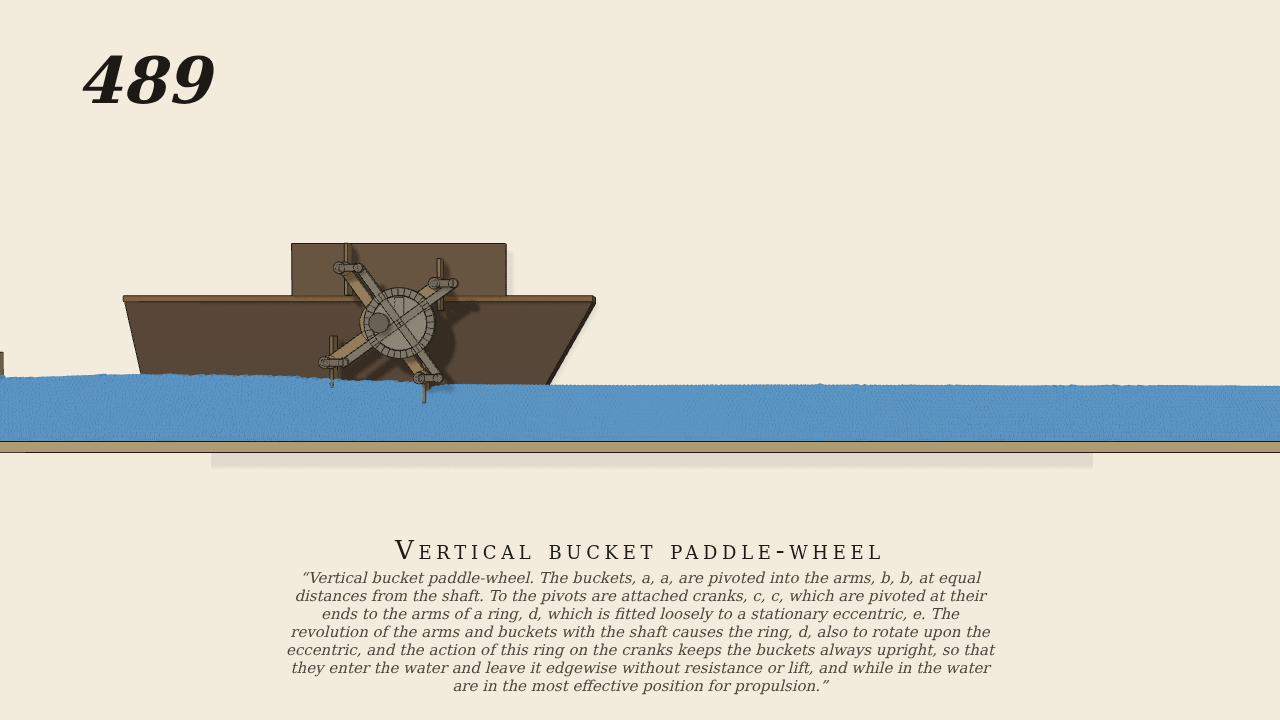
Vertical bucket paddle-wheel. The buckets, a, a, are pivoted into the arms, b, b, at equal distances from the shaft. To the pivots are attached cranks, c, c, which are pivoted at their ends to the arms of a ring, d, which is fitted loosely to a stationary eccentric, e. The revolution of the arms and buckets with the shaft causes the ring, d, also to rotate upon the eccentric, and the action of this ring on the cranks keeps the buckets always upright, so that they enter the water and leave it edgewise without resistance or lift, and while in the water are in the most effective position for propulsion.
Only the input is driven; every other part of this model moves by physics (MuJoCo), and its ratios are measured. Run it live, change its parameters, or switch the friction off to see the output stop.
- Modelled as
- Seen from the side, gravity on. A vessel floats in a long basin on a level slide with hull drag. The wheel (4 arms, driven at 24 rpm, the only input) carries buckets a hinged on its arms; cranks b on the buckets are pinned to the ring d, which turns freely on the stationary eccentric c fixed to the vessel. The basin water is particle water.
- Measured
- As the wheel turns, the ring and cranks keep the buckets upright, so they enter and leave the water edgewise and push square in it; the vessel moves forward at about 14 cm/s. The water is drawn from the particles. The motion gate passes.
- Notes
- Grade B. The basin runs past both frame edges (WARN: basin partly out of frame), on purpose; by 10 s the stern of the vessel nears the right edge.
Film (MP4) · Still (PNG) · Spec (YAML) · Model (MJCF)