Plan of a vertical wind-mill
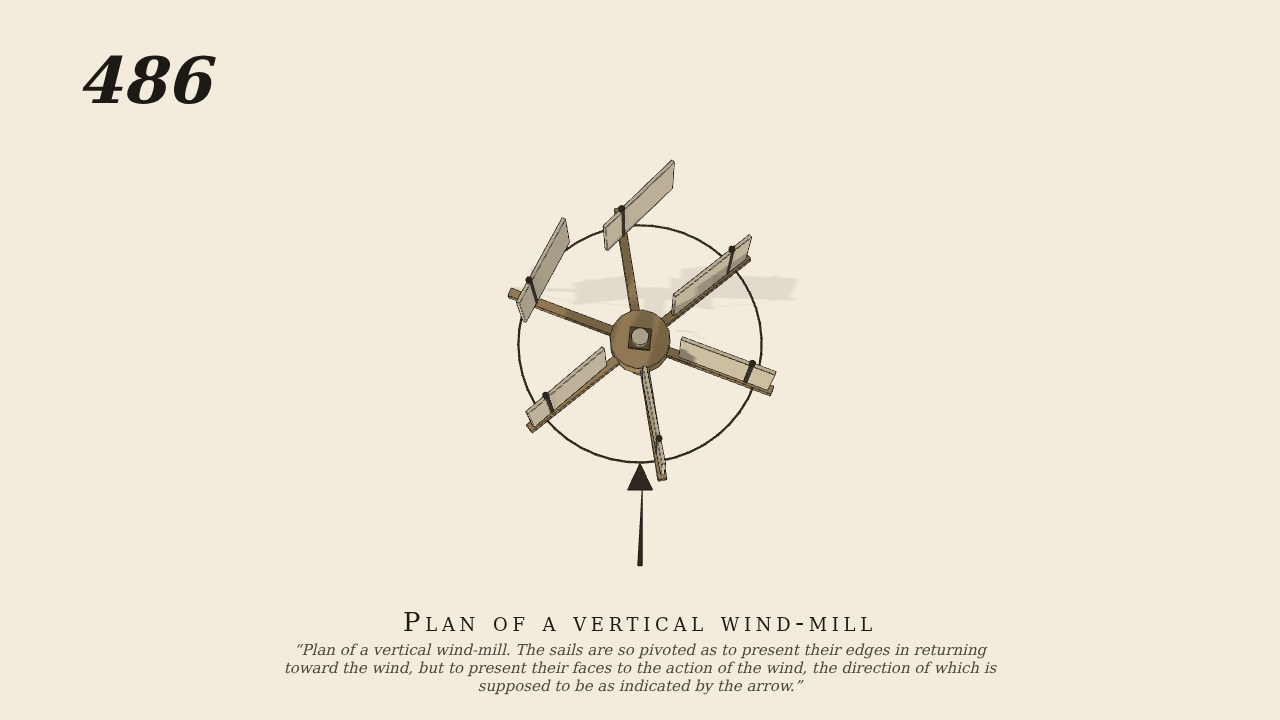
Plan of a vertical wind-mill. The sails are so pivoted as to present their edges in returning toward the wind, but to present their faces to the action of the wind, the direction of which is supposed to be as indicated by the arrow.
Only the input is driven; every other part of this model moves by physics (MuJoCo), and its ratios are measured. Run it live, change its parameters, or switch the friction off to see the output stop.
- Modelled as
- In plan from above, as Brown, gravity on. A rotor on an upright shaft: six arms and a ring of rods, and a sail on each arm hung on its own pivot 12 cm out, longer inward (7.5 cm) than outward (2.5 cm) and free to swing through 175 degrees. The wind (3 m/s across, the arrow) is the only input: MuJoCo's fluid forces (openspec add-air-wind, the ellipsoid model on each sail) push the sails; the shaft works against a light load (0.004 N m s). Nothing is driven.
- Measured
- Going with the wind the sails swing to their stops and present their faces; coming back against it they feather edge-on, so the rotor turns one way (tests/test_air_486.py: mean speed over 0.3 rad/s, sails pressed on over 70% of the with-wind side and under 30% of the other). The motion gate passes with no flags.
- Notes
- Grade B. The air is not drawn (Brown draws only the arrow); the sails are plain plates.
Film (MP4) · Still (PNG) · Spec (YAML) · Model (MJCF)