Reciprocating lift for wells
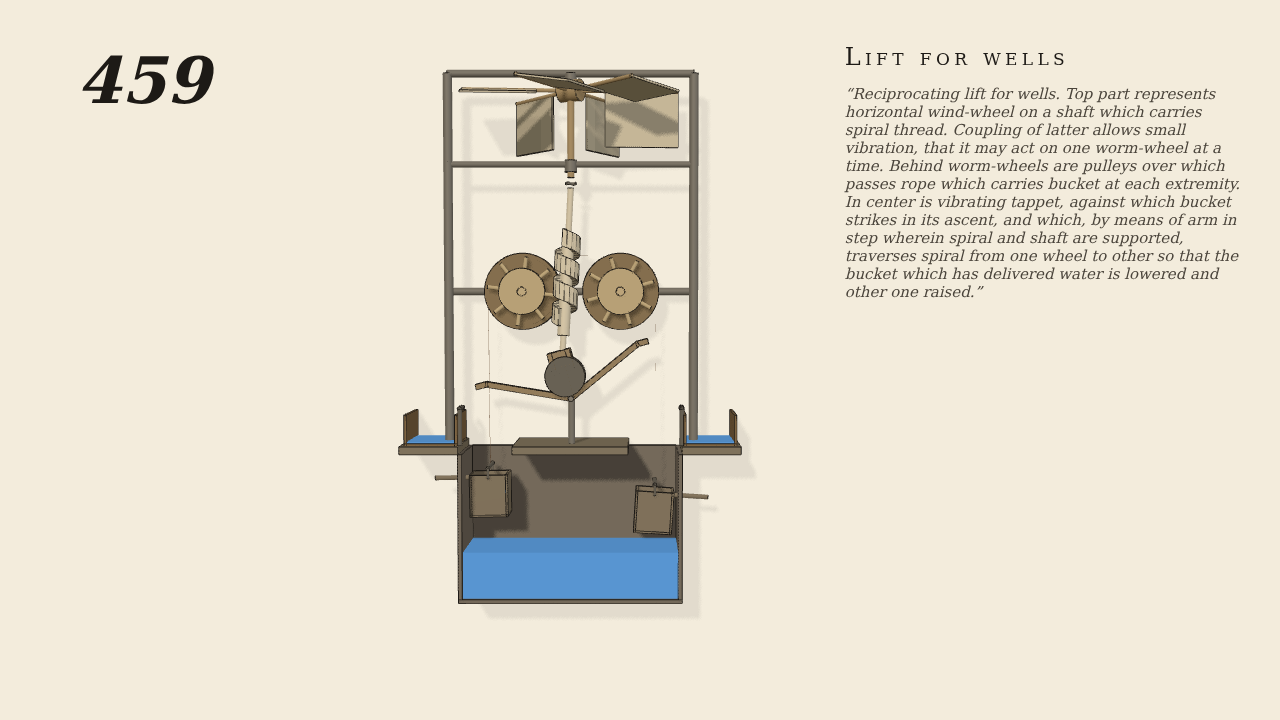
Reciprocating lift for wells. Top part represents horizontal wind-wheel on a shaft which carries spiral thread. Coupling of latter allows small vibration, that it may act on one worm-wheel at a time. Behind worm-wheels are pulleys over which passes rope which carries bucket at each extremity. In center is vibrating tappet, against which bucket strikes in its ascent, and which, by means of arm in step wherein spiral and shaft are supported, traverses spiral from one wheel to other so that the bucket which has delivered water is lowered and other one raised.
Only the input is driven; every other part of this model moves by physics (MuJoCo), and its ratios are measured. Run it live, change its parameters, or switch the friction off to see the output stop.
- Modelled as
- Seen from in front, gravity on. The air blows along x at 12 m/s (MuJoCo's fluid model, sim.air): only the horizontal wind-wheel's 6 sails feel it, as plates hung from hinges along the arms with stops, so they are pressed square going downwind and trail flat coming back, and the wheel turns one way. Its upright shaft carries, through a Hooke's coupling, a single-thread worm between two pin worm-wheels (8 pins); a pulley behind each carries one rope (windings: a limited fixed tendon, so it only pulls) with a bucket at each end. The worm's foot runs in a step on the Y-shaped tappet, which rests by its own weight against one stop or the other, so the worm drives one wheel at a time. A lug on the rising bucket meets a fixed pin and tips it to pour into its trough; then its bail throws the tappet over centre and the worm crosses to the other wheel. The water is the vessels model (src/fluid/vessels.c): the well, each bucket (carried, its water weighing on it), the two troughs, and the pour streams, all drawn from its state. The wind is the only input. gen459.py.
- Measured
- The wind-wheel turns at 4-8 rad/s; each stroke takes about 9 s: the bucket fills in the well (66 g), rises about 22 cm, is tipped about 1 rad and empties into its trough, the tappet is thrown and the other bucket rises. Over 18 s both buckets deliver (troughs 11 to 77 g and 11 to 73 g); in 60 s runs it keeps cycling (about 6 strokes).
- Notes
- The rope is a length constraint over the pulleys (wound, not sliding on them). The pin wheels are discs with pins rather than Brown's spoked wheels, and the troughs are low. The refilled buckets take 44-58 g of the 71 g they start with, since a bucket rises before it is full.
Film (MP4) · Still (PNG) · Spec (YAML) · Model (MJCF)