The common pulley and buckets for raising water
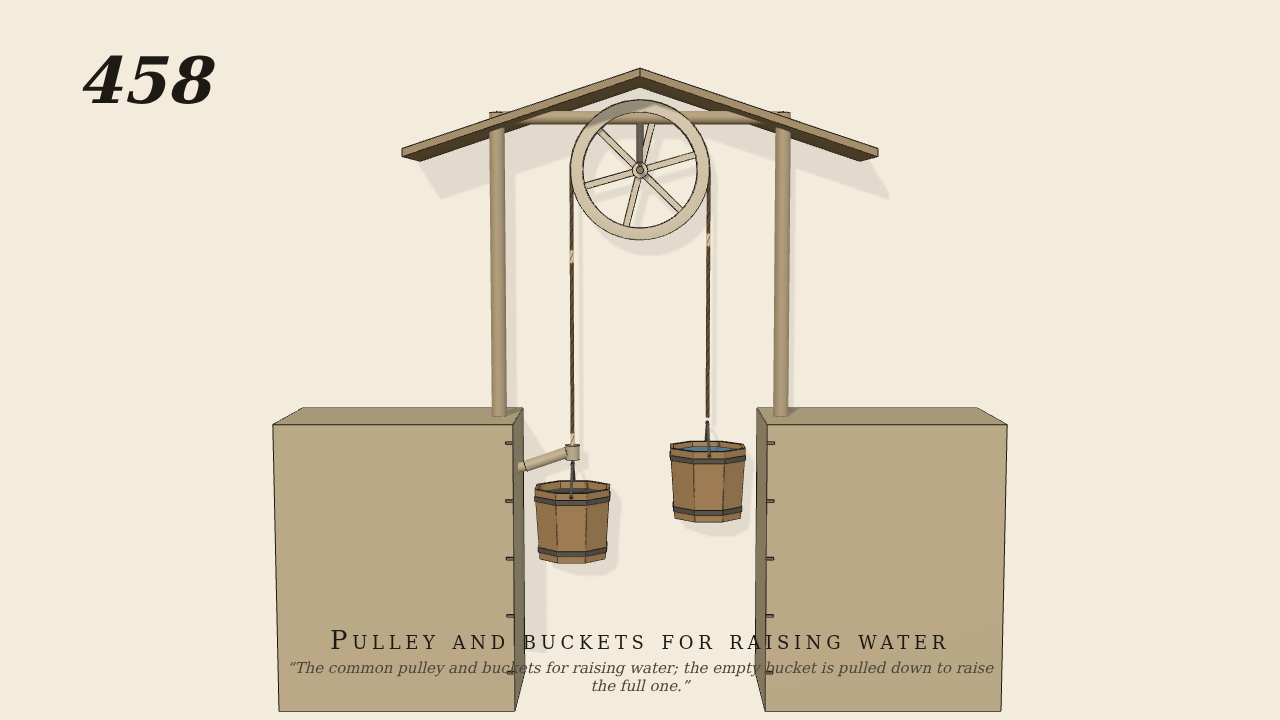
The common pulley and buckets for raising water; the empty bucket is pulled down to raise the full one.
Only the input is driven; every other part of this model moves by physics (MuJoCo), and its ratios are measured. Run it live, change its parameters, or switch the friction off to see the output stop.
- Modelled as
- Seen from in front, as Brown, gravity on. A sheave 14 cm in radius hangs from the tie-beam of a well-house over a lined shaft. A rope over it carries a bucket on each end: the empty one (0.34 kg) up at the left and the full one (2.24 kg, its water a solid) down in the well at the right. The hand on the rope above the empty bucket pulls it down at 12 cm/s on a plumb guide; this is the only input. The rope is a real chain of links that rubs on the sheave, and it is the only thing that lifts the full bucket.
- Measured
- The full bucket rises as fast as the empty one is pulled down (ratio 1.00), 38 cm in 3.2 s. The hand's mean pull is 18.6 N, the difference of the two buckets' weights (18.6 N, the sheave's friction being small), not the full bucket's whole weight (21.9 N).
- Notes
- The full bucket is a solid: its water is a solid block of 1 g/cm³, so the buckets are not emptied or filled. Each bucket rises and falls on a plumb guide. The sheave and buckets are drawn a little larger against the house than in Brown's figure, so they read in the frame.
Film (MP4) · Still (PNG) · Spec (YAML) · Model (MJCF)