G. P. Reed’s patent anchor and lever escapement for watches
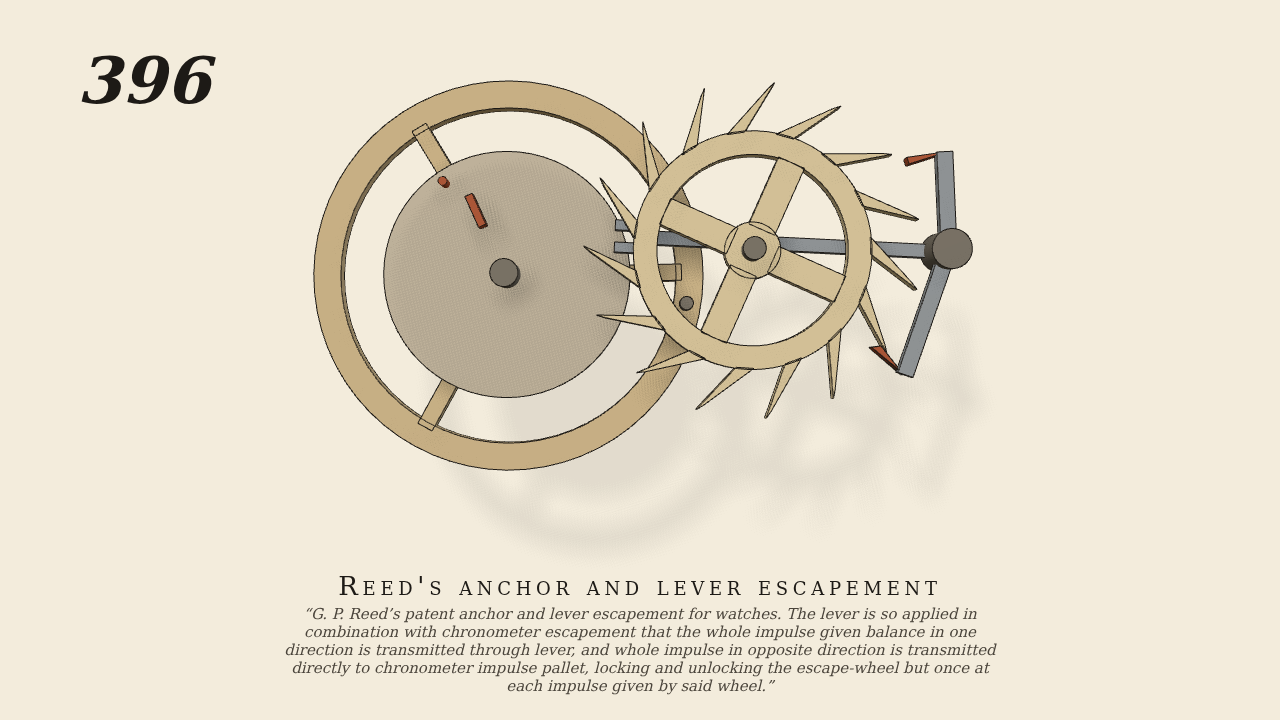
G. P. Reed’s patent anchor and lever escapement for watches. The lever is so applied in combination with chronometer escapement that the whole impulse given balance in one direction is transmitted through lever, and whole impulse in opposite direction is transmitted directly to chronometer impulse pallet, locking and unlocking the escape-wheel but once at each impulse given by said wheel.
Only the input is driven; every other part of this model moves by physics (MuJoCo), and its ratios are measured. Run it live, change its parameters, or switch the friction off to see the output stop.
- Modelled as
- Balance (left), escape wheel (middle) and anchor lever (right) as in Brown's figure; the balance carries a roller with an impulse pin that unlocks the lever, and a stone on the lever's exit pallet gives the balance a direct impulse from the escape wheel, in the manner of a chronometer escapement; the escape wheel is driven by a constant torque, the only input, and the balance's hairspring is its return spring.
- Measured
- The escape wheel advances one tooth (pi/15) each beat at a steady period; balance amplitude grows from 2.07 to 2.62 rad with the lever impulse (2.08 to 2.25 without it); penetration under 0.5 mm.
- Notes
- Turned a quarter turn to Brown's left-to-right layout; the balance is a plain rim wheel and the lever's fork and guard pin are simplified.
Film (MP4) · Still (PNG) · Spec (YAML) · Model (MJCF)