Inverted oscillating or pendulum engine
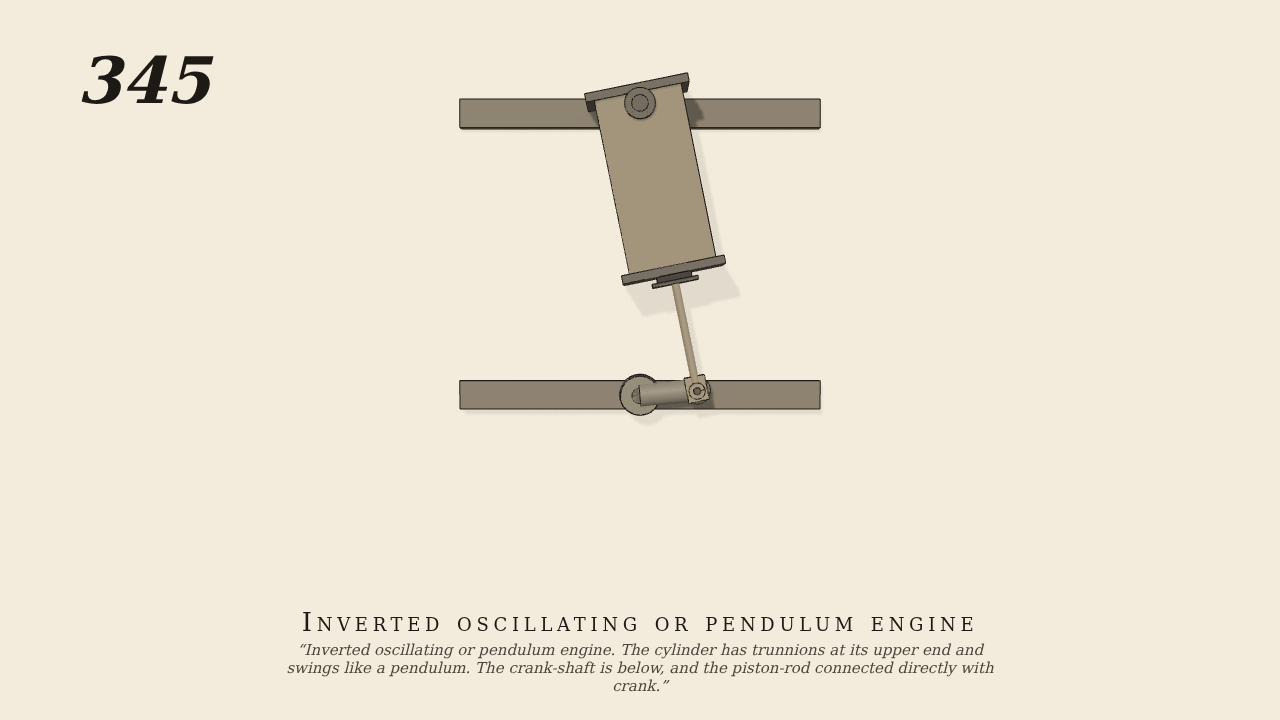
Inverted oscillating or pendulum engine. The cylinder has trunnions at its upper end and swings like a pendulum. The crank-shaft is below, and the piston-rod connected directly with crank.
Only the input is driven; every other part of this model moves by physics (MuJoCo), and its ratios are measured. Run it live, change its parameters, or switch the friction off to see the output stop.
- Modelled as
- The cylinder is 30 cm long and hangs from trunnions at its upper end, in a bearing on the upper beam. It swings like a pendulum. The crank-shaft is below, in a bearing on the lower beam 50 cm under the trunnions. The crank is 10 cm long. The piston-rod, 35 cm long, comes out of the cylinder's lower end and ends in an eye round the crank-pin. The pin is held in the eye by contact, with a few hundredths of a centimetre play. There are no guides. The crank is turned at 30 rev/min. It is the only driven part.
- Measured
- The piston runs the length of its 20 cm stroke, twice the crank's length, once each turn. The cylinder swings 0.201 radian each way, asin(10/50), following the crank-pin. The deepest contact is 0.01 mm.
- Notes
- Brown gives no sizes. Here the crank drives the piston, the reverse of a working engine, and no steam is simulated. The framing is shown as two plain beams.
Film (MP4) · Still (PNG) · Spec (YAML) · Model (MJCF)