A detached pendulum escapement, leaving the pendulum, P, free or…
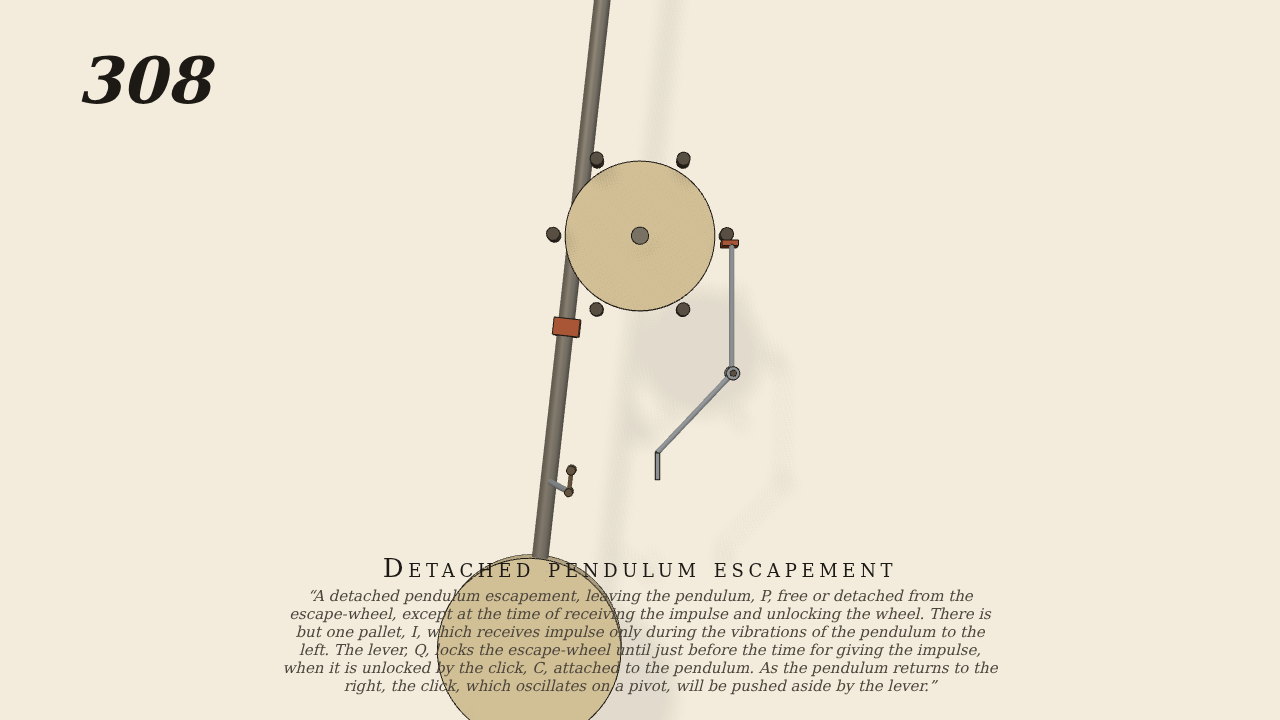
A detached pendulum escapement, leaving the pendulum, P, free or detached from the escape-wheel, except at the time of receiving the impulse and unlocking the wheel. There is but one pallet, I, which receives impulse only during the vibrations of the pendulum to the left. The lever, Q, locks the escape-wheel until just before the time for giving the impulse, when it is unlocked by the click, C, attached to the pendulum. As the pendulum returns to the right, the click, which oscillates on a pivot, will be pushed aside by the lever.
Only the input is driven; every other part of this model moves by physics (MuJoCo), and its ratios are measured. Run it live, change its parameters, or switch the friction off to see the output stop.
- Modelled as
- Gravity on. The escape-wheel has six pins at radius 2 on its front face, and a constant torque turns it clockwise (the weight). The pendulum P hangs from a pivot 14 above the wheel's axis, with its bob 24 below the pivot. The lever Q is pivoted below and to the right of the wheel. One pin rests on the stone at Q's upper end, with its load passing nearly through Q's pivot, and a spring holds Q against its banking. Q's tail reaches down and to the left and ends in a short upright bar. The click C is pivoted on an arm of the pendulum, and a spring holds it upright against a stop, its tip just right of the bar. As the pendulum swings to the left, C, held by its stop, pushes the bar to the left. Q turns, its stone moves out from under the pin, and the wheel is free. As Q turns, the bar also rises, so C's tip passes under it and Q's spring brings Q back in time to lock the next pin. Meanwhile a pin at the bottom of the wheel overtakes the single pallet I on the pendulum and drives it to the left (the impulse), then rises clear before the wheel locks a sixth of a turn on. On the way back to the right, C meets the other side of the bar. Q is on its banking and cannot give, so C turns down on its pivot, passes under, and its spring sets it up again. For the rest of the swing the pendulum is free of the wheel. The pendulum is drawn 6° aside to the right at the start, and the only input is the torque on the wheel.
- Measured
- The wheel goes a sixth of a turn for each swing to the left, a twelfth of a turn per beat (0.5236 rad; 0.5236 expected) over 14 beats. The pendulum's period is 0.989 s against 0.981 s for the free compound pendulum, 0.8% slow. Its swing holds at about 6.9° either side (6.70° in the first third, 6.86° in the last). It also runs with 0.8 times the torque (6.1°). The wheel turns back at most 1.2° (allowed 2.3°). The deepest contact after the first second is 0.39 mm.
- Notes
- Brown gives no sizes. Like a real detached escapement it does not start itself: the pendulum is drawn aside at the start. With 0.4 times the torque the swing dies away and the click stops reaching the lever after about 7 s. With 1.6 times the torque it runs, but the pins strike the stone 0.53 mm deep (allowed 0.5). The swing is measured about the pendulum's hanging position, 6° from where it starts.
Film (MP4) · Still (PNG) · Spec (YAML) · Model (MJCF)