A modification of the above with long stopping teeth, D and E, A…
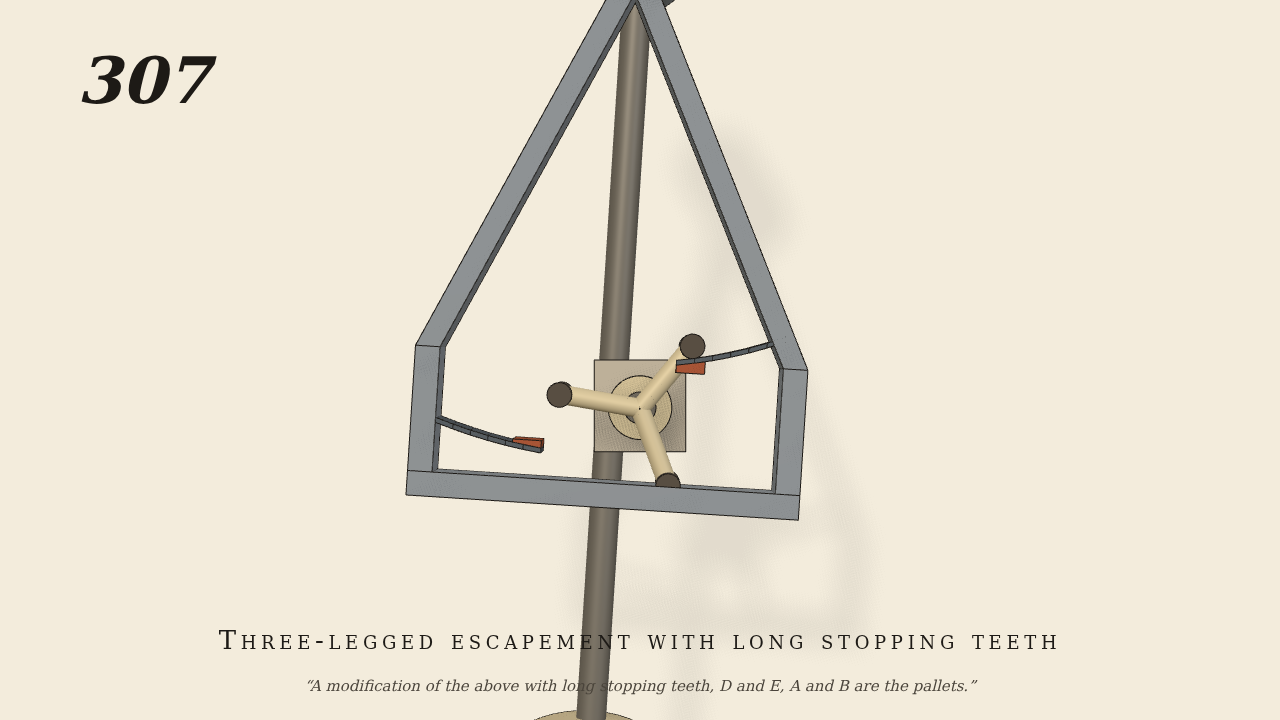
A modification of the above with long stopping teeth, D and E, A and B are the pallets.
Only the input is driven; every other part of this model moves by physics (MuJoCo), and its ratios are measured. Run it live, change its parameters, or switch the friction off to see the output stop.
- Modelled as
- Gravity on. Built as No. 306: the same three-legged wheel, at radius 1, turned clockwise by a constant torque (the weight), and the same pendulum hung 6 above the wheel's axis, with a plate round the wheel. Here the locking and the impulse are done by separate pieces. D and E are long, thin stopping teeth reaching in from the plate's sides above and below the wheel. A tooth coming over the top lands on D's top, 40° past the top, and rests there while the pendulum swings on. A and B are the pallets, short blocks under D's free end and over E's. When the pendulum carries D's end past the tooth, the tooth drives A's upright face to the right: the impulse. A sixth of a turn later the next tooth comes up under E, rests on its underside, and then drives B's upright face to the left. D's top and E's underside are arcs about the pendulum's pivot. At rest they stop just short of the teeth, so the escapement sets itself going from rest. The only input is the torque on the wheel.
- Measured
- The wheel goes a sixth of a turn per beat (1.0472 rad; 1.0472 expected) over 18 beats. The pendulum's period is 0.707 s against 0.694 s for the free compound pendulum, 1.9% slow. Its swing holds at about 6.3° either side (6.21° in the first third, 6.26° in the last). It also runs with two-thirds and with 1.5 times the torque. The wheel turns back at most 1.1° (allowed 2.3°). The deepest contact after the first second is 0.16 mm.
- Notes
- Brown gives no sizes, and his figure is not followed in detail. The stopping teeth D and E are 0.06 thick and the pallets A and B 0.35 wide. The working faces are where No. 306 has them, so the two run alike; what differs is that the locking faces and the impulse faces are separate pieces. The run-back comes when a tooth lands near the free end of a stopping tooth and is pushed back a little as it slides off. A little damping on the wheel's arbor keeps the teeth from bouncing when they land.
Film (MP4) · Still (PNG) · Spec (YAML) · Model (MJCF)