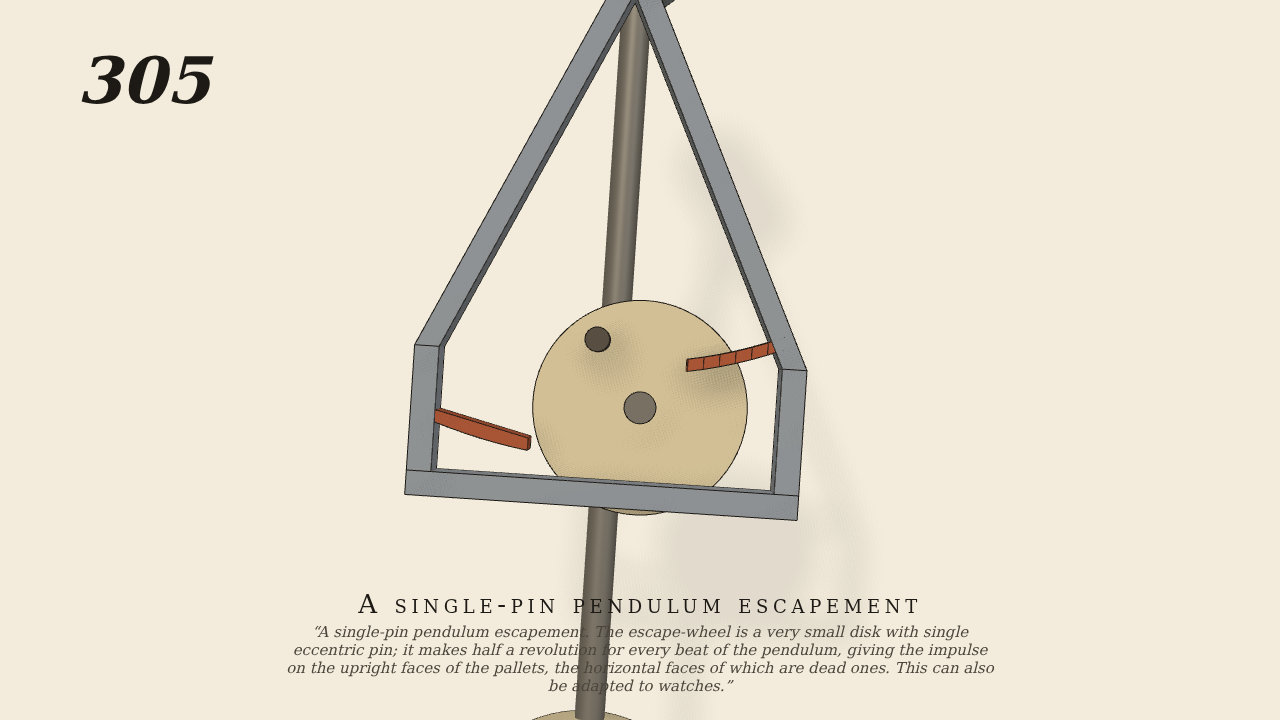
A single-pin pendulum escapement
A single-pin pendulum escapement. The escape-wheel is a very small disk with single eccentric pin; it makes half a revolution for every beat of the pendulum, giving the impulse on the upright faces of the pallets, the horizontal faces of which are dead ones. This can also be adapted to watches.
Only the input is driven; every other part of this model moves by physics (MuJoCo), and its ratios are measured. Run it live, change its parameters, or switch the friction off to see the output stop.
- Modelled as
- Gravity on. The escape-wheel is a little disc with a single pin at radius 1 on its front face. A constant torque turns it clockwise (the weight). The pendulum hangs from a pivot 6 above the disc's axis and carries a frame round the disc with two pallets in it. The upper pallet's top face is dead: the pin, coming over the top, lands on it 40° past the top and rests there while the pendulum swings on. When the pendulum, coming back, carries the face's left end past the pin, the pin drops off. It then drives the pallet's upright left face before it to the right: the impulse. The pin runs on round and comes up under the lower pallet (the same pallet turned half round), rests on its dead underside, and then drives its upright right face to the left. The dead faces are arcs about the pendulum's pivot, which look nearly level over their short length, so a resting pin is not moved as they slide. At rest the dead faces stop just short of the pin. The pin falls on an impulse face and sets the pendulum going by itself, which starts at rest. The only input is the torque on the disc.
- Measured
- The disc goes half a turn per beat (3.1415 rad; 3.1416 expected) over 18 beats. The pendulum's period is 0.700 s against 0.694 s for the free compound pendulum. Its swing holds at about 6.5° either side (6.38° in the first third, 6.46° in the last). It also runs with two-thirds and with 1.5 times the torque (5.5° and 7.4° swings), and with half the bob's weight. The deepest contact after the first second is 0.17 mm.
- Notes
- Brown gives no sizes. The pin sometimes lands near the end of a dead face and is pushed back a little as the face slides off: up to 1.3° of run-back, against the 2.3° the check allows. A little damping on the disc's arbor keeps the pin from bouncing when it lands. Without the pallets the disc would run more than three times as fast (30 rad/s against 9), so the escapement, not the damping, sets the rate. The impulse starts a little before the middle of each swing, so the escapement sets itself going.
Film (MP4) · Still (PNG) · Spec (YAML) · Model (MJCF)