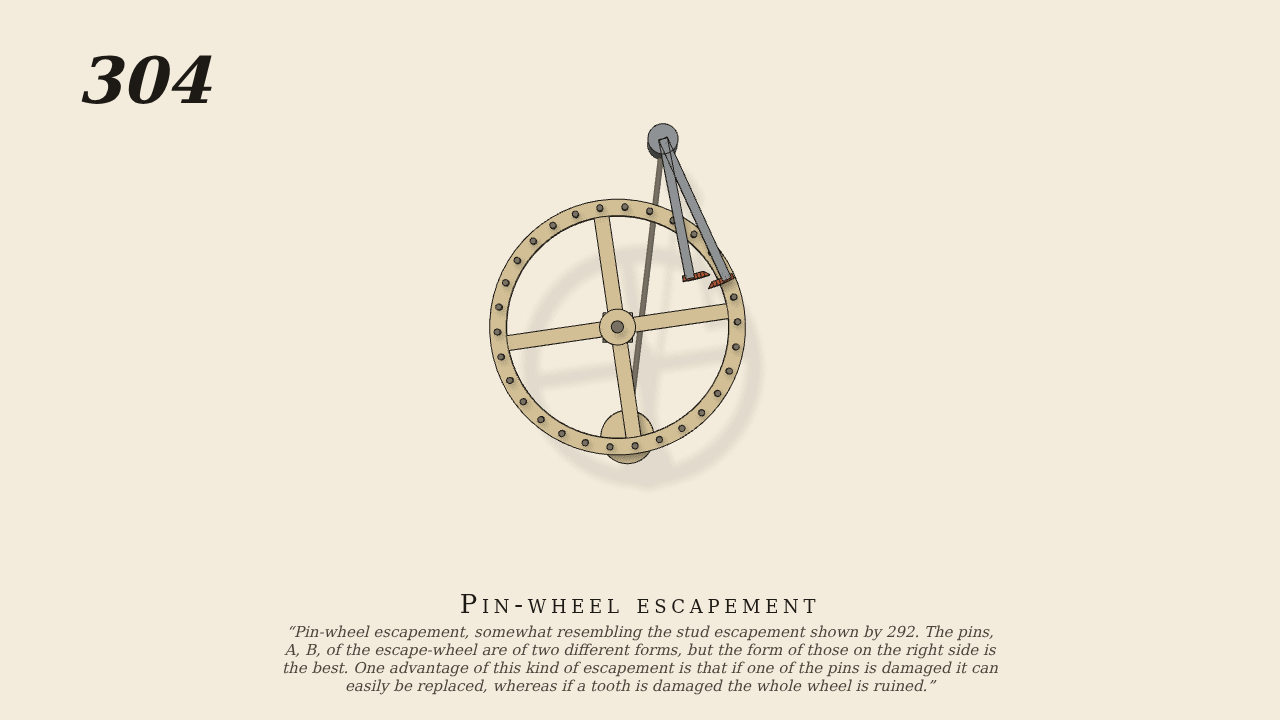
Pin-wheel escapement, somewhat resembling the stud escapement…
Pin-wheel escapement, somewhat resembling the stud escapement shown by 292. The pins, A, B, of the escape-wheel are of two different forms, but the form of those on the right side is the best. One advantage of this kind of escapement is that if one of the pins is damaged it can easily be replaced, whereas if a tooth is damaged the whole wheel is ruined.
Only the input is driven; every other part of this model moves by physics (MuJoCo), and its ratios are measured. Run it live, change its parameters, or switch the friction off to see the output stop.
- Modelled as
- Gravity on. As in No. 292, a pendulum hangs from the pallets' arbor F, and a constant torque on the escape-wheel (the weight) is the only input. Here the wheel has a single ring of 30 round pins standing out of its front face at radius 8, and both pallets work on the same pins in front of the wheel. F stands 10 up the tangent from where the outer pallet works, 25° up the wheel's right side. The outer pallet comes in from outside the pins' circle there. The inner pallet comes in from inside, half a pitch further up. Each pallet's upper face is a locking face: an arc about F, so a pin resting on it does not move as the pallet slides under it (dead beat). The pallet's corner nearest the circle is bevelled for the impulse. When the pallet slides out far enough, the pin runs down the bevel, pushes the pallet on out, and drops off. The next pin then falls on the other pallet. The pallets' arms lie in front of the pins' ends, so the pins pass behind them. The pendulum starts at rest.
- Measured
- The wheel goes 0.1047 rad per beat (half a pitch, 0.1047 expected) over 14 beats. The pendulum's period is 0.891 s against 0.873 s for the free compound pendulum. Its swing holds at about 5.7° either side (5.70° in the first third, 5.58° in the last). The wheel never runs back more than 0.11° while a pin rests on a locking face (dead beat). The deepest contact after the first second is 0.14 mm. It also runs with 1.7 times the torque. With two-thirds of the torque the pendulum never builds up a swing and the wheel stays locked.
- Notes
- Brown gives no sizes. The pallets and pendulum are No. 292's. Brown's figure shows pins of two forms, A and B. Here all the pins are round, and the model is tuned to them: with pins a quarter thicker, the escapement stalls and the pendulum never gets going. The pallets' arms are put in front of the pins' ends so they clear the pins.
Film (MP4) · Still (PNG) · Spec (YAML) · Model (MJCF)