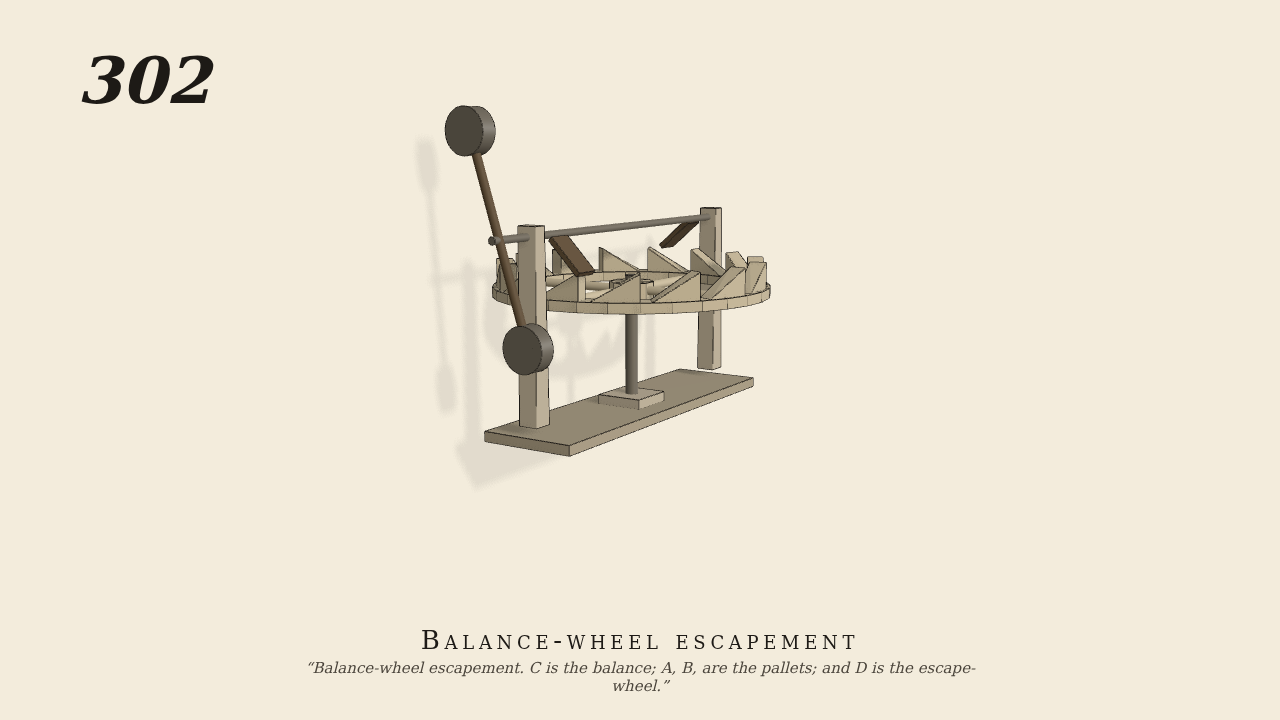
Balance-wheel escapement
Balance-wheel escapement. C is the balance; A, B, are the pallets; and D is the escape-wheel.
Only the input is driven; every other part of this model moves by physics (MuJoCo), and its ratios are measured. Run it live, change its parameters, or switch the friction off to see the output stop.
- Modelled as
- Gravity on. Brown's figure is a side view of a crown-wheel D: sawtooth teeth stand up from its rim, the near ones moving right, on an upright arbor with a pinion below. The balance's staff is seen end-on at C above it. The two pallets A and B on the staff reach down to the teeth on the near and far sides. The balance is a bar with a ball at each end, centred on the staff. Here, as in No. 234, D has 15 sawtooth teeth and turns under a constant torque (the weight or mainspring). An odd number of teeth means a tooth stands at one end of a diameter when a space is at the other. The staff lies across the wheel 3.7 above the rim. A and B, 3 long, lean 47° either side of straight down over the teeth at the two ends of the diameter. The balance C is on the staff, outside the wheel. It is a bar with balls of radius 1.3 at 6 either side of the staff, tilted 20° as drawn. It is balanced, so gravity does not swing it, and it has no spring. It swings to and fro only because the teeth push A and B in turn. Each tooth that catches a pallet stops the balance and drives it back (the recoil). The only input is the torque on D. The balance starts at rest.
- Measured
- D goes 0.2095 rad per beat (half a tooth; 0.2094 expected) over 19 beats. The balance's swing settles at about 10.7° either side. With no spring and no gravity to set a period, the balance beats as fast as the teeth drive it: about 2.7 beats a second here, 3.7 with twice the torque and 2.1 with 0.6 times it. That dependence is why the balance spring was added later. The deepest contact is 0.05 mm.
- Notes
- Brown gives no sizes. The wheel, staff and pallets are No. 234's. In the figure the balance is centred on the staff above the wheel; here it is put on the staff just outside the wheel, so that its lower ball clears the wheel's arbor. The camera looks along the staff from slightly to one side and above, as Brown's figure does. The pinion under D is left out.
Film (MP4) · Still (PNG) · Spec (YAML) · Model (MJCF)