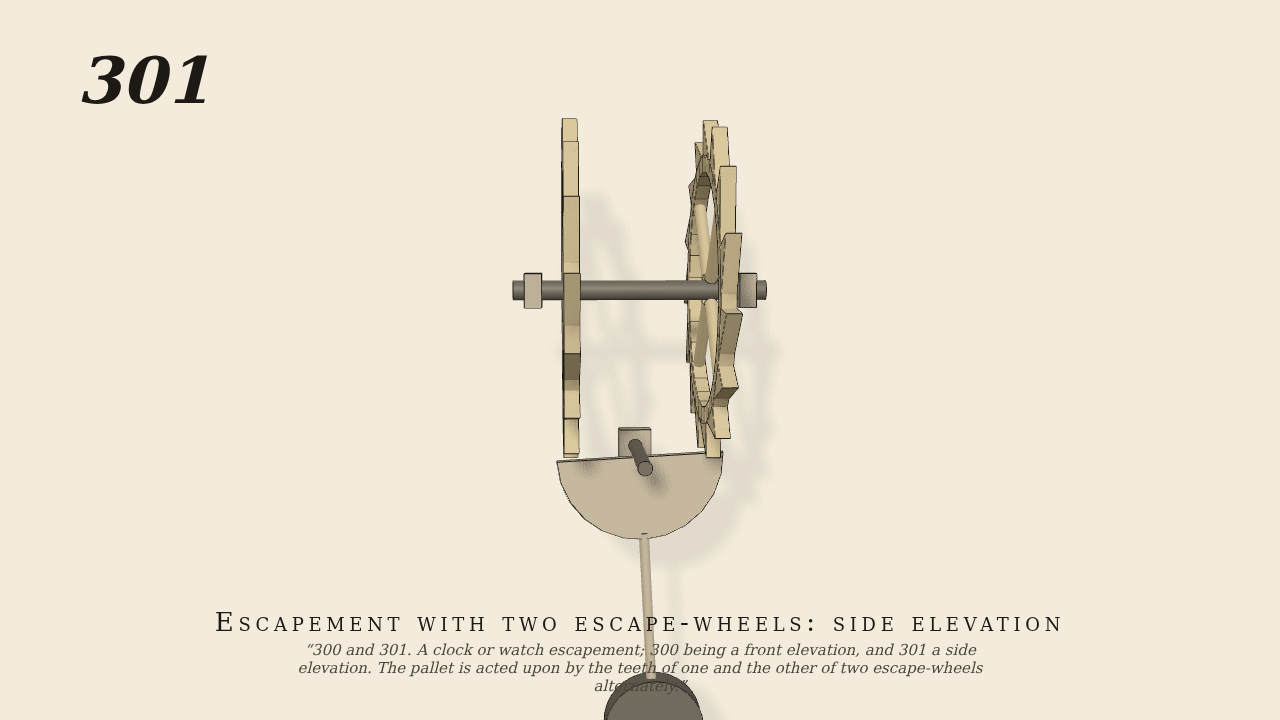
A clock or watch escapement
300 and 301. A clock or watch escapement; 300 being a front elevation, and 301 a side elevation. The pallet is acted upon by the teeth of one and the other of two escape-wheels alternately.
Only the input is driven; every other part of this model moves by physics (MuJoCo), and its ratios are measured. Run it live, change its parameters, or switch the friction off to see the output stop.
- Modelled as
- Gravity on. Brown's figures show two escape-wheels side by side on one horizontal arbor (301). Under them is a pallet on its own arbor, which in the front elevation (300) lies across the picture, along the way the lowest teeth move. In 301 the pallet is a half-disc with its straight edge up and its arbor at the middle of that edge, spanning both wheels. A rod hangs down from it (300). Here two wheels of 15 teeth, tips at radius 6, stand 5 apart on one arbor, with their teeth half a pitch apart. A constant torque (the weight) turns them. The half-disc, radius 3, hangs on its arbor right under them, with its straight edge at the level of the teeth's tips. A pendulum, 10 from the arbor to the bob's centre, hangs from the same arbor. When the pendulum swings one way, the half-disc's edge rises under one wheel and falls under the other. On the raised side, the sloped front of a tooth presses that corner down. That swings the pendulum and raises the other corner in front of a tooth of the other wheel, half a pitch behind, which presses it down in turn. The only input is the torque on the wheels. The pendulum starts hanging at rest. Nos. 300 and 301 are the same machine, seen as in Brown's two figures; this one is the side elevation, looking along the pallet's arbor, so that the half-disc is seen rocking face-on between the two wheels.
- Measured
- The wheels go 0.2096 rad per beat (half a tooth; 0.2094 expected) over 24 beats. The pendulum's swing settles at about 8° either side. The period is 0.592 s, against 0.625 s for the pendulum swinging freely. Like a verge, the teeth press on the pallet all through the beat and push the pendulum back, so it runs quick, and its rate depends on the weight: 0.562 s with half again as much torque. The deepest contact is 0.03 mm.
- Notes
- Brown gives no sizes, and the teeth's shape is hard to read in the figure. Here each tooth has a sloped front and a radial back, so that the tooth presses the corner down as it passes. The half-disc's edge is set level with the teeth's tips. Set 0.05 lower, the wheels run past without touching it. Set 0.1 higher, both corners catch at once and the wheels lock. The wheel spacing, the pendulum and the weight are choices. The model is No. 300's; only the camera differs.
Film (MP4) · Still (PNG) · Spec (YAML) · Model (MJCF)