Lever escapement
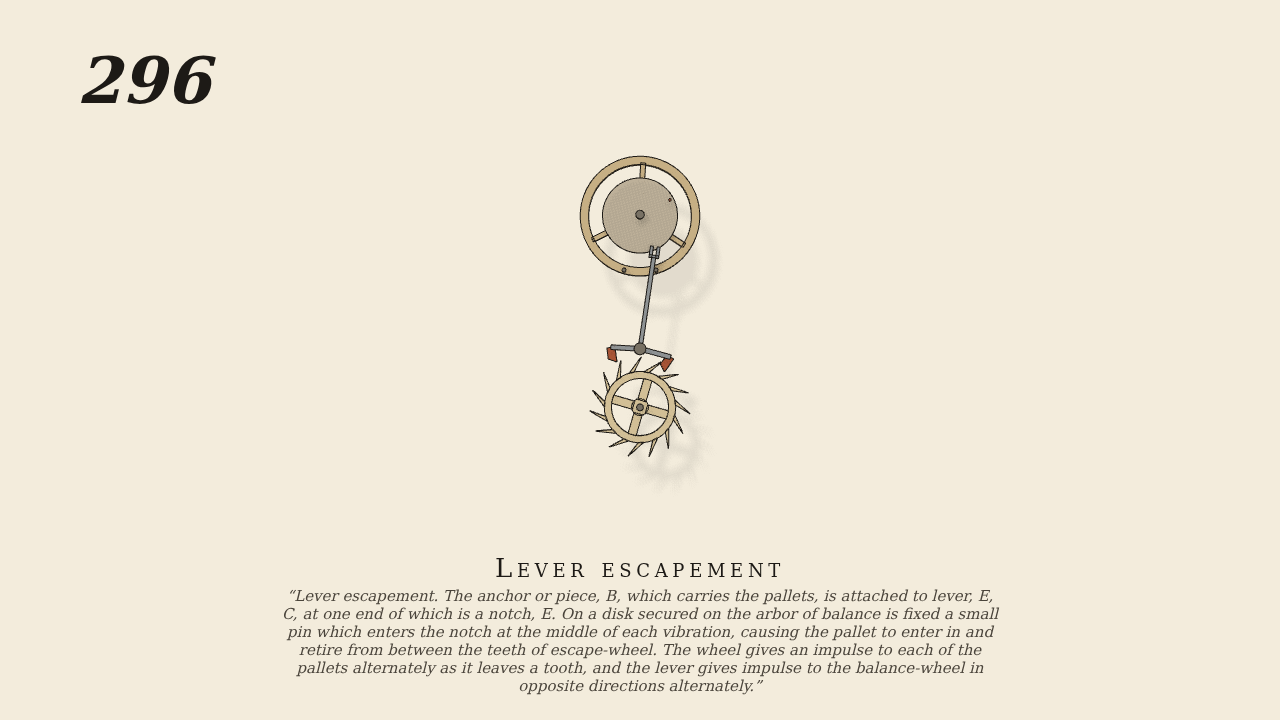
Lever escapement. The anchor or piece, B, which carries the pallets, is attached to lever, E, C, at one end of which is a notch, E. On a disk secured on the arbor of balance is fixed a small pin which enters the notch at the middle of each vibration, causing the pallet to enter in and retire from between the teeth of escape-wheel. The wheel gives an impulse to each of the pallets alternately as it leaves a tooth, and the lever gives impulse to the balance-wheel in opposite directions alternately.
Only the input is driven; every other part of this model moves by physics (MuJoCo), and its ratios are measured. Run it live, change its parameters, or switch the friction off to see the output stop.
- Modelled as
- A plan of the watch (gravity off). The escape-wheel has 15 ratchet teeth, their points leading and undercut. The anchor B carries two pallet stones that span 2 1/2 teeth. Its lever runs up to the notch E, and two banking pins limit its swing to 16.9°. The balance's arbor is beyond the notch, and the impulse pin stands on its disk. Each stone has a locking face, where a tooth's point rests, and below it an impulse face. The locking faces lean so the resting tooth draws the pallet in, and the lever stays against its banking pin. At the middle of each swing the pin enters the notch and turns the lever. This unlocks the stone, and the tooth slides along the impulse face. That pushes the lever, and the lever pushes the pin (the impulse). The wheel then drops onto the other stone's locking face. The balance swings on freely and comes back to unlock the other stone. The only input is a constant torque on the wheel (the mainspring). The balance is set going by hand: it is let go 2 rad from its rest.
- Measured
- The wheel goes 0.2094 rad per beat (half a tooth; 0.2094 expected) over 16 beats. Over 12 s it went exactly one tooth per period, and the lever rested on its banking pins between unlockings. The swing holds at 123°. The period is 1.020 s against the balance on its spring alone (1.019 s). The wheel never turns back more than 0.009 rad (the draw's recoil at unlocking). The deepest contact is 0.11 mm.
- Notes
- Brown gives no sizes. The tooth count, the lock, the lift and the lever's length are choices. The lever's pivot has a little friction, and that damps its rebound off the banking pins.
Film (MP4) · Still (PNG) · Spec (YAML) · Model (MJCF)