A cylinder escapement
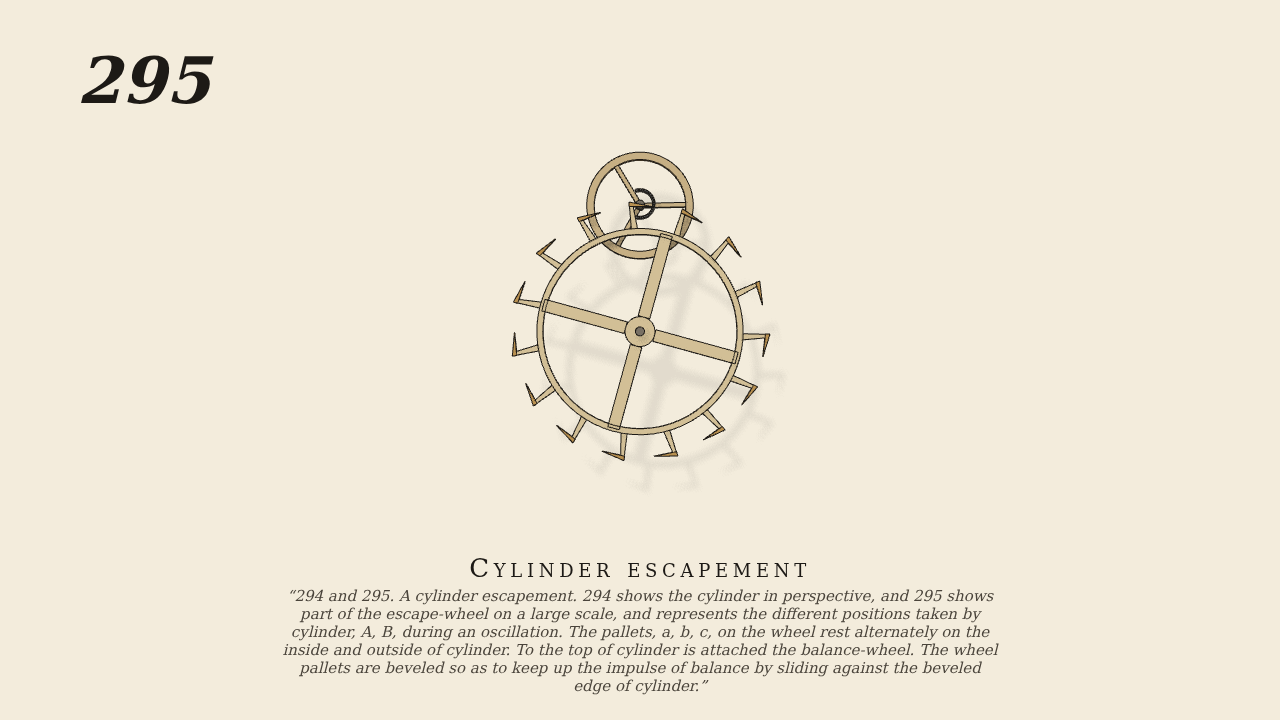
294 and 295. A cylinder escapement. 294 shows the cylinder in perspective, and 295 shows part of the escape-wheel on a large scale, and represents the different positions taken by cylinder, A, B, during an oscillation. The pallets, a, b, c, on the wheel rest alternately on the inside and outside of cylinder. To the top of cylinder is attached the balance-wheel. The wheel pallets are beveled so as to keep up the impulse of balance by sliding against the beveled edge of cylinder.
Only the input is driven; every other part of this model moves by physics (MuJoCo), and its ratios are measured. Run it live, change its parameters, or switch the friction off to see the output stop.
- Modelled as
- A plan of the watch (gravity off). The cylinder is the balance's axis. At the level of the wheel's pallets a little more than half of it is left (217° over the top), and its two edges are the lips. The escape-wheel has 15 teeth, each a wedge on a stalk (Brown's pallets a, b, c). The wedge's point leads and its face rises 0.3 cm to the heel, and the wedges' path passes through the cylinder. A point rests on the cylinder's outside. When the balance turns clockwise far enough, the entry lip passes the point and the wedge slides under the lip, pushing it on (the impulse). The point goes in and rests on the inside. Swinging back, the exit lip passes the point, the wedge slides out under that lip (the second impulse), and the next point falls on the outside. The only input is a constant torque on the wheel (the mainspring). The balance is set going by hand: it is let go 2.2 rad from its rest.
- Measured
- The wheel goes 0.2094 rad per beat (half a tooth; 0.2094 expected) over 16 beats. Over 12 s it went exactly half a tooth at every swing, the points resting alternately on the outside and the inside. The swing holds at 105°. The period is 1.036 s against the balance on its spring alone (1.034 s). The wheel never turns back more than 0.002 rad. The deepest contact is 0.14 mm.
- Notes
- Brown gives no sizes. The tooth count, the wedges' rise and the cylinder's opening are choices. The cylinder's shell is built of 22 straight-sided pieces. Their ends taper in, so a resting point never catches on a join. The balance-wheel is drawn behind.
Film (MP4) · Still (PNG) · Spec (YAML) · Model (MJCF)