Another kind of pendulum escapement
Another kind of pendulum escapement.
Only the input is driven; every other part of this model moves by physics (MuJoCo), and its ratios are measured. Run it live, change its parameters, or switch the friction off to see the output stop.
- Modelled as
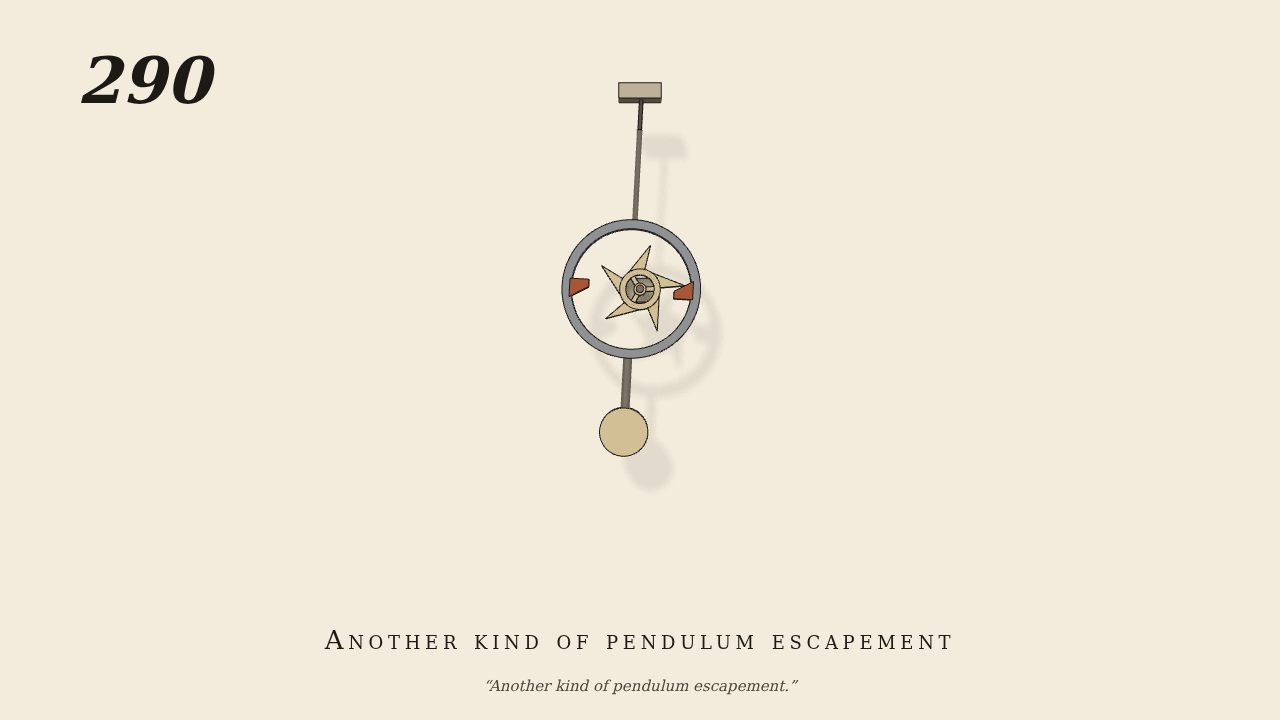
- This is laid out as Brown draws it. The pendulum hangs from its suspension C, 11 cm above the axis D of a 5-toothed escape-wheel. Its rod is a ring K round the wheel and goes on below to the bob. Two pallets on the inside of the ring, A on the right and B on the left, reach 0.15 cm into the path of the teeth at rest. As the ring swings to and fro they go in and out of the teeth in turn: A catches a tooth coming down on the right, then B catches one coming up on the left. Each pallet's face slopes 30° outward, so the tooth pushes the pallet out as it comes out (the impulse). The only input is a constant torque on the wheel (the clock's weight). The pendulum swings under gravity and is kept going only by the teeth.
- Measured
- The pendulum starts itself from rest. The wheel goes 0.6255 rad per beat (half a tooth, 0.6283) over 17 beats. The swing holds at 3.4°. Because the faces slope, the wheel turns back up to 0.043 rad while a pallet goes on in (a recoil). The period is 0.669 s, 20% quicker than the pendulum swinging free (0.835 s): the pallets bear on the teeth for much of each swing. The deepest contact is 0.41 mm.
- Notes
- Brown gives no sizes, and his figure does not show the pallets' faces closely. The 30° slope is a choice: with flat faces nothing would give the impulse. Brown's suspension spring C is drawn but modelled as a hinge. The tooth count (5) follows the figure.
Film (MP4) · Still (PNG) · Spec (YAML) · Model (MJCF)