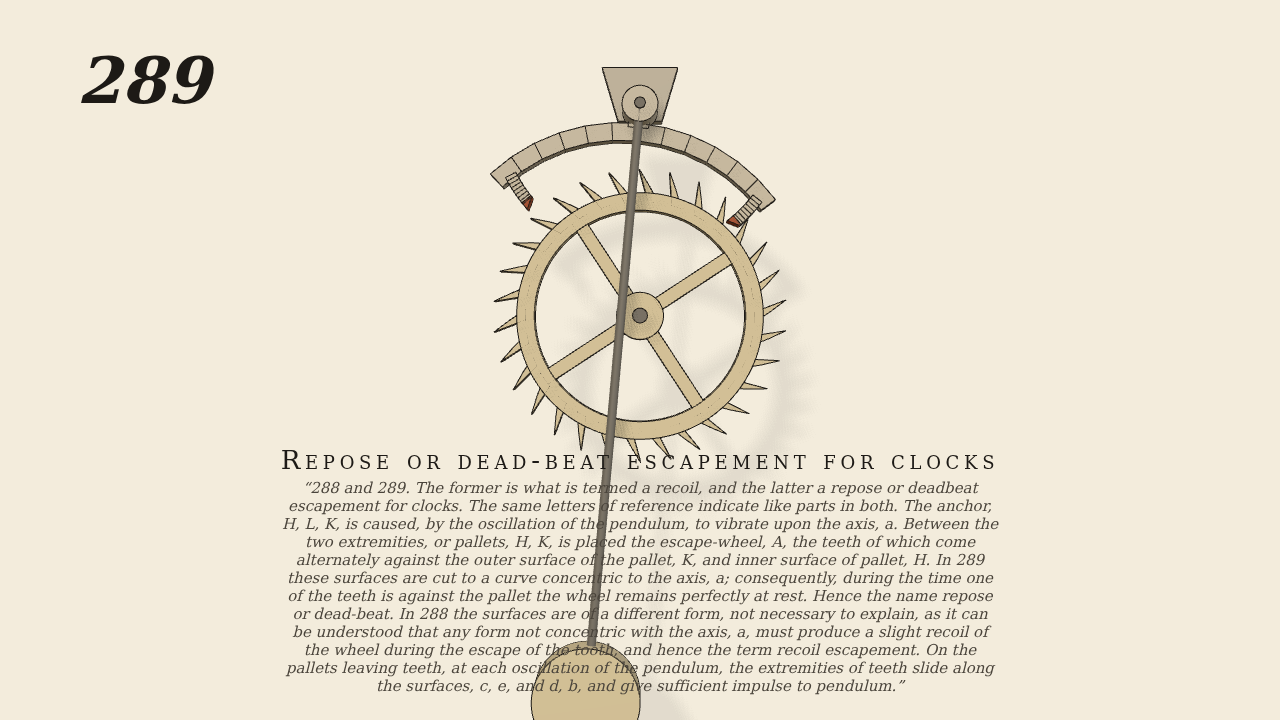
The former is what is termed a recoil, and the latter a repose or…
288 and 289. The former is what is termed a recoil, and the latter a repose or deadbeat escapement for clocks. The same letters of reference indicate like parts in both. The anchor, H, L, K, is caused, by the oscillation of the pendulum, to vibrate upon the axis, a. Between the two extremities, or pallets, H, K, is placed the escape-wheel, A, the teeth of which come alternately against the outer surface of the pallet, K, and inner surface of pallet, H. In 289 these surfaces are cut to a curve concentric to the axis, a; consequently, during the time one of the teeth is against the pallet the wheel remains perfectly at rest. Hence the name repose or dead-beat. In 288 the surfaces are of a different form, not necessary to explain, as it can be understood that any form not concentric with the axis, a, must produce a slight recoil of the wheel during the escape of the tooth, and hence the term recoil escapement. On the pallets leaving teeth, at each oscillation of the pendulum, the extremities of teeth slide along the surfaces, c, e, and d, b, and give sufficient impulse to pendulum.
Only the input is driven; every other part of this model moves by physics (MuJoCo), and its ratios are measured. Run it live, change its parameters, or switch the friction off to see the output stop.
- Modelled as
- This is No. 288's wheel and anchor (No. 303's Graham layout, mirrored so that A turns counter-clockwise, with Brown's letters K and H). Here K's outer face and H's inner face are arcs about the axis a, as Brown says. While a tooth rests on one, its force is radial to a, so the wheel stands still. The slanted tips are the impulse faces. The only input is a constant torque on A (the clock's weight). The anchor and pendulum swing under gravity and are kept going only by the teeth pressing on the pallets.
- Measured
- A advances 0.1046 rad per beat (half a tooth, 0.1047) and never turns back more than 0.0016 rad, which is contact compliance. No. 288's recoil faces give 0.0139 rad. The swing holds at 5.8°. The period is 0.894 s against the free compound pendulum's 0.882 s (1.4%).
- Notes
- This is Graham's escapement, as in No. 303, which it mirrors. Brown's letters c, e and d, b for the impulse faces are not drawn.
Film (MP4) · Still (PNG) · Spec (YAML) · Model (MJCF)