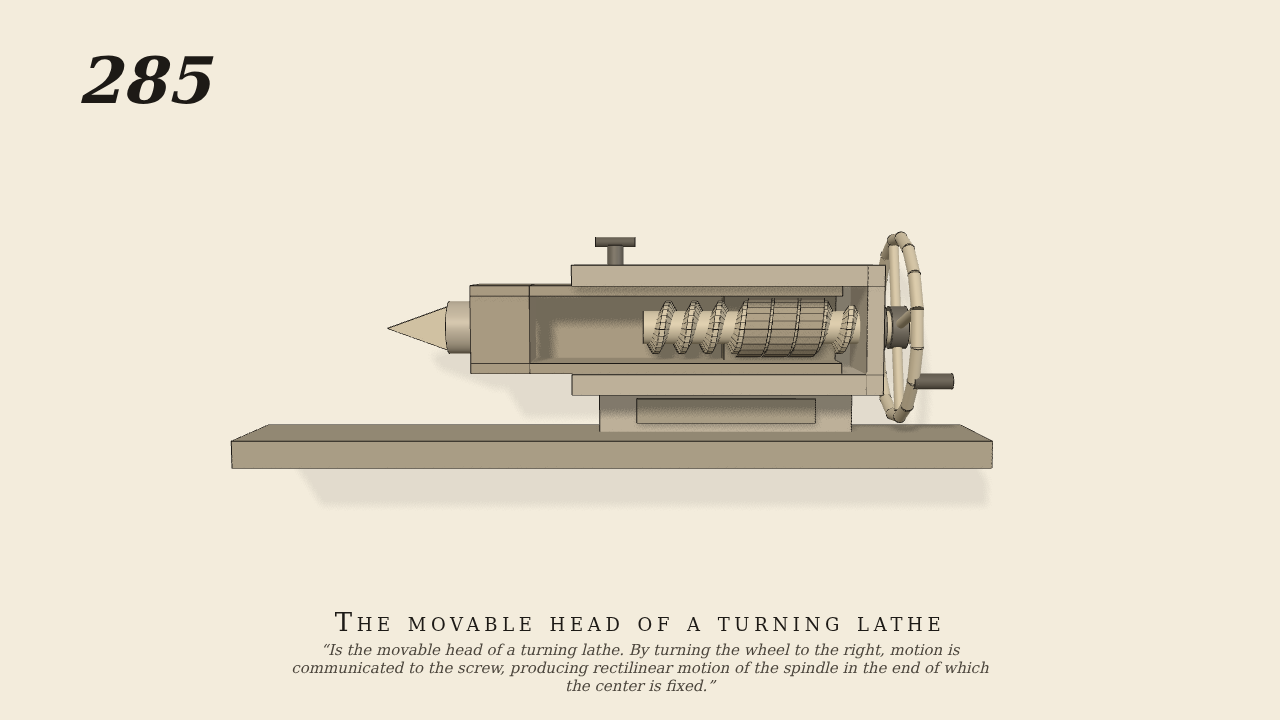
The movable head of a turning lathe
Is the movable head of a turning lathe. By turning the wheel to the right, motion is communicated to the screw, producing rectilinear motion of the spindle in the end of which the center is fixed.
Only the input is driven; every other part of this model moves by physics (MuJoCo), and its ratios are measured. Run it live, change its parameters, or switch the friction off to see the output stop.
- Modelled as
- The hand-wheel is the one driven joint. It turns to the right (clockwise, as the turner at the wheel sees it) at 16 turns a minute, and is fast on a left-hand screw of pitch 1.6 cm held endwise in the right-hand end of the head. The screw works, by real contact, in a 3-turn nut in the end of the spindle; its thread is that of No. 103, with 0.04 cm clear on each flank. The spindle can only slide along the head, so each turn of the wheel runs it and its center out to the left by one pitch. A spring stands for the work's thrust on the center and keeps the same flanks loaded. The head is drawn cut away, as in the plate.
- Measured
- The spindle follows the wheel at 0.2547 cm per radian (expected 1.6/2π = 0.2546; r² 1.0000) and runs 3.9 cm out to the left in 9.5 s. The deepest contact after 0.5 s is 0.001 mm.
- Notes
- Brown gives no sizes. The plate's screw is drawn left-handed so that turning the wheel to the right runs the center out toward the work. The clamp-screw that locks the spindle is drawn but not modelled.
Film (MP4) · Still (PNG) · Spec (YAML) · Model (MJCF)