A V-grooved pulley having its groove notched to increase the…
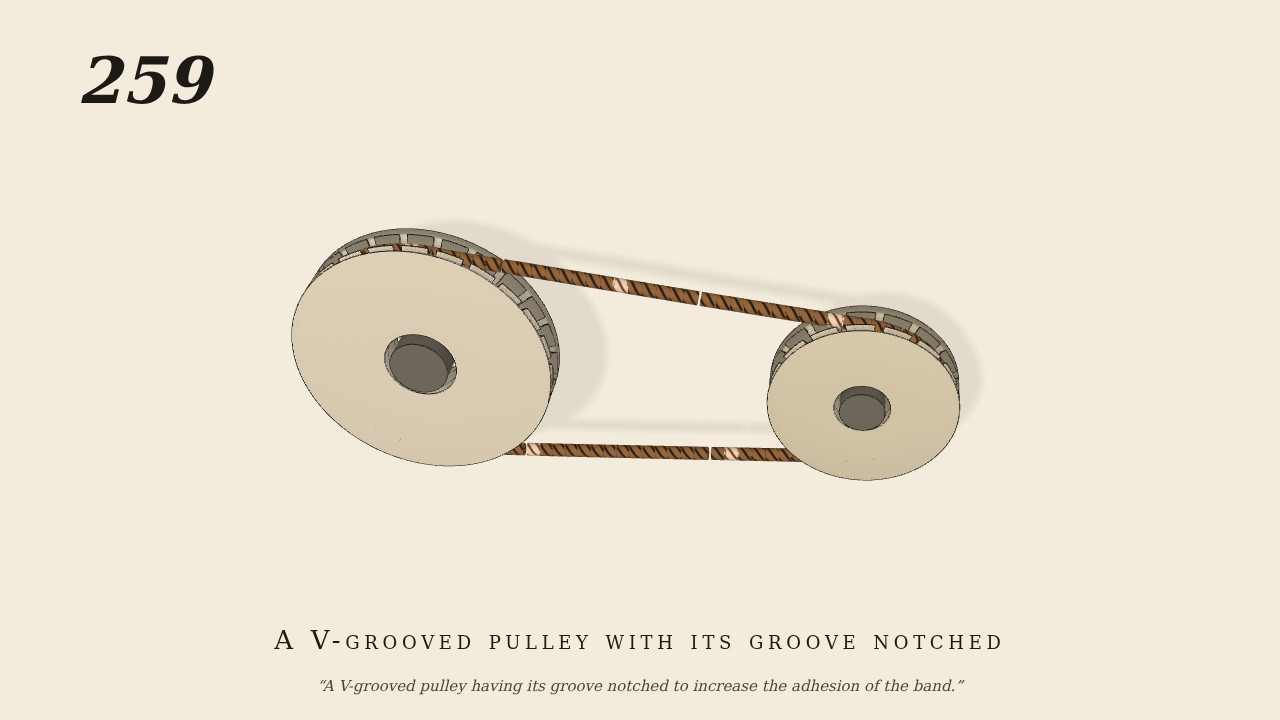
A V-grooved pulley having its groove notched to increase the adhesion of the band.
Only the input is driven; every other part of this model moves by physics (MuJoCo), and its ratios are measured. Run it live, change its parameters, or switch the friction off to see the output stop.
- Modelled as
- Front view from above, shafts level, gravity on. No. 258's two V-grooved pulleys (flanks 20 degrees either side of the radial plane), each groove notched across both flanks: 24 notches round the larger, 16 round the smaller, each 0.5 cm wide at the rim and sunk 0.35 cm below the flanks. The larger (pitch radius 7.4 cm) is on the driving shaft, turned at 40 rpm (the one driven joint). The smaller (pitch radius 4.9 cm), 26 cm away, carries a load (a damper). A tensioned round band (0.8 cm cord) of links on real contact lies wedged on the lands between the notches and settles into the cuts as they pass, driving the smaller by friction on the lands and by the notches' edges.
- Measured
- The small pulley turns at 1.4899 times the large one's speed against 1.5102 from the pitch radii (slip 1.3%), over 1 to 5.5 s. The band stays in the grooves (radial deviation 0.45 cm, lateral 0.03 cm). The deepest contact after 1 s is 1.18 mm, inside the cord's soft contact.
- Notes
- Brown gives no sizes. The notches are real cuts (src 26a9618): each notched frustum slab is collided as the frustum sunk by the notch depth plus one convex sector per land. With friction taken away the notches alone still carry the small pulley at 35% of the working ratio, where No. 258's smooth V gives 1.1%: the notches' own grip on the band.
Film (MP4) · Still (PNG) · Spec (YAML) · Model (MJCF)