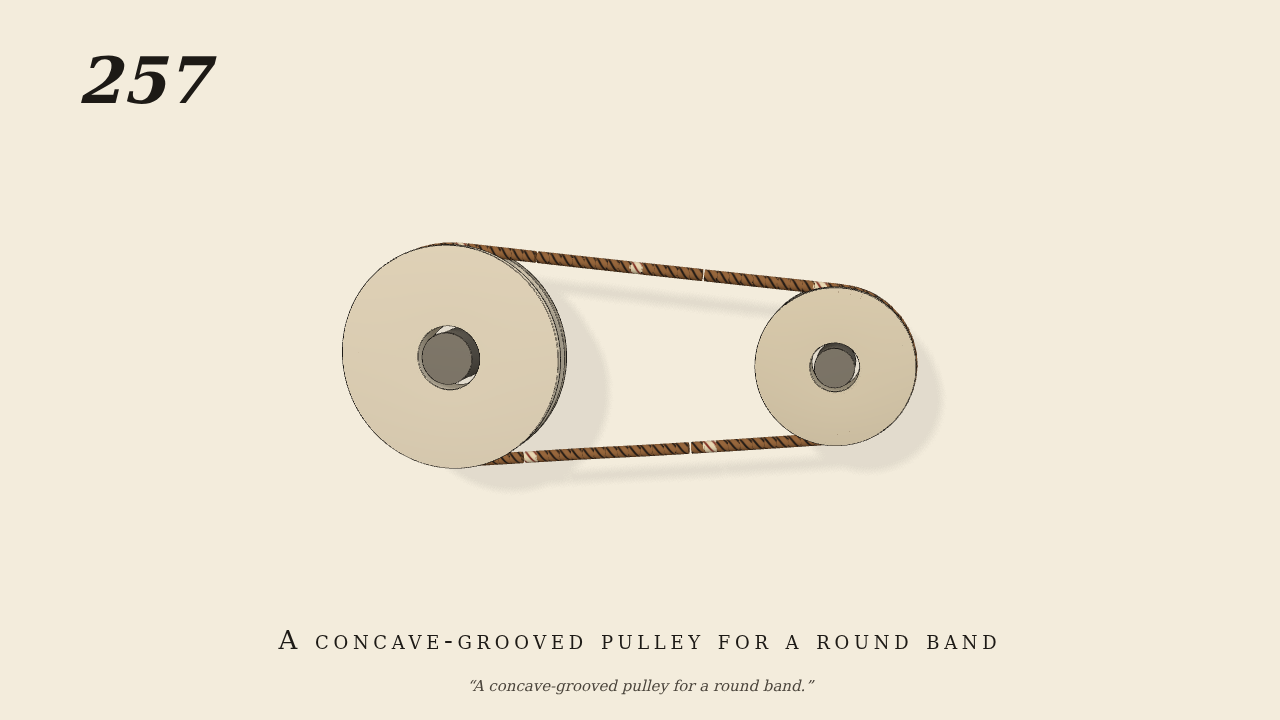
A concave-grooved pulley for a round band
A concave-grooved pulley for a round band.
Only the input is driven; every other part of this model moves by physics (MuJoCo), and its ratios are measured. Run it live, change its parameters, or switch the friction off to see the output stop.
- Modelled as
- Front view, shafts level, gravity on. Two pulleys, each with a concave (round-bottomed) groove of radius 0.55 cm turned in its face, a little larger than the round band (0.8 cm cord) that lies in it. The larger (groove bottom radius 7 cm) is on the driving shaft, turned at 40 rpm (the one driven joint). The smaller (4.5 cm), 26 cm away, carries a load (a damper). A tensioned round band of links on real contact lies in the hollows and drives the smaller by friction.
- Measured
- The small pulley turns at 1.4842 times the large one's speed against 1.5090 from the pitch radii, r + 0.41 (slip 1.6%), over 1 to 5.5 s. The band stays in the hollows (radial deviation 0.12 cm, lateral 0.03 cm). The deepest contact after 1 s is 0.64 mm, inside the cord's soft contact.
- Notes
- Brown gives no sizes. The faces are solids of revolution of the groove's section, built as frusta with rings of 48 points (at 12 the band caught on the corners and a frictionless band was carried at 26%).
Film (MP4) · Still (PNG) · Spec (YAML) · Model (MJCF)