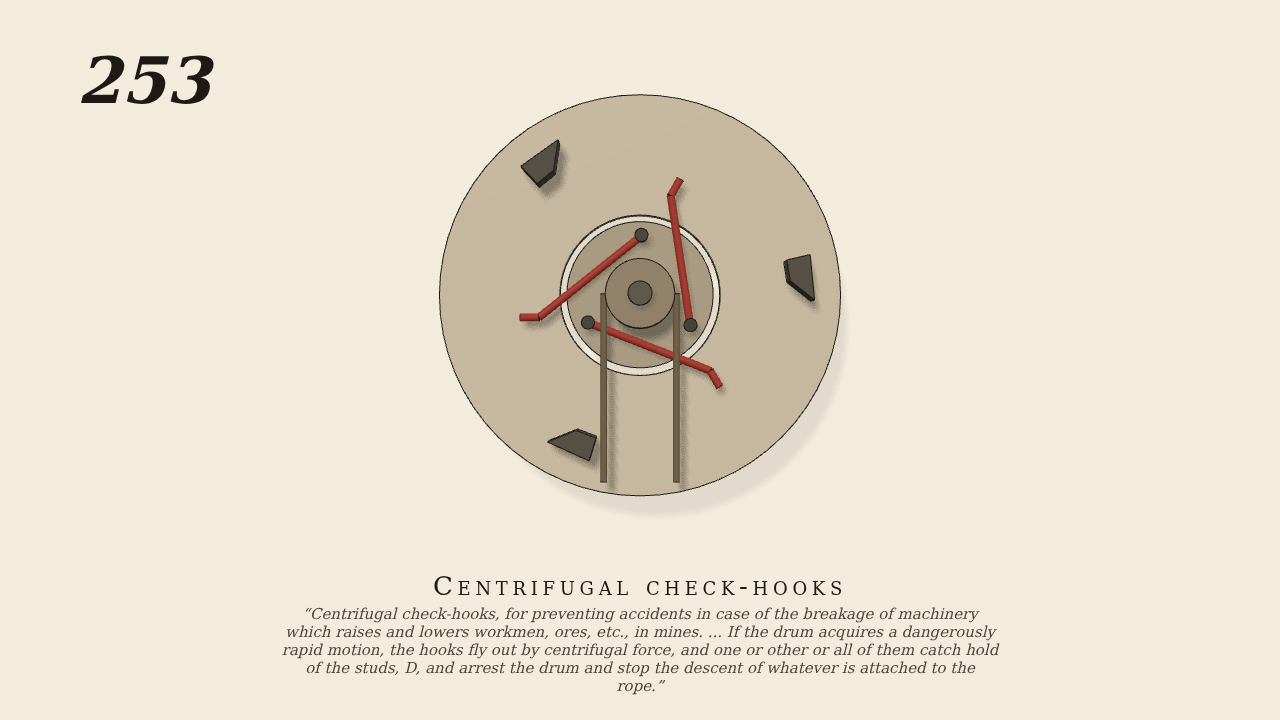
Centrifugal check-hooks, for preventing accidents in case of the…
Centrifugal check-hooks, for preventing accidents in case of the breakage of machinery which raises and lowers workmen, ores, etc., in mines. A is a frame-work fixed to the side of the shaft of the mine, and having fixed studs, D, attached. The drum on which the rope is wound is provided with a flange, B, to which the checkhooks are attached. If the drum acquires a dangerously rapid motion, the hooks fly out by centrifugal force, and one or other or all of them catch hold of the studs, D, and arrest the drum and stop the descent of whatever is attached to the rope. The drum ought besides this to have a spring applied to it, otherwise the jerk arising from the sudden stoppage of the rope might produce worse effects than its rapid motion.
Only the input is driven; every other part of this model moves by physics (MuJoCo), and its ratios are measured. Run it live, change its parameters, or switch the friction off to see the output stop.
- Modelled as
- Face view of the drum, axis level, gravity on. The load on the rope turns the drum with a steady 0.2 N m (the one driven joint: the brake gear broken), against light bearing drag, so it runs faster and faster. Three hooks are pinned to the drum's flange B, each held in against its stop by a light preloaded spring. The frame A carrying the studs D stands on a stiff spring and damper (Brown's spring against the jerk). Hooks on studs is real contact.
- Measured
- The hooks lie in while the drum is slow; as it speeds up they fly out against their springs, flutter twice off the studs, and at 2.95 s a hook catches a stud D: the drum is arrested and held (49.9 rad turned, still from 3.4 s). Penetration under 2 mm. Hold control: over 3.5-5 s the drum's mean
- Notes
- is 0.0002 rad/s arrested and 114.5 rad/s with the studs out of contact (it runs away).
Film (MP4) · Still (PNG) · Spec (YAML) · Model (MJCF)