Union coupling
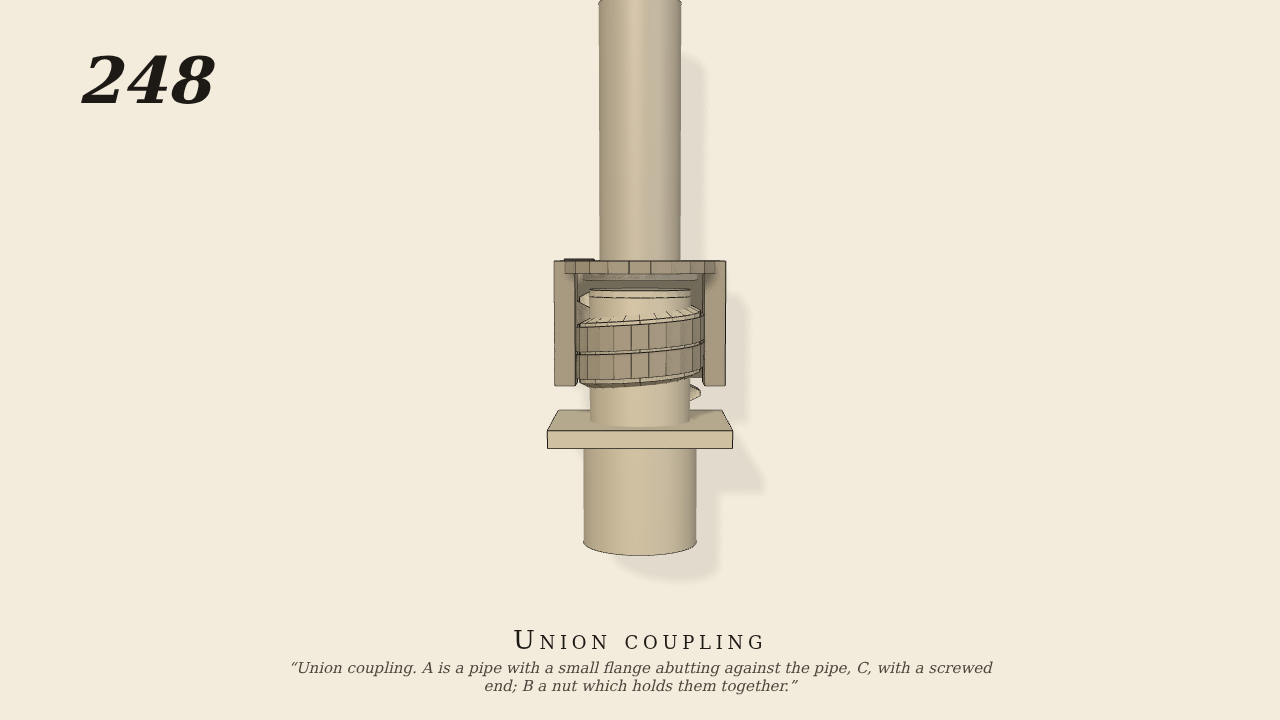
Union coupling. A is a pipe with a small flange abutting against the pipe, C, with a screwed end; B a nut which holds them together.
Only the input is driven; every other part of this model moves by physics (MuJoCo), and its ratios are measured. Run it live, change its parameters, or switch the friction off to see the output stop.
- Modelled as
- Brown's section, upright, gravity on, the nut drawn cut away at the front. The pipe C stands fixed with a right-hand screwed end (pitch 1.6 cm, 3.5 turns). The nut B turns on it (the one driven joint, 15 turns a minute, the hand's torque limited to 0.6 N m) and is free to run along it, its thread in C's groove. The pipe A, on its own guide, is held 1.2 cm off C's end by the spring of the pipe line; its flange lies inside the nut, under the nut's lip. Thread on thread, lip on flange and flange on C's end are all real contact.
- Measured
- The nut runs down C one pitch a turn (0.0025 m/rad, r² 0.9995). Its lip takes A's flange and draws A down 1.2 cm until the flange abuts against C's end; the nut is then tight and stops. Penetration under 2 mm. With all contact off the nut spins free and A is not drawn (0%).
- Notes
- The nut is cut away at the front rather than the whole coupling drawn in section; the pipes are plain (no hatching); A's guide and the pipe line's spring stand for the rest of the pipe run.
Film (MP4) · Still (PNG) · Spec (YAML) · Model (MJCF)