A mode of transmitting power from a horizontal shaft to two…
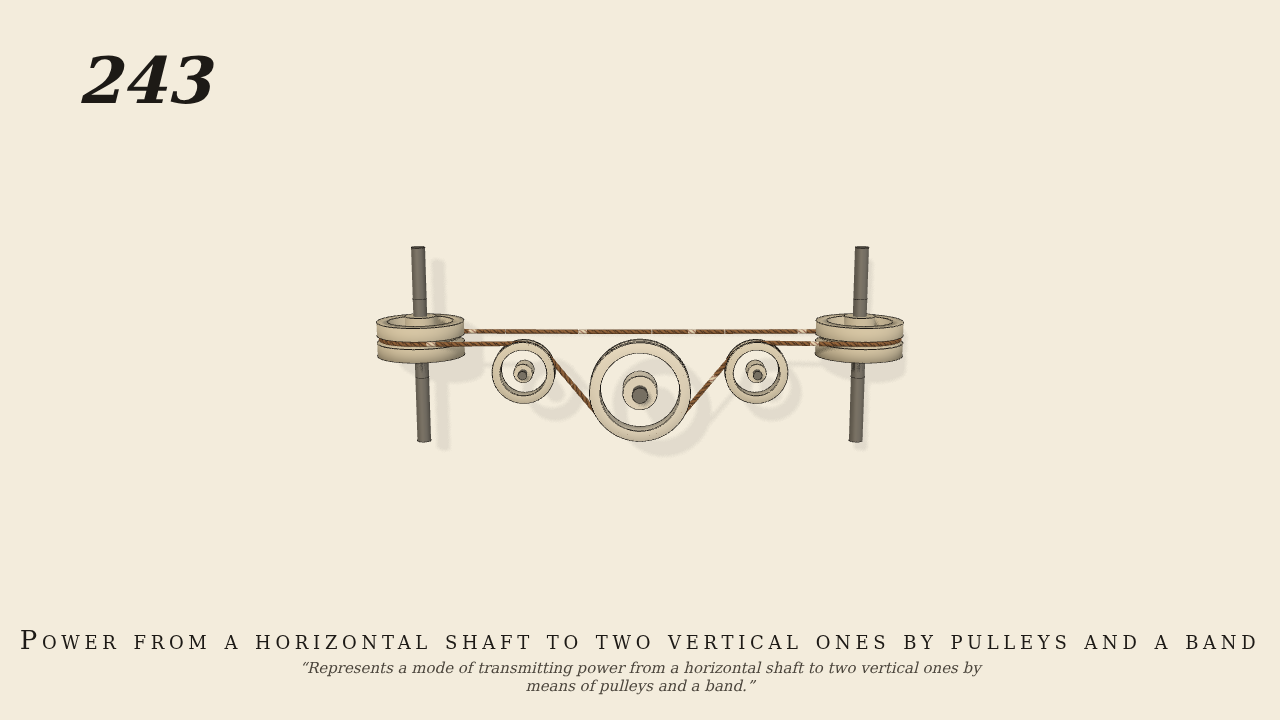
Represents a mode of transmitting power from a horizontal shaft to two vertical ones by means of pulleys and a band.
Only the input is driven; every other part of this model moves by physics (MuJoCo), and its ratios are measured. Run it live, change its parameters, or switch the friction off to see the output stop.
- Modelled as
- The driving pulley (radius 6) is on the horizontal shaft and turns at 30 rev/min, the one driven joint. Two guide pulleys (radius 3.5) sit on horizontal studs either side of it and a little above, all in one upright plane in front of the two upright drums (radius 5, 58 apart). The band is a round cord, 160 links on real contact (friction 0.6, pretension 20 N), in one closed loop. It runs under the driving pulley and up over each guide. The guide turns it to run level at the guides' height, tangent to the front of a drum, half round that drum, along the back to the other drum, half round it and back to the other guide. The route is spatial (the spans are the common tangents between pulleys whose shafts are at right angles, src/geom/path3d.ts), as in No. 4. Each upright shaft carries a small bearing load.
- Measured
- Both upright shafts turn the same way: the left one at -1.1751 times the driving shaft and the right one at -1.1796 (expected -1.18 ± 0.06; the radius ratio is 1.2, less the band's seat in the grooves). Slip is under 0.5%. The band stays on every pulley (largest radial deviation 0.25, lateral 0). The deepest contact is 1.5 mm, the round band seated in its groove (limit 3.5).
- Notes
- Brown gives no sizes, so they are scaled from the plate. The guides' tops are placed at the height of the drums' band so that the level runs leave the guides tangent to the drums' fronts. The band then needs no twist on the drums: it lies flat in one horizontal plane round both of them and turns through a right angle only over the guides.
Film (MP4) · Still (PNG) · Spec (YAML) · Model (MJCF)