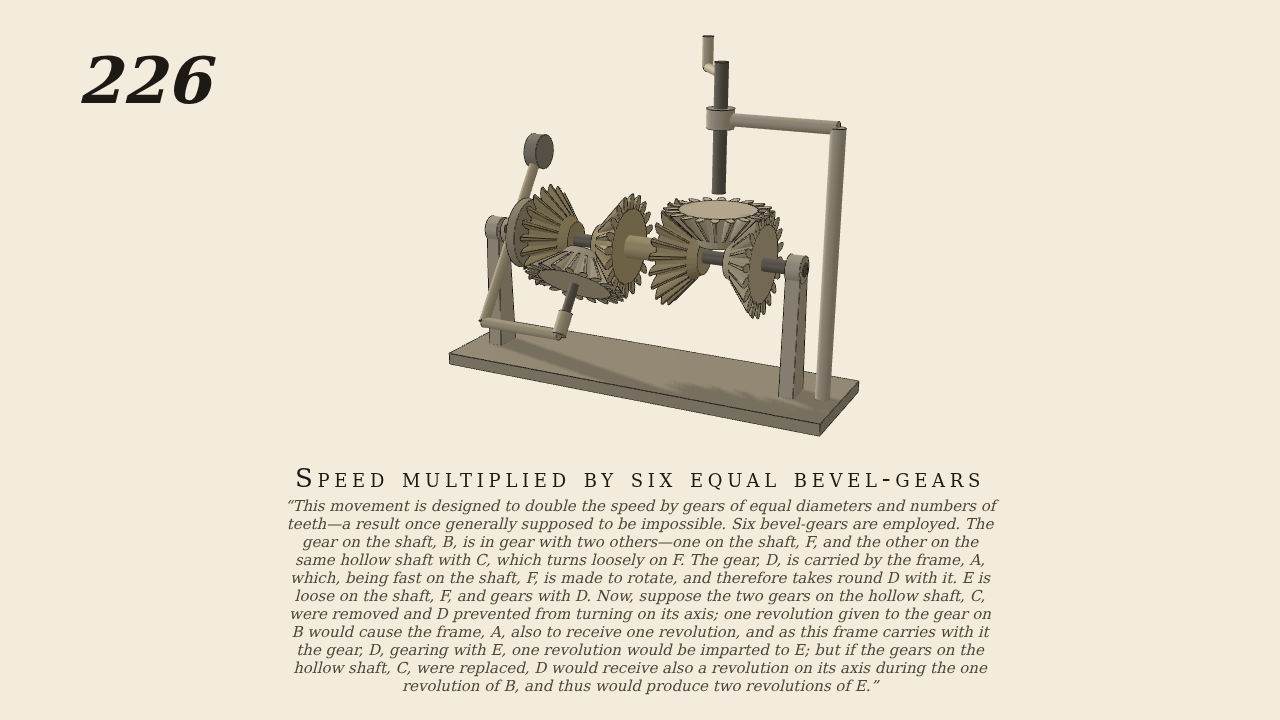
This movement is designed to double the speed by gears of equal…
This movement is designed to double the speed by gears of equal diameters and numbers of teeth—a result once generally supposed to be impossible. Six bevel-gears are employed. The gear on the shaft, B, is in gear with two others—one on the shaft, F, and the other on the same hollow shaft with C, which turns loosely on F. The gear, D, is carried by the frame, A, which, being fast on the shaft, F, is made to rotate, and therefore takes round D with it. E is loose on the shaft, F, and gears with D. Now, suppose the two gears on the hollow shaft, C, were removed and D prevented from turning on its axis; one revolution given to the gear on B would cause the frame, A, also to receive one revolution, and as this frame carries with it the gear, D, gearing with E, one revolution would be imparted to E; but if the gears on the hollow shaft, C, were replaced, D would receive also a revolution on its axis during the one revolution of B, and thus would produce two revolutions of E.
Only the input is driven; every other part of this model moves by physics (MuJoCo), and its ratios are measured. Run it live, change its parameters, or switch the friction off to see the output stop.
- Modelled as
- Six equal bevel-gears (20 teeth, pitch radius 4, 45-degree cones). The gear on the upright shaft B gears with one gear fast on F and one on the hollow shaft C, loose on F, so F and C turn opposite ways at B's speed. 12 further along F, the second gear of C and the gear E (loose on F) face each other with D between them. D turns on a pin in the frame A, which is fast on F and reaches round E; so A carries D round with F, while C's second gear turns D on its pin. A counterweight on A balances D and the frame (gravity on). Only B is driven (15 rpm).
- Measured
- F turns at B's speed (-1.0000), C the other way (-1.0000 of F), and E 3.0002 times as fast as F. Max penetration 0.05 mm.
- Notes
- The model gives three turns of E to one of B, not the two the description claims. Relative to the frame, C runs backwards at twice F's speed, so D turns E forward at twice F's speed relative to the frame, and E = 2A - C = 3F. The description counts C's turn relative to the frame as one. The plate gives no sizes; the bevels are No. 61's.
Film (MP4) · Still (PNG) · Spec (YAML) · Model (MJCF)