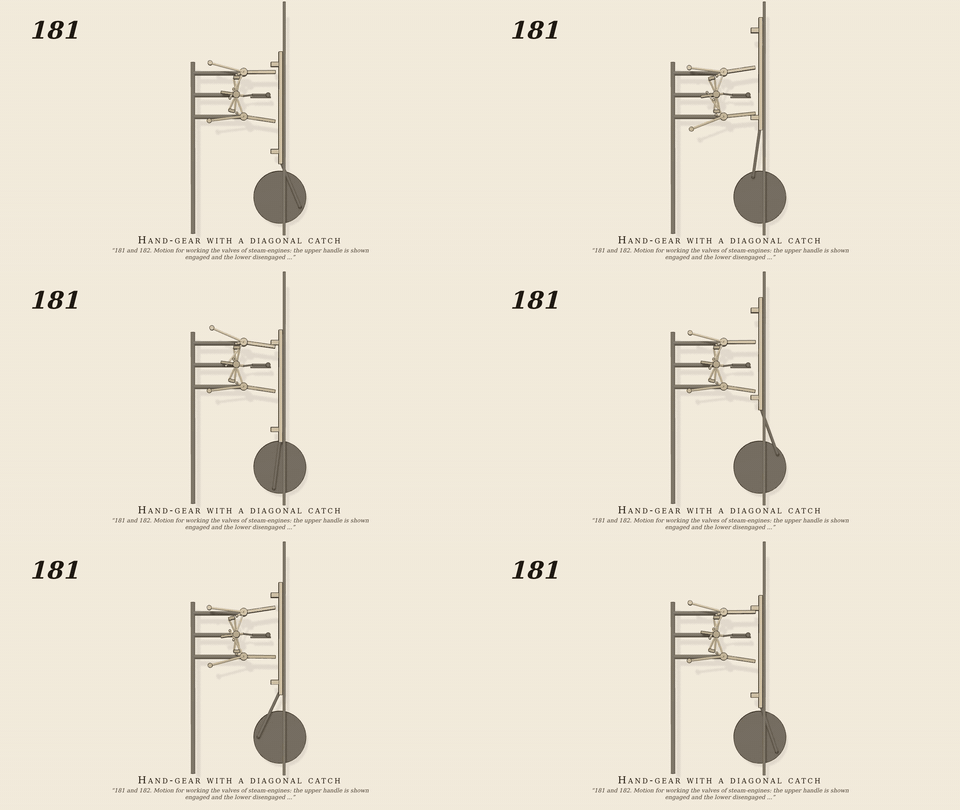
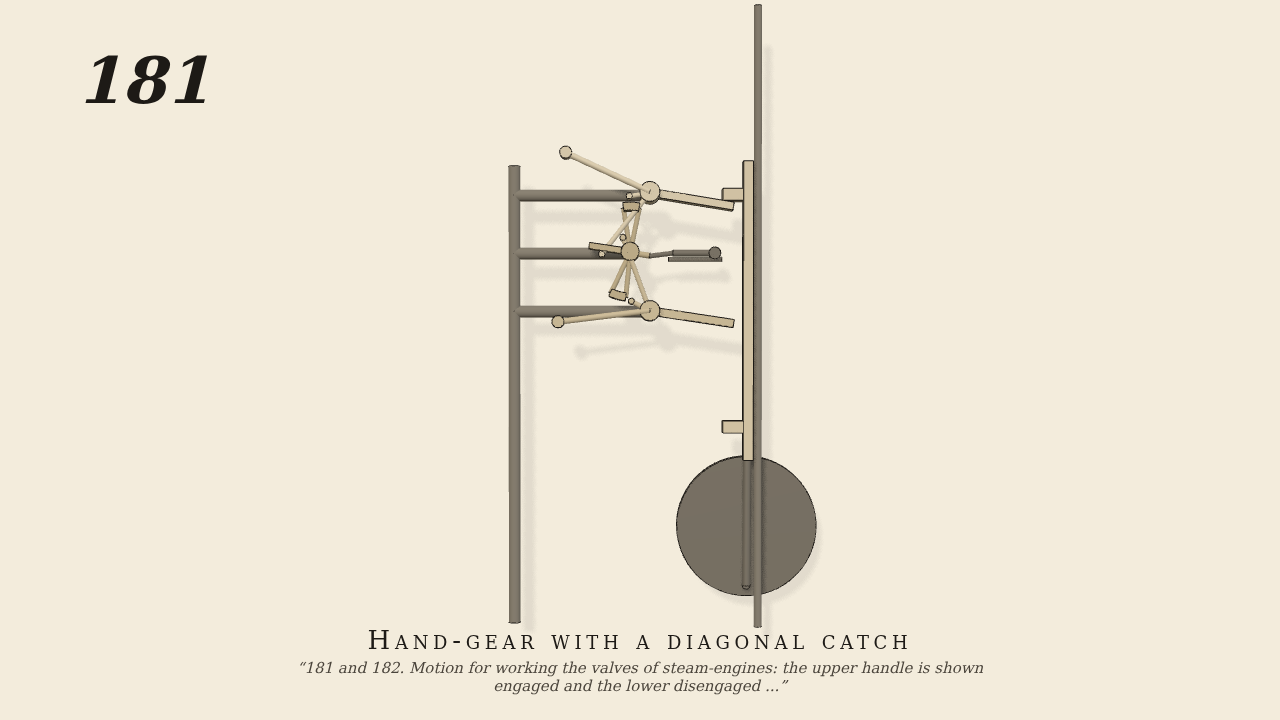
Diagonal catch or hand-gear used in large blowing and pumping engines
181 and 182. Diagonal catch or hand-gear used in large blowing and pumping engines. In 181 the lower steam-valve and upper eduction-valve are open, while the upper steam-valve and lower eduction-valve are shut; consequently the piston will be ascending. In the ascent of the piston-rod the lower handle will be struck by the projecting tappet, and, being raised, will become engaged by the catch and shut the upper eduction and lower steam valves; at the same time, the upper handle being disengaged from the catch, the back weight will pull the handle up and open the upper steam and lower eduction valves, when the piston will consequently descend. 182 represents the position of the catchers and handles when the piston is at the top of the cylinder. In going down, the tappet of the piston-rod strikes the upper handle and throws the catches and handles to the position shown in 181.
Only the input is driven; every other part of this model moves by physics (MuJoCo), and its ratios are measured. Run it live, change its parameters, or switch the friction off to see the output stop.
- Modelled as
- Upper and lower valve handles on shafts 12 apart, each with a back-weight (a joint spring set past its rest stop). A diagonal catch rocks on a pin between them and is held over on either of two stops (+/-8.6 deg) by a spring toggle: a sprung plunger works a link to the catchs tail pin, over-centre either way. The catch carries two hooks, arcs about its own pin, and a tail-arm. Each handle has a finger whose nose bears straight in on a hook, so a held handle puts no turning force on the catch, and a pusher that trips the tail-arm. A plug-rod worked by a crank (the only driven joint, 20 rpm) carries tappet A under the lower handle and tappet B over the upper. Near the top A throws the lower handle up, its pusher rocks the catch past dead centre, the toggle snaps it over, the upper hook releases the upper handle (which swings up to rest) and the lower hook comes under the lower finger, holding the lower handle up. Near the bottom B throws the upper handle down and the catch back. Starts in the state of No. 181.
- Measured
- Over 3 crank turns the states alternate every half turn: after each top throw the catch is on its + stop (0.300 rad from the start), the lower handle held at +0.139 and the upper at rest at +0.150; after each bottom throw the catch is back (0.000), the upper handle held at +0.010 and the lower at rest at 0.000. Max penetration 0.07 mm.
- Notes
- The valves are not drawn; joint springs stand in for the back-weights, and the toggle spring for the catchs weight. A single catch with two hooks stands for Browns pair of diagonal catches.
Film (MP4) · GIF · Still (PNG) · Spec (YAML) · Model (MJCF)