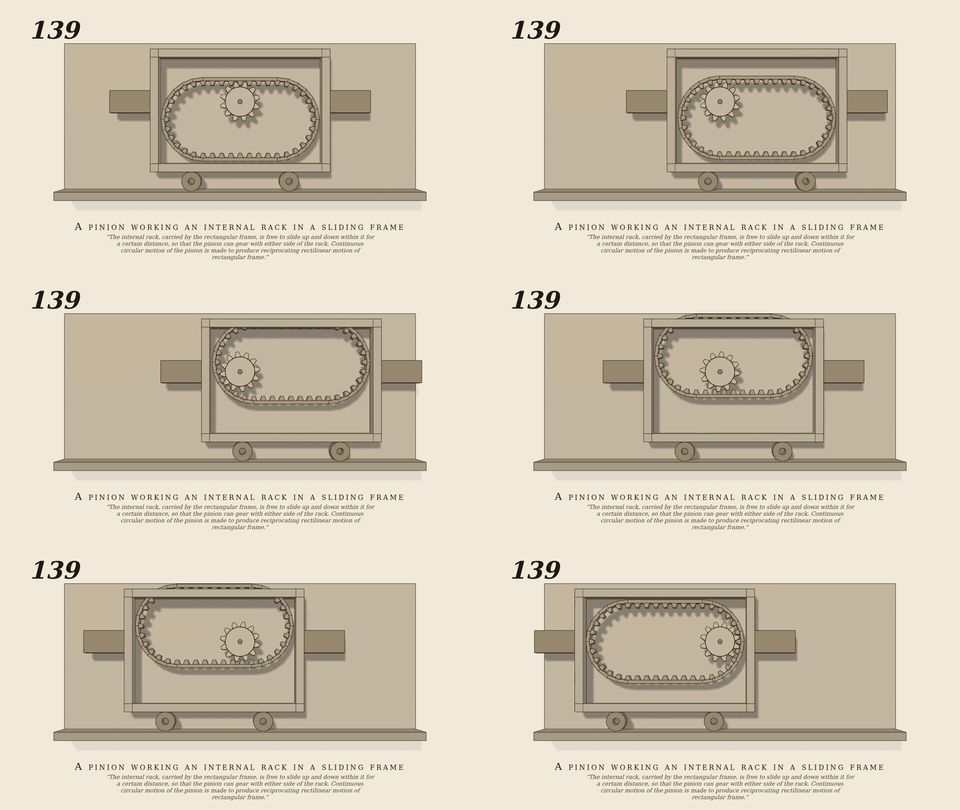
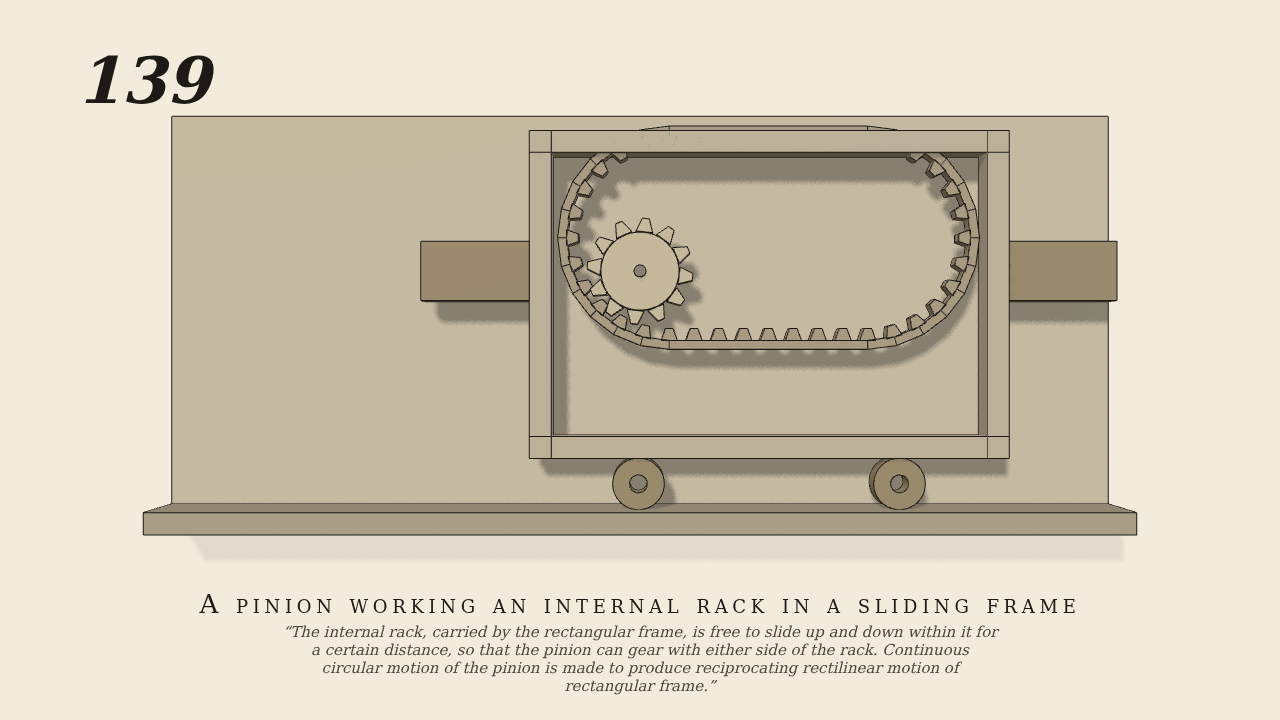
The internal rack, carried by the rectangular frame, is free to…
The internal rack, carried by the rectangular frame, is free to slide up and down within it for a certain distance, so that the pinion can gear with either side of the rack. Continuous circular motion of the pinion is made to produce reciprocating rectilinear motion of rectangular frame.
Only the input is driven; every other part of this model moves by physics (MuJoCo), and its ratios are measured. Run it live, change its parameters, or switch the friction off to see the output stop.
- Modelled as
- A 12-tooth pinion (module 0.8) on a fixed shaft is the one driven joint (18 turns a minute). It gears inside a stadium-shaped rack of 40 teeth (two straight sides of 8 pitches, two round ends of pitch radius 9.6 cm) carried by a rectangular frame. The rack slides up and down in the frame by one centre distance each way (9.6 cm), and the frame slides to and fro on its rails. On the top side the pinion drives the frame forward, on the round end it climbs the rack by the teeth alone, and on the bottom side the frame comes back: gen139.py.
- Measured
- The frame moves one pinion radius per radian of the pinion on every straight side: +0.0482 / -0.0479 / +0.0482 / -0.0483 / +0.0479 m per rad in five windows (expect +-0.048, r2 0.9997 or better); travel -14.89..+14.84 cm (expect +-14.9). On a round end the rack climbs 0.0452 m per rad (expect 0.0472, r2 0.9997). Penetration 0.02 mm.
- Notes
- Without gravity (a plan): the pinion pressing the flanks would push the rack away from the pinion, so the rack is given a little dry friction in its slide (0.08 N) and a light mass, and the servo a small torque limit so it starts gently. The rack comes to rest 5 mm short of full depth on each side, which still drives at the right ratio.
Film (MP4) · GIF · Still (PNG) · Spec (YAML) · Model (MJCF)