A cam-wheel—of which a side view is shown—has its rim formed into…
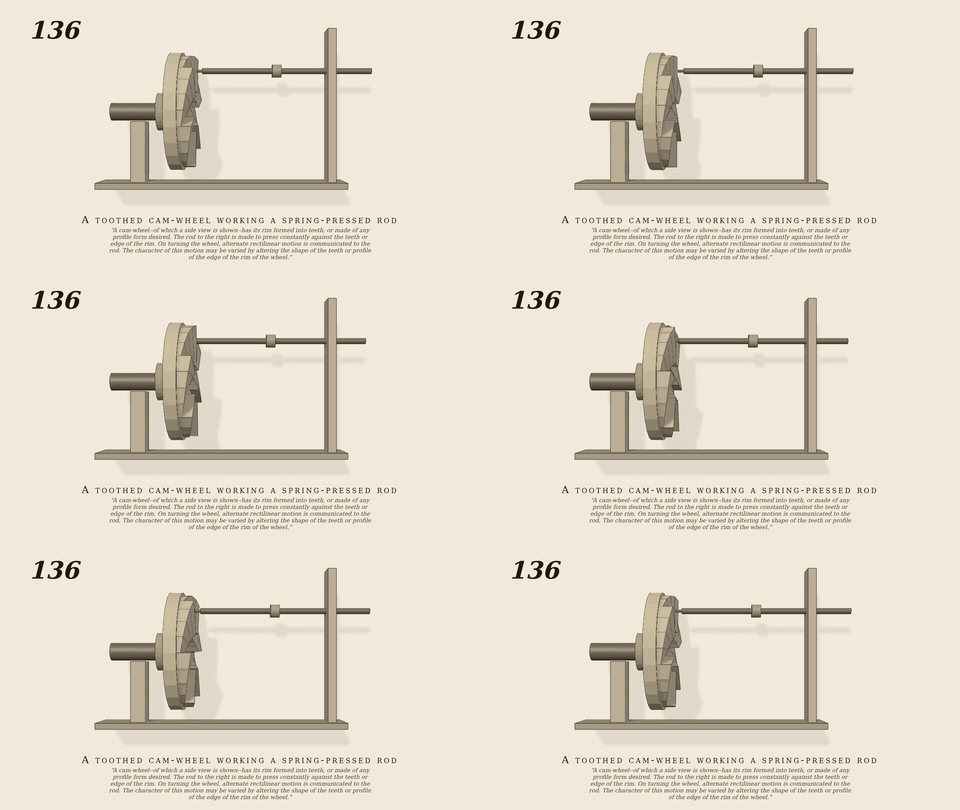
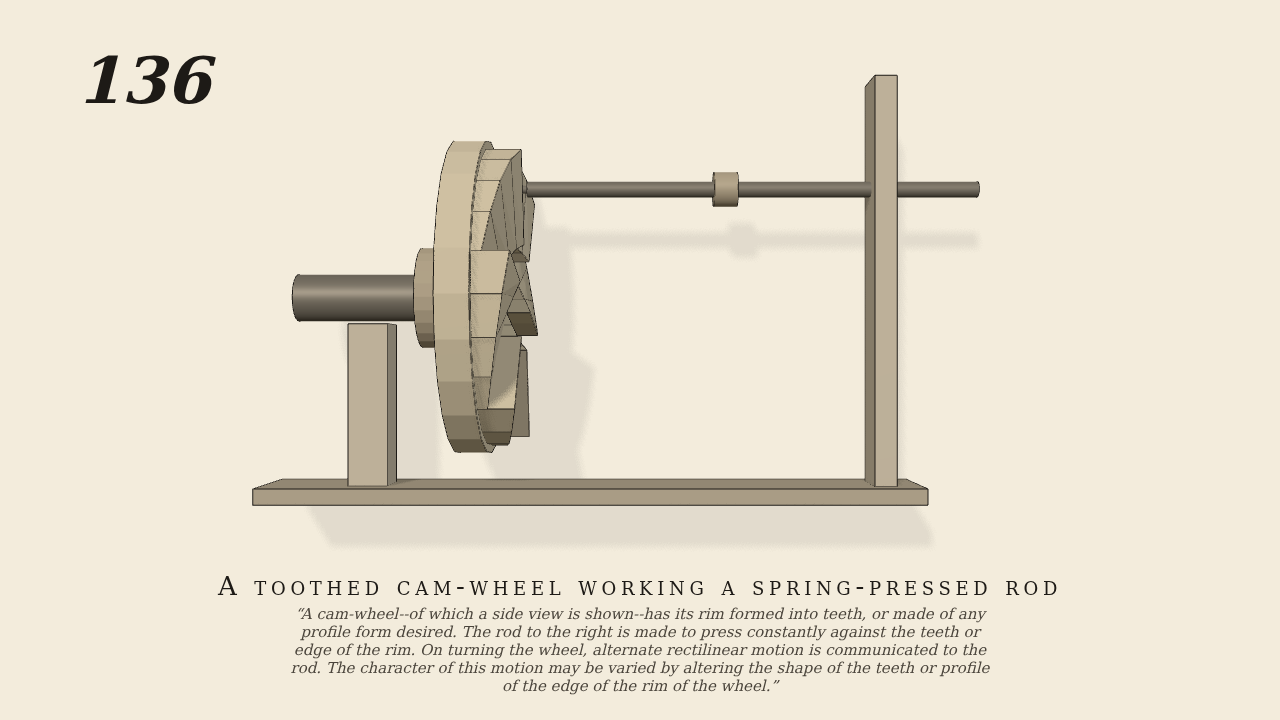
A cam-wheel—of which a side view is shown—has its rim formed into teeth, or made of any profile form desired. The rod to the right is made to press constantly against the teeth or edge of the rim. On turning the wheel, alternate rectilinear motion is communicated to the rod. The character of this motion may be varied by altering the shape of the teeth or profile of the edge of the rim of the wheel.
Only the input is driven; every other part of this model moves by physics (MuJoCo), and its ratios are measured. Run it live, change its parameters, or switch the friction off to see the output stop.
- Modelled as
- A wheel with six saw-teeth 1.6 cm high on its face is turned on a horizontal shaft by the one driven joint (10 turns a minute). A rod parallel to the shaft, pressed against the teeth by a joint spring (the plate coil), rides on them at 7 cm from the axis by real contact. gen136.py.
- Measured
- The rod rises 0.0153 m per radian of the wheel on each ramp (nominal 0.01528; r2 0.992) in four windows and is thrown back by the spring at each wall; travel -1.414..0.000 cm. Penetration under 1 mm with the contact solref tightened to 0.001. The driver is stiff (kv 3000) because the rod kicks the wheel as it falls off an edge.
- Notes
- Six teeth a turn give six alternate strokes: a slow rise on the slope and a quick return at the wall.
Film (MP4) · GIF · Still (PNG) · Spec (YAML) · Model (MJCF)