Chinese windlass
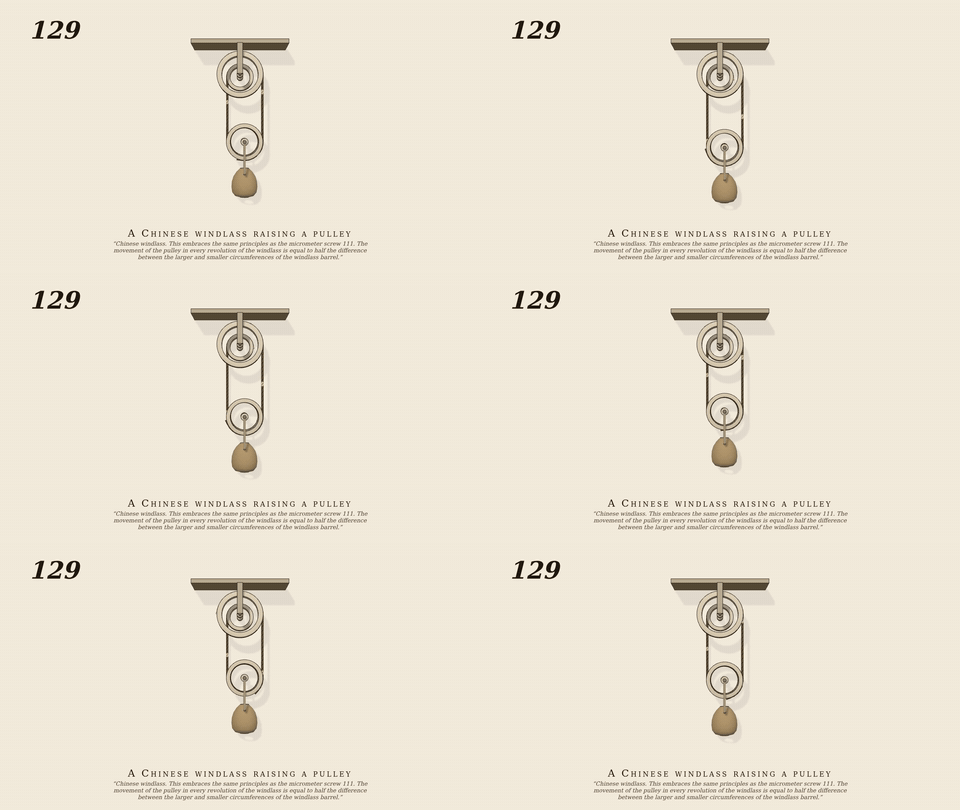
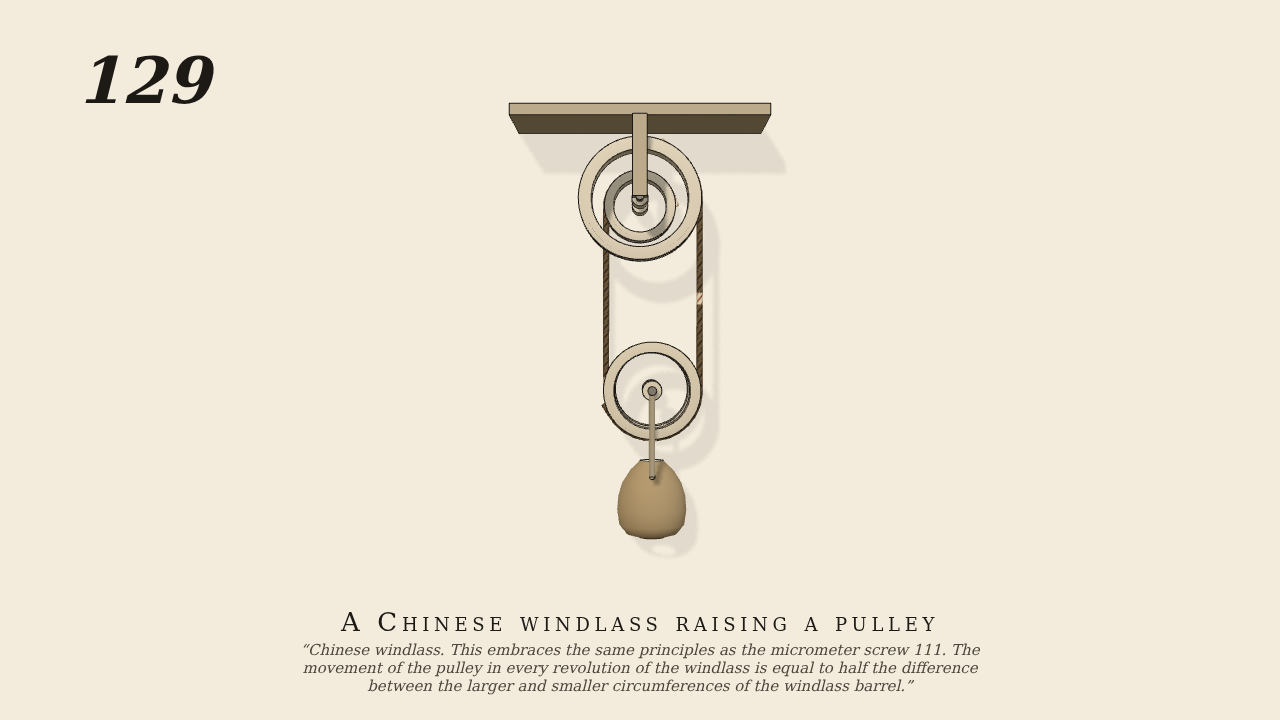
Chinese windlass. This embraces the same principles as the micrometer screw 111. The movement of the pulley in every revolution of the windlass is equal to half the difference between the larger and smaller circumferences of the windlass barrel.
Only the input is driven; every other part of this model moves by physics (MuJoCo), and its ratios are measured. Run it live, change its parameters, or switch the friction off to see the output stop.
- Modelled as
- A barrel of two drums on one shaft (radii 7 and 4 cm, two rope planes 7.2 cm apart) is the only driven joint, turned 1.2 rad each way at 0.15 Hz. One rope is lashed to the large drum and winds on it; the other is lashed to the small drum and winds the other way. Both run down to a movable pulley (radius 5.5 cm, a sheave on each side of its block, locked together by a pin) and are seized to the bottom of it. The pulley hangs with a 5 kg weight. Ropes are real cords. gen129.py.
- Measured
- The pulley falls 1.49 cm per radian of the barrel (follow slope -0.0149 m/rad, expected -0.015 = half the difference of the radii; r2 0.9998), so half the difference of the circumferences a turn. The pulley itself turns once per radian of the barrel (slope 0.9987). Penetration 0.15 mm after the first second.
- Notes
- The two drums must be one casting (an assembly with two wheels) and the ropes lie in separate planes with the rims narrowed so each rope clears the other drum.
Film (MP4) · GIF · Still (PNG) · Spec (YAML) · Model (MJCF)