A heart-cam
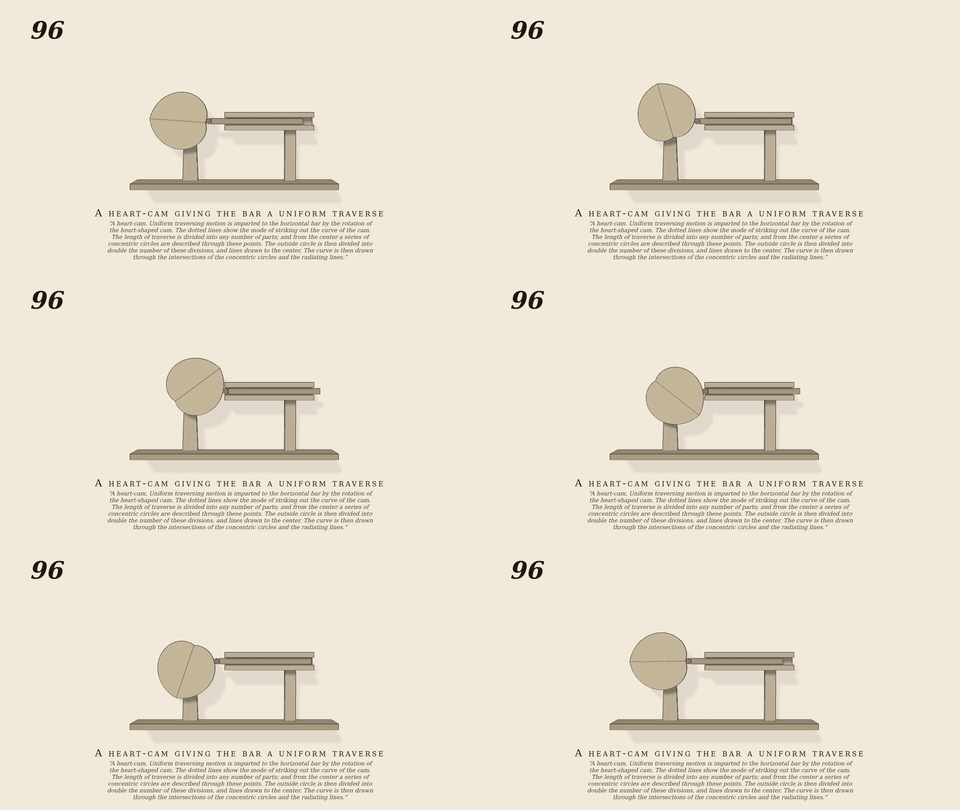
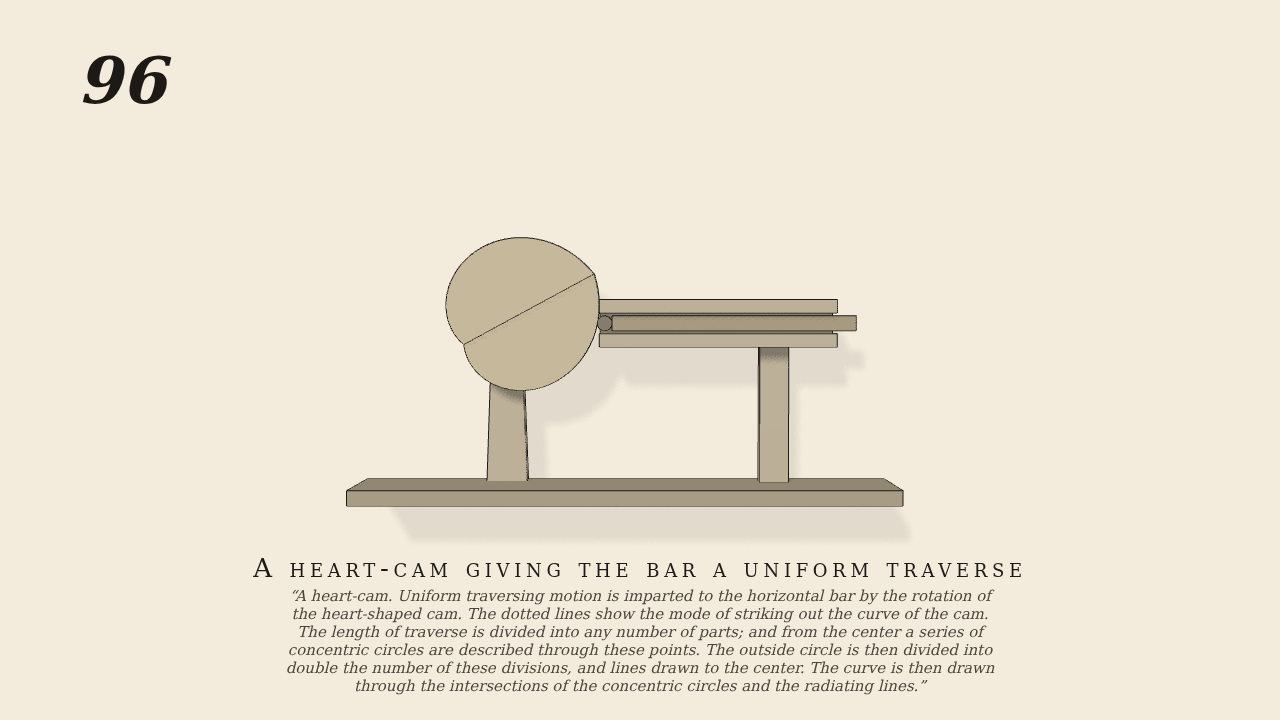
A heart-cam. Uniform traversing motion is imparted to the horizontal bar by the rotation of the heart-shaped cam. The dotted lines show the mode of striking out the curve of the cam. The length of traverse is divided into any number of parts; and from the center a series of concentric circles are described through these points. The outside circle is then divided into double the number of these divisions, and lines drawn to the center. The curve is then drawn through the intersections of the concentric circles and the radiating lines.
Only the input is driven; every other part of this model moves by physics (MuJoCo), and its ratios are measured. Run it live, change its parameters, or switch the friction off to see the output stop.
- Modelled as
- The heart-cam (the only driven joint, 10 rpm) is struck out as the plate directs: its radius grows 1.273 cm to the radian over the first half-turn, from 3 to 7 cm, and falls as fast over the second, so each half is a convex Archimedean arc. The horizontal bar ends in a 1 cm roller held on the cam by a spring (its joint), and the contact carries the roller out and back 3.96 cm at a uniform speed.
- Measured
- Bar speed against the cam: +0.0127 m/rad out (ideal +0.01267, from the roller-offset curve) and -0.0127 back (-0.01266), r2 1.0000; stroke 3.96 cm (ideal 3.96). Max penetration 0.04 mm.
- Notes
- The spring (250 N/m, rest 0.8 cm behind the stroke) is the joint spring; the stop only catches the bar in the control.
Film (MP4) · GIF · Still (PNG) · Spec (YAML) · Model (MJCF)