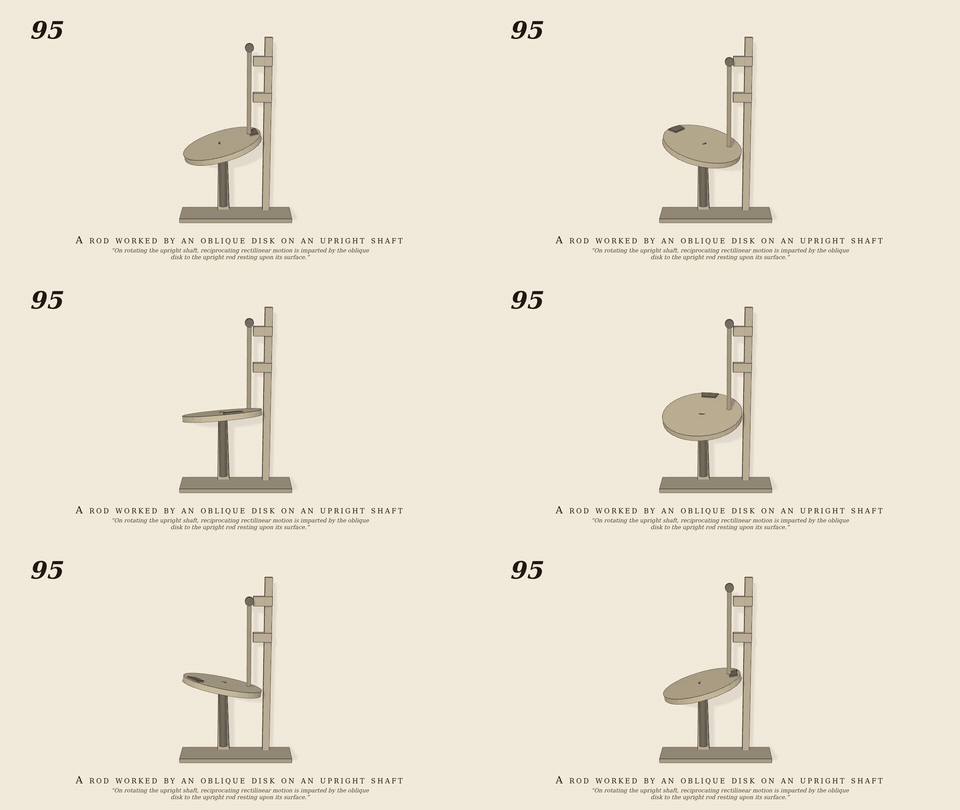
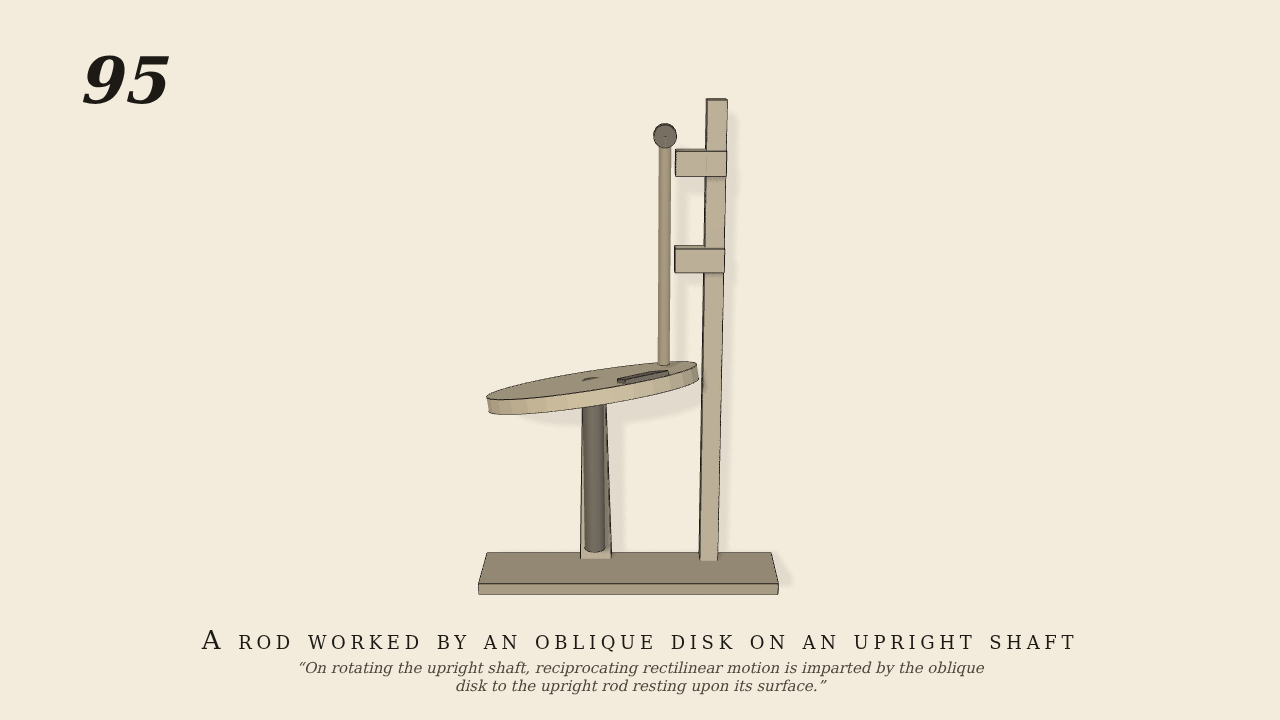
On rotating the upright shaft, reciprocating rectilinear motion is…
On rotating the upright shaft, reciprocating rectilinear motion is imparted by the oblique disk to the upright rod resting upon its surface.
Only the input is driven; every other part of this model moves by physics (MuJoCo), and its ratios are measured. Run it live, change its parameters, or switch the friction off to see the output stop.
- Modelled as
- The upright shaft and its oblique disk (9 cm across, set 15 deg out of square to the shaft) turn together at 20 rpm, the only driven joint. The upright rod rests by its rounded foot on the disk face, 6 cm from the shaft, held down only by its own weight in two collars. As the disk turns, the face under the foot rises and falls by r tan(a) cos(t), so the rod moves harmonically, 3.2 cm to and fro, by real contact.
- Measured
- Rod slope against the shaft: -0.0161 (ideal -0.01606) at 90 deg, -0.0113 (-0.01135) at 45 deg, +0.0161 (+0.01606) at 270 deg, r2 0.9995-1.0000; stroke 3.23 cm (ideal 3.22). Max penetration 0.03 mm.
- Notes
- The collars are the slide joint (drawn, damping 0.05); a range stop 1.5 cm below the stroke only catches the rod in the control.
Film (MP4) · GIF · Still (PNG) · Spec (YAML) · Model (MJCF)