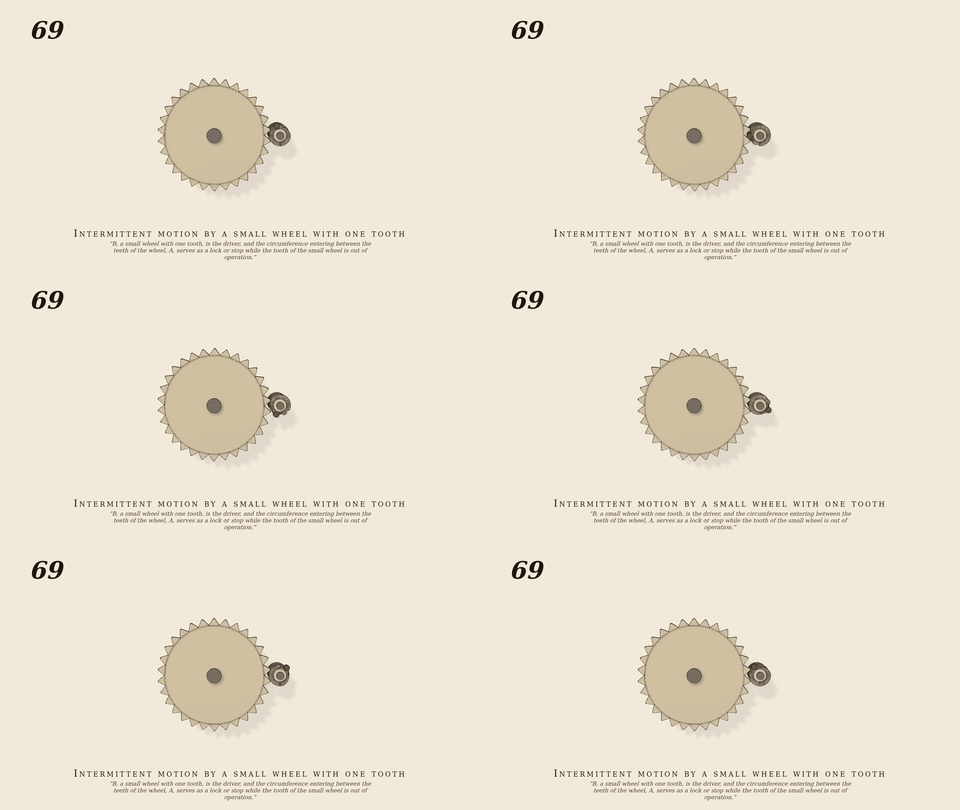
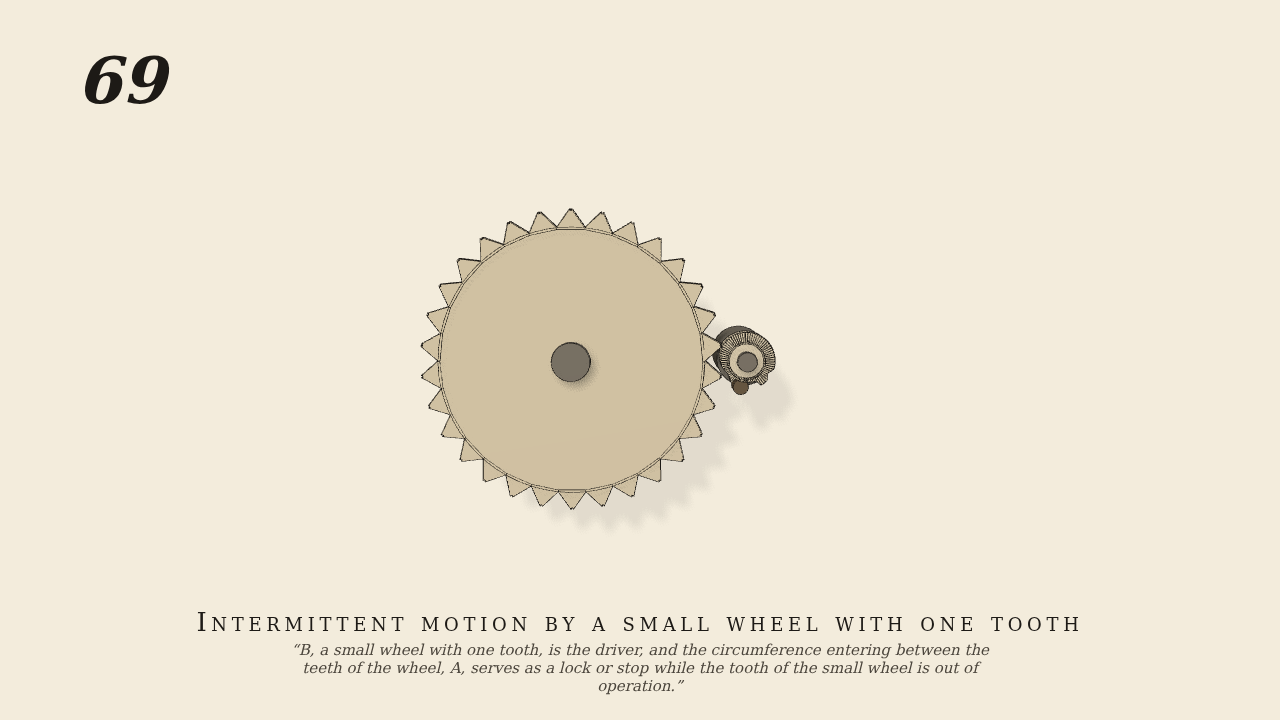
B, a small wheel with one tooth, is the driver, and the…
B, a small wheel with one tooth, is the driver, and the circumference entering between the teeth of the wheel, A, serves as a lock or stop while the tooth of the small wheel is out of operation.
Only the input is driven; every other part of this model moves by physics (MuJoCo), and its ratios are measured. Run it live, change its parameters, or switch the friction off to see the output stop.
- Modelled as
- B (driver, small) carries one tooth (a stud 0.2 proud of its circumference); A has 30 V-teeth with rounded points. Between strokes B's circumference stands between two of A's points (0.01 clear) and locks A. The tooth carries A ~1.25 pitch; where B's circumference re-enters between the next two points its generated cam ramp sets A back to the exact pitch. B's cut-away beside the tooth is generated from the motion; a heavy drum hidden behind B steadies the drive.
- Measured
- A/B 0.0333 vs 1/30 (−0.01%, three whole turns of B mid-dwell to mid-dwell); dwell positions 0.2085/0.4188/0.6275/0.8371 vs k·2π/30; A still between strokes (0.0003 rad/s); max pen 0.06 mm
- Notes
- A shallow tooth meets A's points at a dead point (it pushed A either way); a tooth deep enough to always enter the right gap over-pushes, so B's circumference cams A back. Tested under the Nix flake env.
Film (MP4) · GIF · Still (PNG) · Spec (YAML) · Model (MJCF)