The single tooth, A, of the driving-wheel, B, acts in the notches…
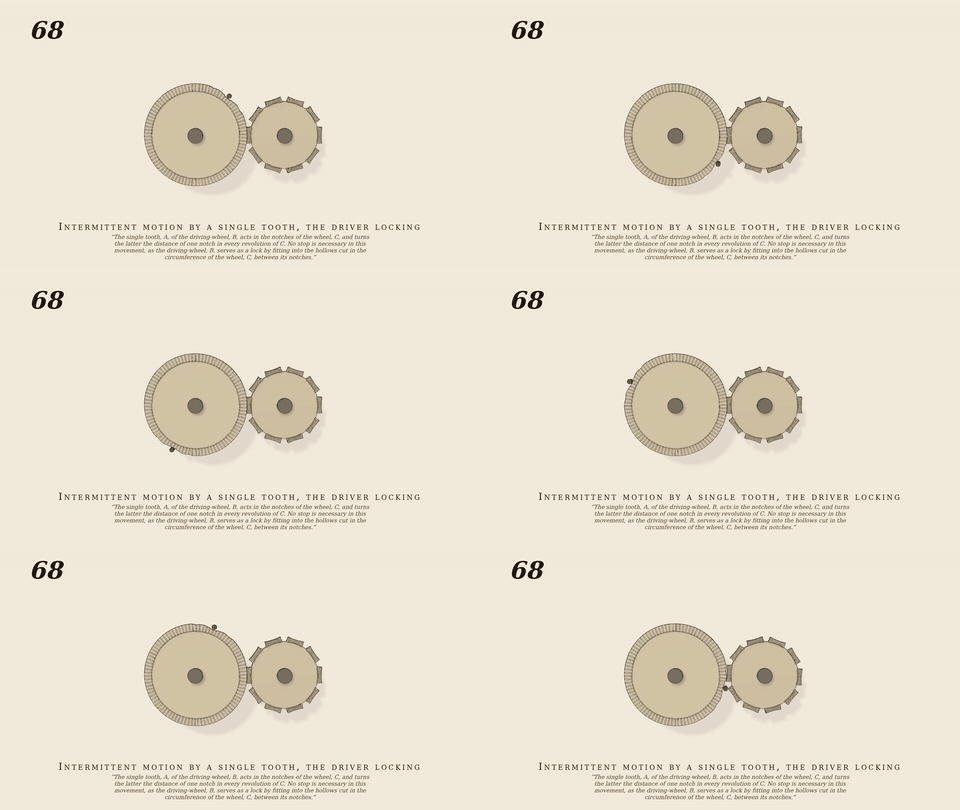
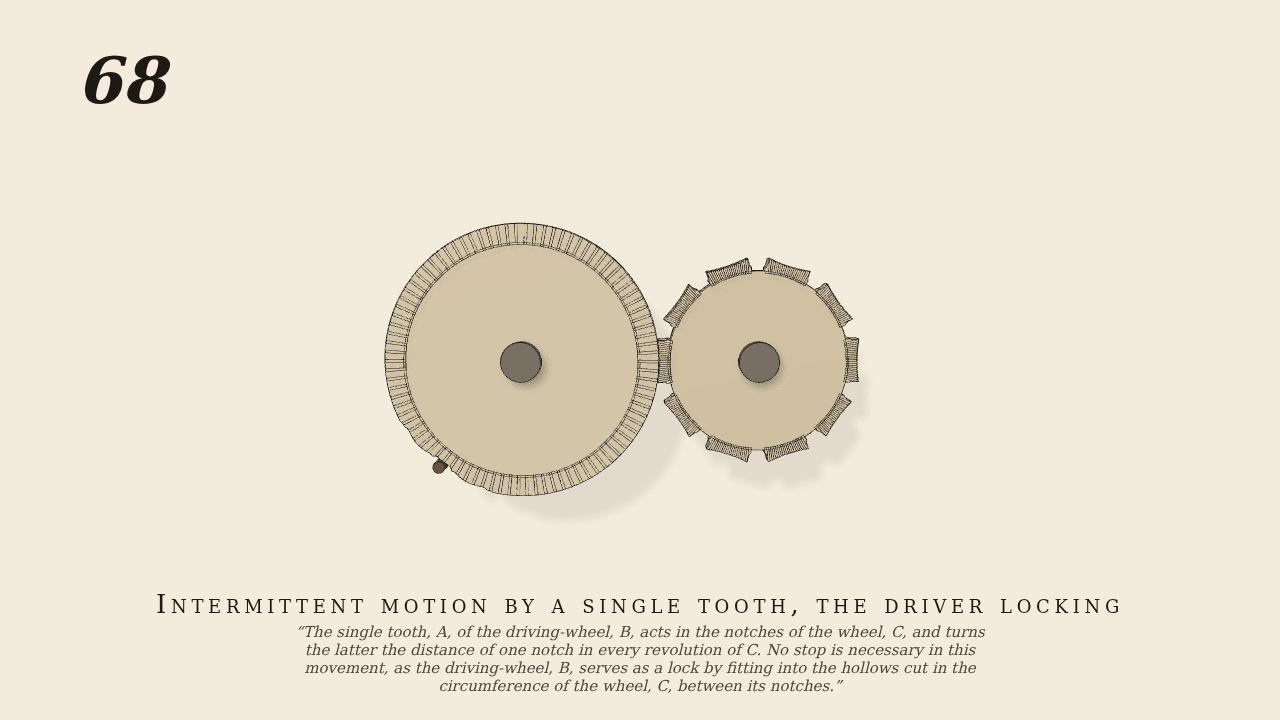
The single tooth, A, of the driving-wheel, B, acts in the notches of the wheel, C, and turns the latter the distance of one notch in every revolution of C. No stop is necessary in this movement, as the driving-wheel, B, serves as a lock by fitting into the hollows cut in the circumference of the wheel, C, between its notches.
Only the input is driven; every other part of this model moves by physics (MuJoCo), and its ratios are measured. Run it live, change its parameters, or switch the friction off to see the output stop.
- Modelled as
- B (driver) carries one tooth A (a pin at its circumference); C has 10 notches with hollows between them that fit B's circumference. A enters a notch and turns C one notch per turn of B; B's circumference in a hollow locks C between strokes. B's relief beside the tooth and the easing of C's notch lips are generated from the ideal motion (±0.05 rad play).
- Measured
- C/B −0.1000 (each stroke 0.6285 vs 2π/10 = 0.6283); C still between strokes; max pen 0.07 mm
- Notes
- Every notch must be eased alike (an asymmetric C first drifted under gravity). Brown writes "every revolution of C"; it is every revolution of B.
Film (MP4) · GIF · Still (PNG) · Spec (YAML) · Model (MJCF)