Clutch-box
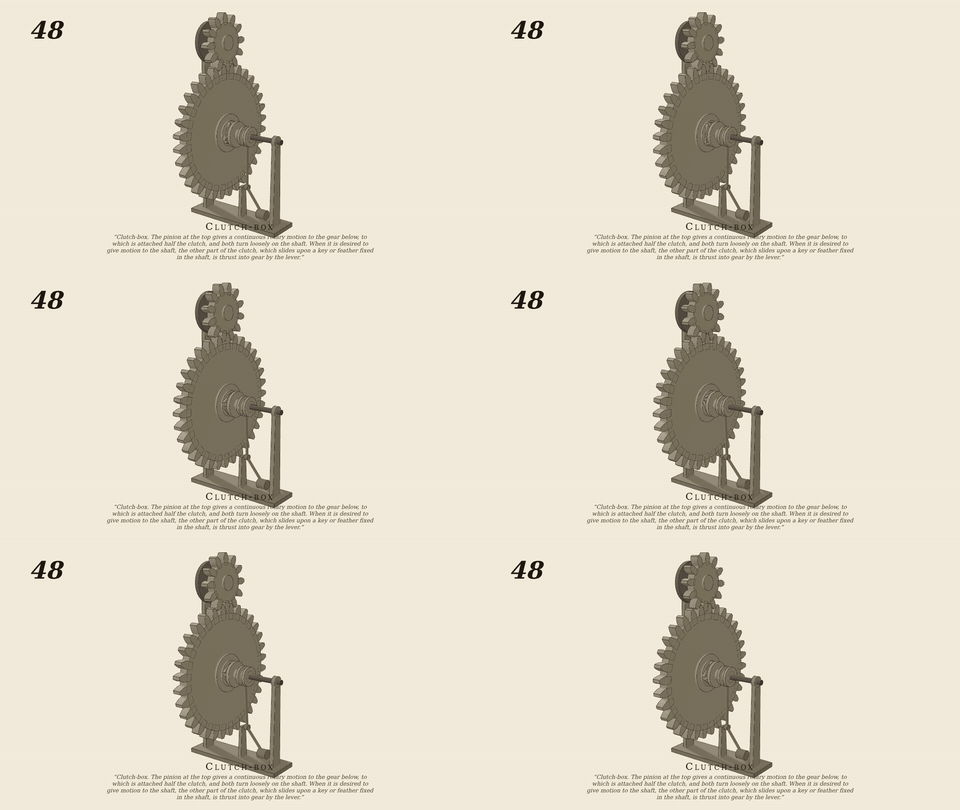
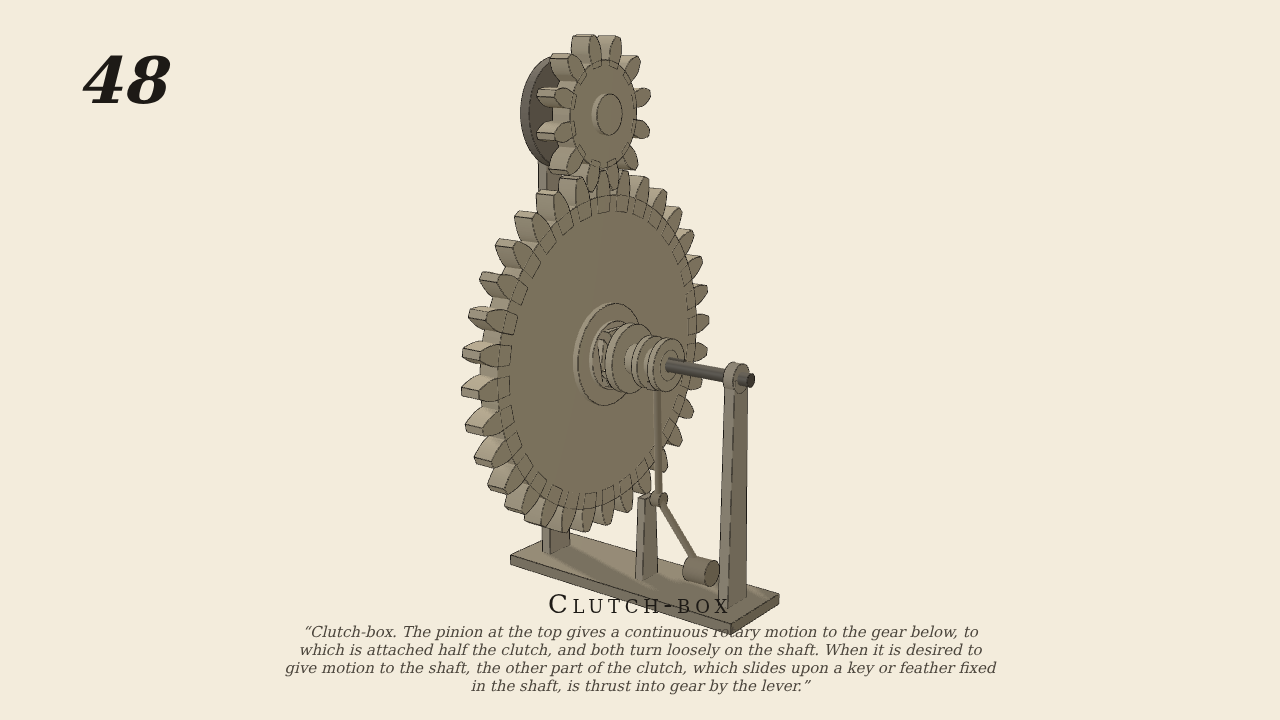
Clutch-box. The pinion at the top gives a continuous rotary motion to the gear below, to which is attached half the clutch, and both turn loosely on the shaft. When it is desired to give motion to the shaft, the other part of the clutch, which slides upon a key or feather fixed in the shaft, is thrust into gear by the lever.
Only the input is driven; every other part of this model moves by physics (MuJoCo), and its ratios are measured. Run it live, change its parameters, or switch the friction off to see the output stop.
- Modelled as
- a 12-tooth pinion (the one motor-driven shaft) turns a 32-tooth gear loose on the shaft; the gear's face carries three roofed jaws with parallel-sided slots; the other half slides on the shaft's feather (a slide joint) with three round jaws (radial pins, capsules) and is thrust in by the iron lever's fork in its hub groove, a spring holding the lever where the hand sets it: in at 2 s, out at 5.5 s
- Measured
- gear/pinion −0.3750 (ideal −12/32), shaft/pinion 0.0000 out, −0.3771 in (window ends inside the pin's play), 0.0003 out again; max penetration 0.18 mm; speeds 0.5×–2× clean (≤1.14 mm), at 0.75×–0.9× the pins take longer to find a slot
- Notes
- The shaft is turned only by pin on jaw; the hand only moves the lever's spring. New: a part's rod may collide as a capsule (`capsule: true`, openspec add-capsule-rod-on-part); mesh-on-mesh jaws threw rare impulses that broke the tooth mesh. CG iterations 500. Negative control: the gear's jaws out of contact with the lever thrown in → the shaft stands (0.0000).
Film (MP4) · GIF · Still (PNG) · Spec (YAML) · Model (MJCF)