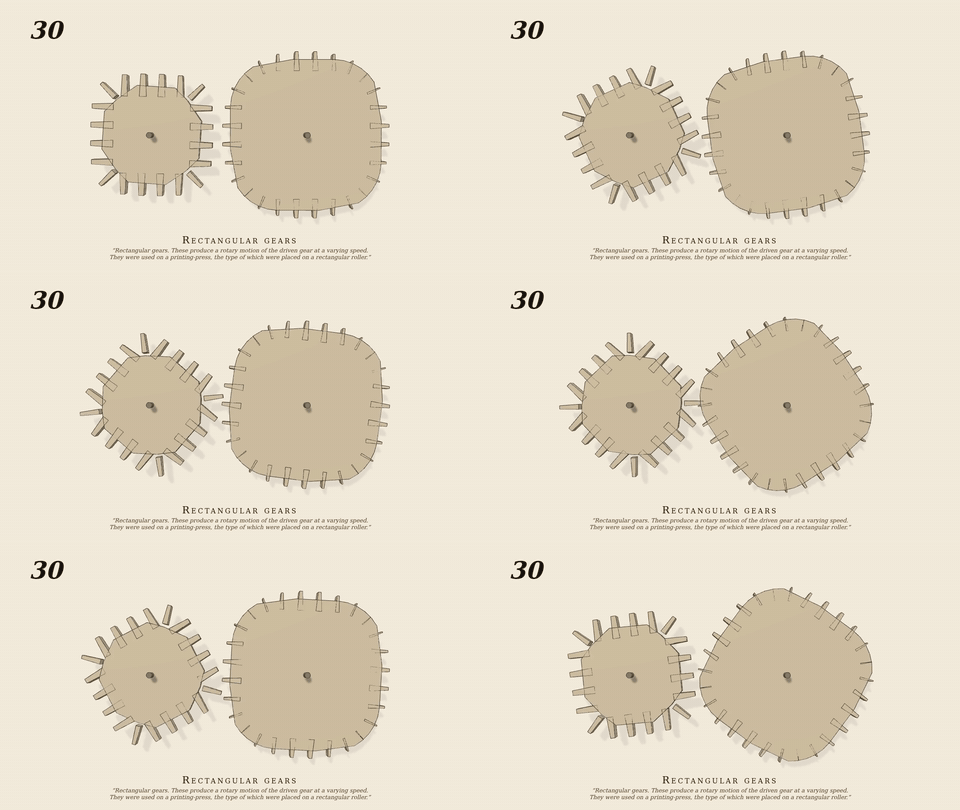
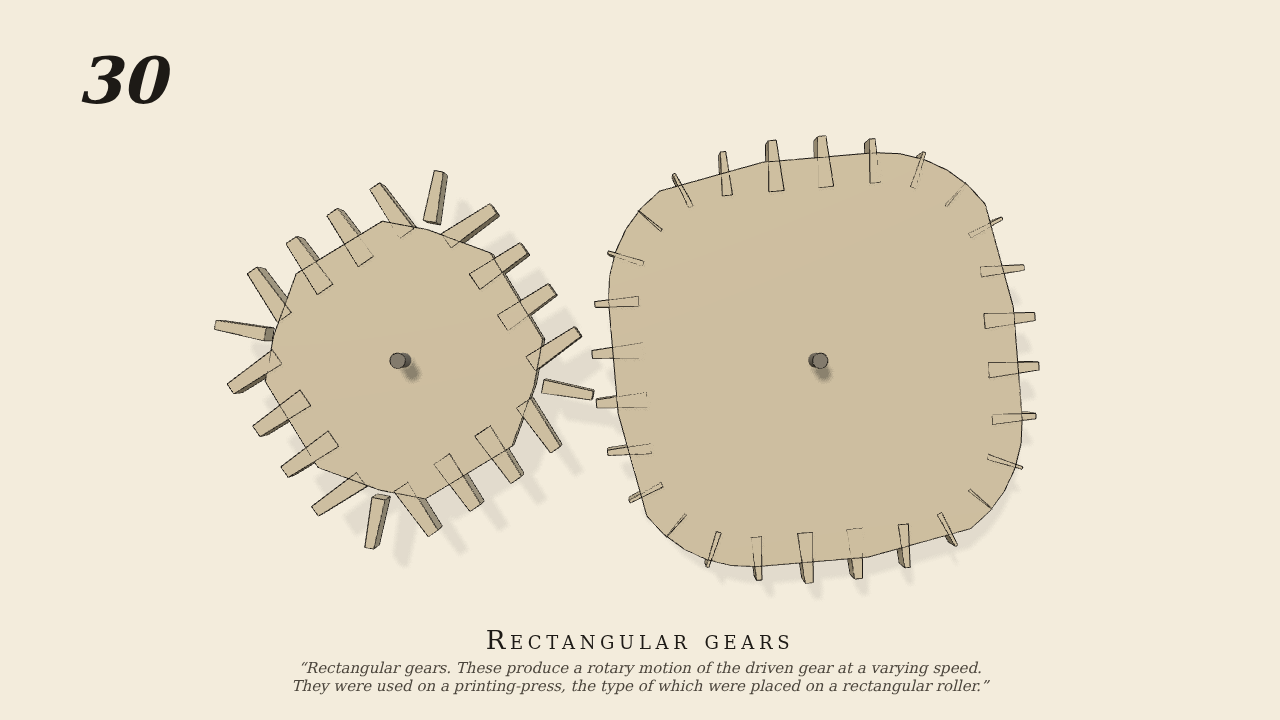
Rectangular gears
Rectangular gears. These produce a rotary motion of the driven gear at a varying speed. They were used on a printing-press, the type of which were placed on a rectangular roller.
Only the input is driven; every other part of this model moves by physics (MuJoCo), and its ratios are measured. Run it live, change its parameters, or switch the friction off to see the output stop.
- Modelled as
- two square gears in mesh — teeth at even 5 cm pitch running right round each rounded square (perimeter = teeth × pitch pins the sides: 26.72 vs 40.58), 20 driving 28 teeth, one convex hull per tooth on each pitch curve — with the driver's corner teeth eased 70 % and the driven's sunk to 0.5 mm pancakes where the pitch curve turns a right angle (the 45° head-on beats pass through valleys instead of jamming; wider corners re-wedge, taller corners)
- Measured
- ω2/ω1 = -0.7216 (expect -20/28 = -0.7143, slip 1.0 % over 2.4–6.4 s), driven speed swings -0.87..-0.58 round the mean (geometry's corner/flat extremes 13.36/23.31 .. 17.23/20.29 = 0.57..0.85), never runs back, pen ≤ 0.34 mm
- Notes
- Only the left (smaller, on-corner, 20-tooth) gear's shaft is motor-driven; the right (rounder, 28-tooth) square turns solely through tooth contact — the fillet f2 = 13.0 keeps r1 + r2 inside 6 cm of tooth at every phase, and corner_ease (src/geom/square.ts) keeps the corner beats from jamming. Negative control: the driven square's tooth contact switched off → stays still (0.000000 rad/s after 6.4 s).
Film (MP4) · GIF · Still (PNG) · Spec (YAML) · Model (MJCF)