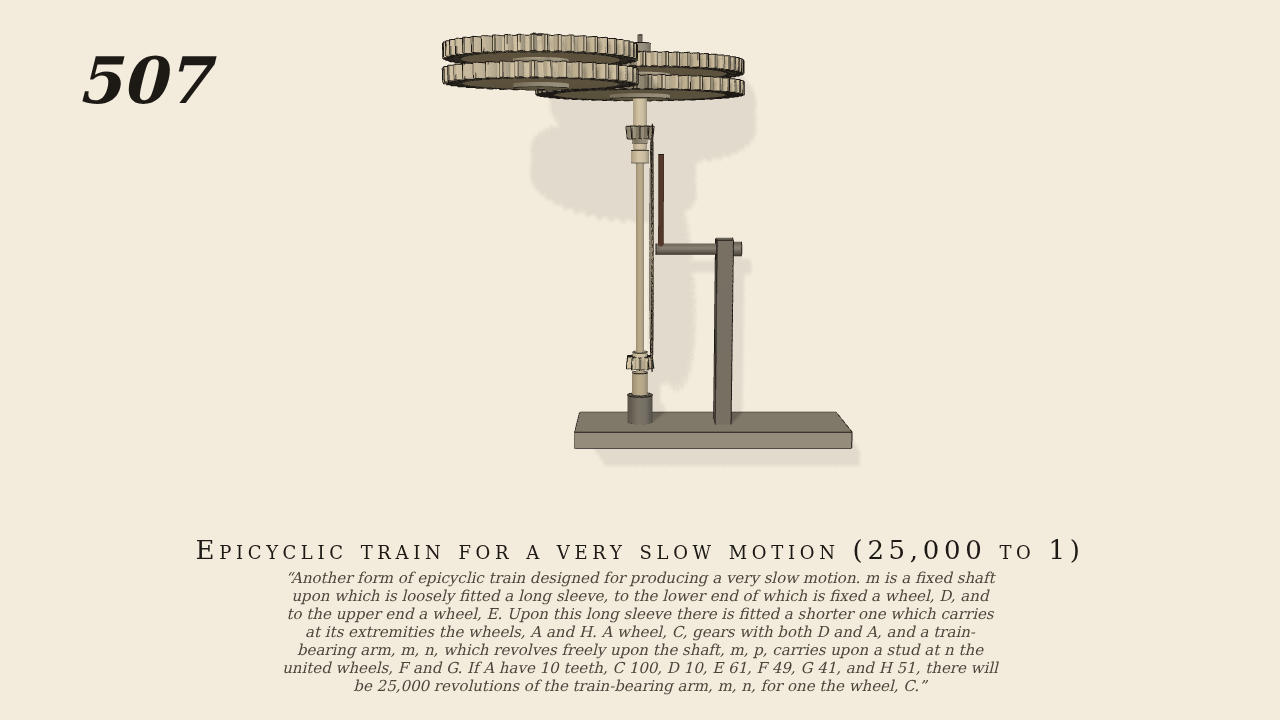
Another form of epicyclic train designed for producing a very slow…
Another form of epicyclic train designed for producing a very slow motion. m is a fixed shaft upon which is loosely fitted a long sleeve, to the lower end of which is fixed a wheel, D, and to the upper end a wheel, E. Upon this long sleeve there is fitted a shorter one which carries at its extremities the wheels, A and H. A wheel, C, gears with both D and A, and a train-bearing arm, m, n, which revolves freely upon the shaft, m, p, carries upon a stud at n the united wheels, F and G. If A have 10 teeth, C 100, D 10, E 61, F 49, G 41, and H 51, there will be 25,000 revolutions of the train-bearing arm, m, n, for one the wheel, C.
Only the input is driven; every other part of this model moves by physics (MuJoCo), and its ratios are measured. Run it live, change its parameters, or switch the friction off to see the output stop.
- Modelled as
- Seen from the front and a little above, the shaft m upright. On the fixed shaft m a long sleeve turns loose, D (10 teeth, bevel) at its foot and E (61) at its head; on it a shorter sleeve with A (10, bevel) below and H (51) above. C (100, bevel) on a horizontal axle in the standard a gears with both A and D, so the two sleeves are tied to turn equally opposite ways. The arm m, n turns freely on m at a steady 40 rpm - the only input - and carries on its stud n the united F (49) and G (41): F gears with E, G with H. E/F module 0.4, G/H module 0.478 so both pairs share one centre distance. Coloured bars on E, H, F-G and a spoke on C show their turning.
- Measured
- F and G spin on the stud (1.244 turns per turn of the arm), while the sleeves creep round opposite ways at 1/2500 of the arm's speed (measured 0.000394 and -0.000423) and C at 1/25,000: in the clip the arm makes about 6 turns, E and H turn under a degree and C hardly at all - the very slow motion Brown describes.
- Notes
- The sleeves rattle within the backlash of the 10-tooth A and D against C, so the slow ratios are checked to within 20 %. C's bevel is nearly a crown wheel (100 to 10).
Film (MP4) · Still (PNG) · Spec (YAML) · Model (MJCF)